Deconstructing the Steel Carapace: A Technical and Avant-Garde Analysis of a 16th-Century South German Breastplate for Zoey Fashion Lab
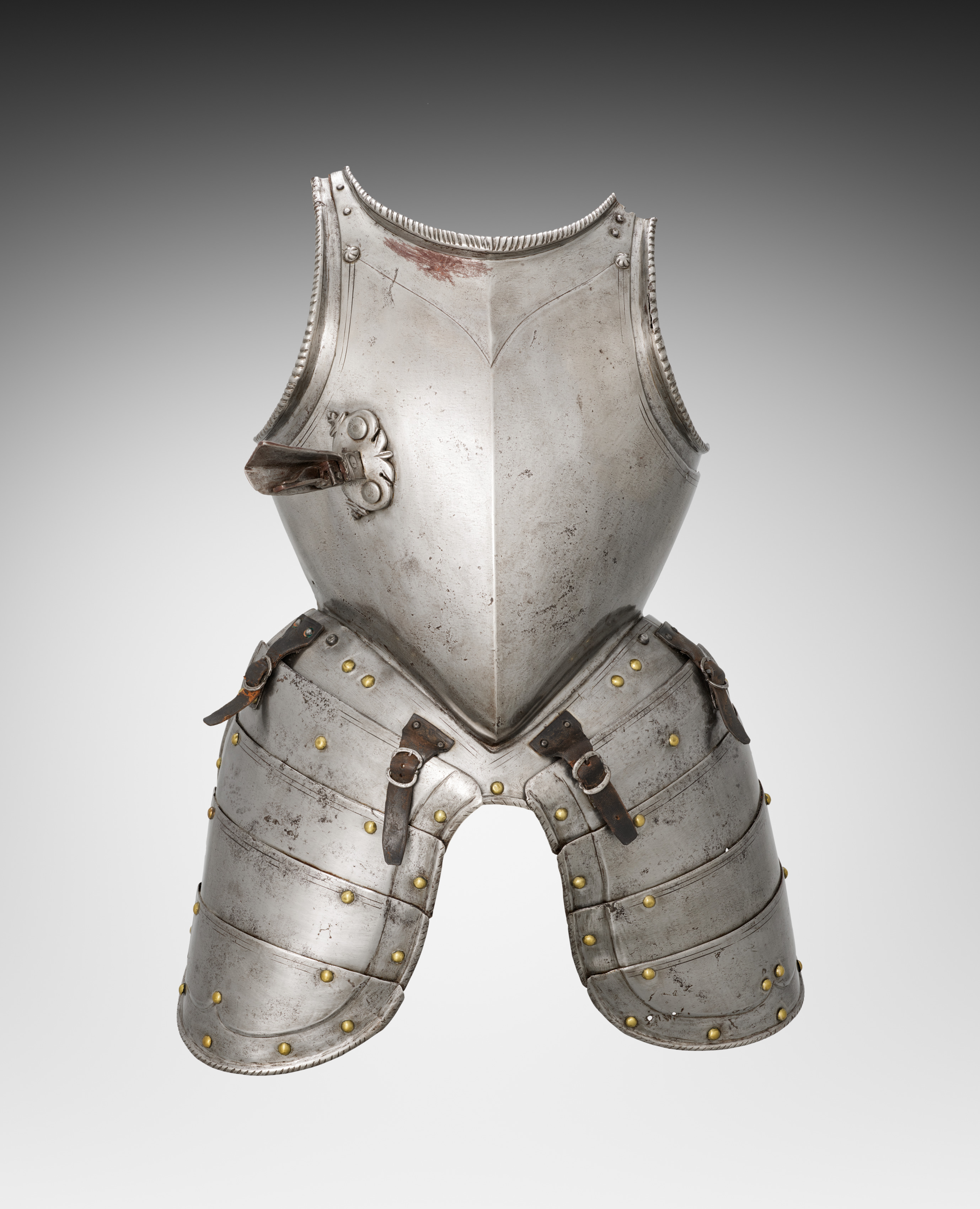
At Zoey Fashion Lab, our mission is to dismantle historical artifacts not merely as relics of the past, but as living blueprints for future fashion. The subject of this analysis—a 16th-century South German breastplate, forged from steel, secured with leather straps and brass rivets—presents a singular opportunity. It is not simply armor; it is a New DNA Strand for an avant-garde collection that interrogates protection, identity, and the human form. This report will deconstruct its material, structural, and symbolic DNA to propose a radical reinterpretation for the contemporary runway.
Material DNA: Steel, Leather, and Brass as a Triadic Language
The breastplate’s primary material, steel, is a testament to the technological mastery of the 16th-century South German armorer. It is not a passive shell but an active participant in the wearer’s existence. The steel’s cold, reflective surface speaks of impenetrability, of a boundary between the vulnerable interior and the hostile exterior. In an avant-garde context, we must re-read this steel not as a barrier, but as a medium of light and shadow. Its polished curves, designed to deflect blades, can be reimagined as sculptural elements that distort and fragment the silhouette. The patina of age—the subtle pitting, the oxidized streaks—becomes a textural narrative, a map of time and conflict that we can digitally replicate or physically exaggerate in new alloys or composites.
The leather straps, typically overlooked, are the connective tissue of the armor. They are the interface between machine and flesh. Their organic, fibrous nature contrasts with the steel’s rigidity. In the 16th century, they were functional, adjusting the plate to the body. For Zoey Fashion Lab, these straps become a design vocabulary of tension and release. We can envision them as exaggerated, elongated ties that bind the breastplate to the body in a non-functional, almost ritualistic manner. They can be dyed in unnatural hues—acidic greens, synthetic blacks—to signify a corrupted or evolved state of protection. The brass rivets, meanwhile, are punctuation marks. They are the points of structural stress, the anchors that hold the system together. In our deconstruction, rivets can be multiplied, oversized, or intentionally misplaced to create a sense of precarious assembly. They become decorative studs that mimic a digital grid or a biological suture, merging the mechanical with the organic.
Structural DNA: The Carapace Reimagined as a Mobile Architecture
Anatomically, the 16th-century breastplate is a masterpiece of ergonomic geometry. It follows the contours of the male torso—the pectoral swell, the sternum depression, the waist cinch—while allowing for limited mobility. The New DNA Strand we extract is the concept of adaptive architecture. The original was a static shell; our avant-garde version must be a dynamic exoskeleton that responds to movement, environment, or even biometric data.
We can achieve this through segmentation. Instead of a single forged piece, we propose a modular breastplate composed of overlapping, articulated steel scales. Each scale could be connected by hidden, flexible leather joints or magnetic clasps, allowing the wearer to reconfigure the armor’s shape. This introduces a transformative silhouette—a garment that can collapse into a compact torso piece or expand into a full, wing-like structure. The original’s rigid waistline, designed to deflect upward thrusts, can be reinterpreted as a dramatic, asymmetrical hemline that trails into a train of steel and leather strips, echoing the fluted armor of the period but with a deconstructed, unfinished edge.
Furthermore, the breastplate’s backplate (often lost or separated in museum pieces) must be considered. The original was a front-facing shield; for the avant-garde, we must expose the back. We propose a dual-faced design: the front remains polished and reflective, a mirror for the viewer, while the back is raw, unfinished steel, cross-hatched with leather lacing and exposed rivets. This duality speaks to the contemporary condition of curated public identity versus private vulnerability.
Symbolic DNA: From Protection to Provocation
The symbolic weight of the breastplate is immense. It is a symbol of knighthood, of chivalric codes, of masculine power and territorial defense. In the 16th century, it was also a status symbol, often etched and gilded for display. To inject this into an avant-garde context, we must subvert these meanings. The breastplate must no longer protect; it must provoke.
Our reinterpretation can invert the concept of defense. Instead of protecting the heart, the breastplate can be designed to expose the heart. We can cut a large, organ-shaped aperture into the steel, revealing the wearer’s chest. This aperture could be framed by leather straps that mimic ribs, or filled with a transparent, resin-like material embedded with digital LEDs that pulse like a heartbeat. This is a direct commentary on the vulnerability of the modern subject—the armor is not for war but for emotional exposure.
Another symbolic layer is the fusion of the human and the industrial. The steel can be treated with a patina that resembles rust, not as decay, but as a deliberate aesthetic of entropy. We can integrate brass rivets into patterns that evoke circuitry or neural networks, suggesting that the armor is a technological extension of the nervous system. The leather straps can be replaced with high-tension elastic or carbon-fiber webbing, merging historical craftsmanship with futuristic materials. This creates a garment that is both ancient and alien, a relic from a future where the body and its armor are indistinguishable.
Avant-Garde Application: The Zoey Fashion Lab Collection
For the runway, this breastplate becomes a centerpiece of a collection titled “Carapace: The New Armature.” The garment will be constructed in three layers:
Layer One (Base): A second-skin bodysuit of black, brushed neoprene, with integrated biometric sensors that monitor heart rate and galvanic skin response. This layer is the “flesh” beneath the armor.
Layer Two (Structure): The modular steel breastplate, segmented into 12 interlocking pieces. Each piece is hand-polished to a mirror finish on one side and sandblasted to a matte, porous texture on the other. The rivets are oversized, solid brass, and arranged in a Fibonacci spiral over the sternum. The leather straps are replaced with black, industrial-grade nylon webbing, buckled with magnetic closures that allow for instant reconfiguration.
Layer Three (Expression): A trailing cape of steel mesh and leather fringe, attached at the shoulders by brass grommets. The cape is designed to catch light and movement, creating a shimmering, kinetic aura around the wearer. The entire piece is wired with low-voltage LED strips that trace the rivet patterns, pulsing in sync with the wearer’s heartbeat, transmitted from Layer One.
This breastplate is not armor for battle; it is armor for the age of surveillance, of digital identity, of emotional labor. It is a New DNA Strand that we, at Zoey Fashion Lab, have decoded from the 16th century and re-spun into a fabric of steel, leather, and light. It protects nothing but reveals everything—a paradox that is the essence of true avant-garde fashion.