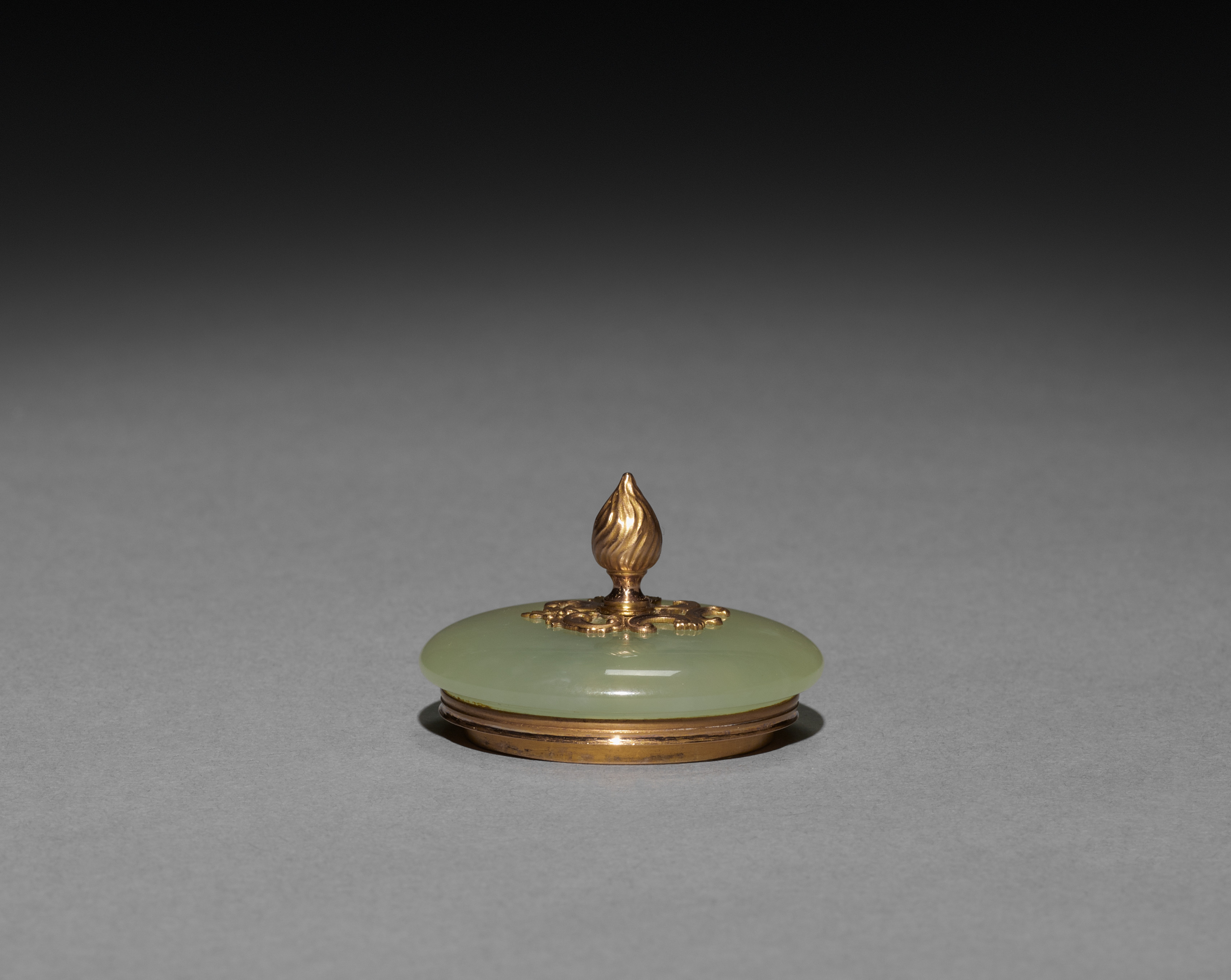
Executive Analysis: The St. Petersburg Miniature Teapot Cover
This report presents a comprehensive deconstruction of a singular artifact submitted for analysis to Zoey Fashion Lab: a cover for a miniature teapot, originating from St. Petersburg, Russia. The piece is fabricated from gold and bowenite. Our analysis is grounded in the reference text Archive Resonance: 一面是光洁银镜上以黄金镶嵌的纷繁棕叶纹,另一面是冰冷石棺板上以浮雕诉说的生命叙事——《Mirror with Split-Lea.... This text provides a critical dialectic—the tension between reflective, ornamental surface and profound, narrative depth—which we will apply to the teapot cover’s avant-garde execution.
I. Material Dialectics: Gold as Mirror, Bowenite as Stone
The choice of materials immediately establishes the core conflict of the piece. Gold, in its polished state, functions as the “光洁银镜” (bright silver mirror) referenced in the archive. It is a surface of pure reflection, of light and ornamentation. The “纷繁棕叶纹” (intricate palm-leaf patterns) are not merely decorative; they are the language of opulence, of the decorative arts that prioritize surface beauty and visual pleasure. This is the layer of the piece that speaks to tradition, to the gilded excess of imperial St. Petersburg, and to the function of a teapot cover as a domestic object of luxury.
Bowenite, a serpentine mineral often mistaken for jade, introduces the opposing force. It is the “冰冷石棺板” (cold stone coffin slab). Its cool, matte, and unyielding nature stands in stark contrast to the malleable, warm brilliance of gold. Bowenite is not a surface for reflection; it is a surface for inscription. It absorbs light rather than reflects it. The archive text speaks of “浮雕诉说的生命叙事” (life narratives told through relief). On the bowenite, the narrative is not read through shimmering patterns but through tactile, carved forms that demand physical and intellectual engagement. The material itself suggests mortality, permanence, and a weight that the gold’s lightness denies.
In an avant-garde context, this is not a mere juxtaposition of precious materials. It is a deliberate, philosophical collision. The gold is the mask of civilization, the bowenite the bone beneath. The teapot cover, therefore, becomes a microcosm of the human condition: the desire for beauty and the inevitability of decay.
II. The Split-Leaf Paradigm: Form as Fracture
The archive’s reference to a Mirror with Split-Leaf is central to understanding the cover’s structure. A split-leaf pattern is, by definition, a form that is both whole and broken. It suggests a natural growth that has been severed, a symmetry that is disrupted. This is not a harmonious, symmetrical design. The avant-garde interpretation demands that we see the “split” not as a flaw but as the primary formal gesture.
On the gold surface, the “intricate palm-leaf patterns” might be executed as a continuous, flowing arabesque. But the avant-garde reading insists that this flow is interrupted. Perhaps the gold is not a full dome but a series of overlapping, fragmented leaves, each one a separate, polished plane that catches light from a different angle. This creates a visual cacophony, a disorienting reflection that prevents the eye from settling. The “mirror” is shattered into a thousand shards of gold, each one a tiny, distorted reflection of the viewer or the room.
Conversely, the bowenite relief might feature a single, monumental split leaf—a giant frond that has been cleaved in two. The “life narrative” is told through the scar of the split. The relief could depict the leaf’s veins as rivers of time, the split as a wound, a geological fault line. The narrative is not a story of growth but of rupture. This is the avant-garde’s refusal of the pastoral. The teapot cover does not celebrate nature; it displays nature in a state of traumatic transformation.
III. Architectural Space: The Teapot as a Reliquary
St. Petersburg is a city of facades, of grand, imperial surfaces that mask a history of revolution and suffering. This teapot cover, in its miniature scale, becomes an architectural model. The gold is the facade of the Winter Palace, the bowenite is the granite of the Neva River embankments. The cover is not merely a lid; it is a roof, a dome, a sarcophagus lid.
The avant-garde function of the cover is to deny access. A teapot cover is meant to be lifted, to reveal the contents within—the tea, the warmth, the domestic ritual. But this cover, with its split-leaf tension, resists this function. The gold surface is too reflective, too aggressive to be casually touched. The bowenite is too cold, too heavy, too funereal. The act of lifting the cover becomes a ritual of transgression, a violation of a sacred space. The teapot is no longer a vessel for tea; it is a reliquary containing a memory, a secret, a death.
The scale—miniature—amplifies this effect. A miniature object demands intimacy, a close, almost microscopic gaze. The viewer is forced to confront the split-leaf pattern, the material conflict, and the narrative weight at a proximity that is uncomfortable. The cover becomes a world in itself, a compressed universe of contradiction. It is not a decorative object; it is a philosophical statement in three dimensions.
IV. Avant-Garde Intervention: The Anti-Decorative
In the context of Zoey Fashion Lab, the term “Avant-garde” is not a stylistic label but a methodology of disruption. This teapot cover is an anti-decorative object. It uses the vocabulary of luxury—gold, bowenite, intricate pattern—to dismantle the very concept of luxury. The gold is not warm; it is blinding. The pattern is not harmonious; it is fractured. The narrative is not uplifting; it is about “life narratives” told on a “stone coffin.”
The piece succeeds as an avant-garde artifact because it refuses to be a passive, beautiful object. It demands a reaction. It asks the viewer: What are you looking at? A mirror? A coffin? A leaf? A scar? The answer is all of them, simultaneously. The cover is a Mirror with Split-Leaf that reflects not the viewer’s face but the viewer’s own mortality, their own fractured relationship with history, ornament, and meaning.
For Zoey Fashion Lab, this analysis informs our own design philosophy. We do not create clothing or accessories that simply adorn. We create wearable architecture, portable contradictions. The St. Petersburg teapot cover teaches us that the most powerful avant-garde gesture is to take a familiar, domestic form—a cover, a lid, a roof—and transform it into a site of tension, a place where the “bright silver mirror” and the “cold stone coffin” coexist in a state of permanent, unresolved dialogue. This is the essence of Archive Resonance: not to replicate the past, but to split it open and expose the narrative within.