The Architecture of Restraint: Deconstructing the Ottoman Gaze for SS26
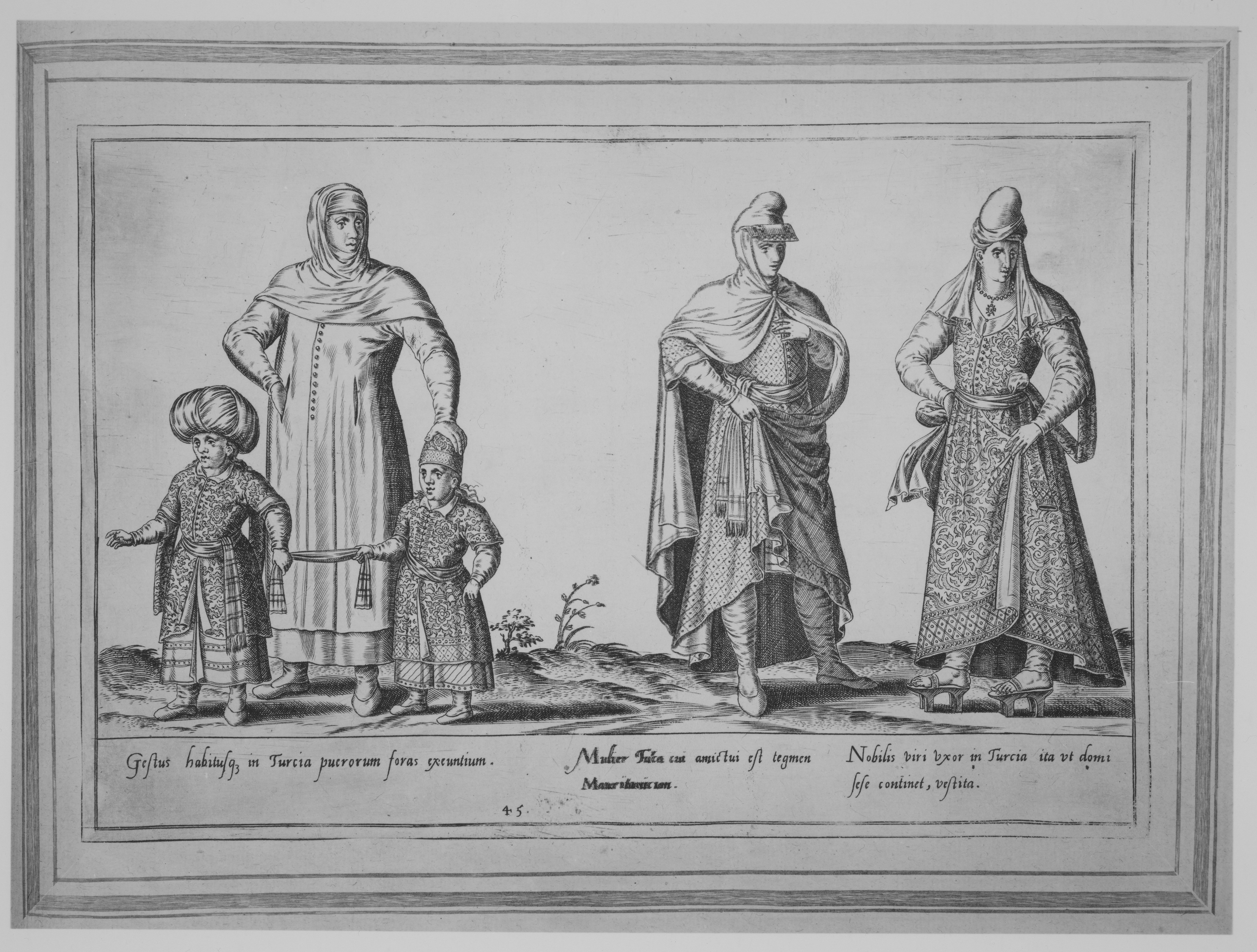
The sartorial lexicon of the Ottoman Empire, as rendered in the 16th and 17th-century engravings of Nicolas de Nicolay and Melchior Lorck, presents a paradox of visibility and concealment. These plates—*Gestus habitusque in Turcia puerorum foras exeuntium* (The Gesture and Habit of Turkish Boys Going Out), *Mulier Turca cui amictui est tegmen Maurit...um* (A Turkish Woman Clothed in a Moorish Mantle), and *Nobilis viri uxor in Turcia ita ut domi sese continet, vestita* (A Nobleman's Wife in Turkey, Dressed as She Stays at Home)—are not mere ethnographic records. They are documents of a gestural architecture, where fabric becomes a second skin of social code, and silhouette is a political statement. For Zoey Fashion Laboratory’s SS26 collection, we shall not replicate these forms; we shall deconstruct their structural logic to forge a futuristic language of restraint and release. This is a study in the habitus of the threshold—the space between the interior and the exterior, the seen and the unseen.
Deconstructing the Engraved Silhouette: From Static Line to Kinetic Volume
The engravings’ defining feature is a rigid, almost architectural, containment. The *puerorum foras exeuntium* (boys going out) are depicted in *entari* (long robes) that cinch at the waist, creating a cylindrical volume that breaks only at the ankle. The *nobilis viri uxor* (nobleman's wife) is swathed in a *ferace* (outer cloak) that falls in severe, unbroken lines from shoulder to floor, her form entirely obscured save for the suggestion of a hand. The *Mulier Turca* with her *tegmen Mauritanicum* (Moorish mantle) presents a pyramidal solidity, a draped mass that swallows the body.
For SS26, we translate this static geometry into kinetic potential. The cylindrical *entari* becomes a parametric exoskeleton—a lattice of 3D-printed, bio-ceramic nodes that articulate like vertebrae. The silhouette is not a fixed line but a morphing volume, expanding and contracting via micro-servos and shape-memory alloys. The garment does not simply contain the body; it negotiates space. The *ferace*’s severe verticality is reimagined as a liquid-crystal textile that shifts from opaque to translucent in response to ambient light, creating a dynamic boundary between the wearer and the observer. The *tegmen Mauritanicum*’s pyramidal mass is inverted: a floating, cantilevered train of recycled carbon-fiber filaments, suspended from a micro-harness that redistributes weight, creating a silhouette of deliberate imbalance—a monument to the body’s agency.
Structural Innovation: The Grammar of the Veil and the Gesture
The engravings are rich with gestural cues. The boys’ hands are often tucked into their sashes (*kuşak*), a posture of modesty and containment. The women’s gestures are minimal—a hand holding a cloth, a slight turn of the head. These are not random poses; they are habitus scripts, learned bodily practices that encode social status and gender. Our innovation lies in re-scripting these gestures through material technology.
We introduce the “Gesture-Membrane”: a garment layer woven from piezoelectric fibers that convert micro-movements into electrical signals. When the wearer’s hand approaches the sash area, the membrane stiffens, creating a structural pocket that mirrors the tucked-hand gesture. This is not passive drape; it is responsive architecture. The *kuşak* itself is re-engineered as a modular tension system: a belt of smart-textile bands that can be tightened or loosened via a haptic interface, altering the entire silhouette from a cinched waist to a flowing, columnar form. The wearer becomes the architect of their own containment.
The *Mulier Turca*’s *tegmen Mauritanicum*—a heavy, enveloping mantle—inspires our “Shroud of Agency.” This is a garment of programmable opacity, using electrochromic panels that can be activated to reveal or conceal specific body zones. But the innovation is deeper: the shroud’s fabric is embedded with micro-fluidic channels that circulate cooling or heating fluids, creating a microclimate of control. The wearer is not hidden; they are curating their own visibility, a futuristic reclamation of the gaze.
Futuristic Silhouettes: The Body as a Threshold
The *nobilis viri uxor*’s domestic confinement—her dress “as she stays at home”—is a potent symbol of spatial politics. Her garment is a boundary marker, delineating the private sphere. For SS26, we explode this boundary. The “Domestic Armature” is a garment that extends the body into the environment. A skirt of self-supporting, origami-folded Tyvek panels, each panel containing a flexible OLED screen that displays abstracted patterns from the original engravings. The silhouette is a mobile architecture, a room that walks. The train of the *ferace* becomes a trailing data-stream—a fiber-optic braid that pulses with biometric data, rendering the wearer’s internal state as external spectacle.
The *puerorum foras exeuntium* (boys going out) silhouette is reimagined as a “Threshold Suit.” A high-collared, asymmetrical jacket with a deconstructed sleeve that detaches via magnetic coupling, allowing the wearer to modulate between a closed, protective form and an open, gestural one. The trousers are asymmetric, volumetric, and segmented, with a single leg flaring into a bell shape while the other is a streamlined, second-skin form. This is not a costume; it is a dialectic of movement and stasis, a commentary on the liminality of youth—caught between domestic obedience and public agency.
Materiality and Craft: The New Alchemy of Engraving
The engravings themselves are line, shadow, and texture. Our material palette translates this into tactile and visual depth. We use laser-etched leather that mimics the cross-hatching of copperplate engraving, creating a surface that is both image and object. Recycled silk organza is pleated with thermoplastic inserts, creating permanent, sculptural folds that reference the drape of the *entari* and *ferace*. The “Engraved Lace”—a laser-cut, multi-layered bioplastic—creates a lattice of shadows, echoing the engraver’s line.
The color story is monochromatic with strategic ruptures: deep indigo, charcoal, and bone white, punctuated by iridescent copper and oxidized silver—a nod to the metallic inks used in early modern prints. The structural innovations are not hidden; they are celebrated as ornament. The 3D-printed nodes are left raw, the micro-servos are encased in translucent resin, the piezoelectric fibers are woven into visible patterns. This is honest construction, a futuristic take on the deconstructivist ethos.
Conclusion: The Gestus Habitus of the Future
Zoey Fashion Laboratory’s SS26 collection does not seek to replicate the Ottoman past. It extracts the latent structural principles—containment, gesture, threshold, and gaze—and re-articulates them through a lens of post-human agency. The *gestus habitusque* (gesture and habit) of these engraved figures become a grammar for a new sartorial syntax. The *puerorum foras exeuntium* is no longer a boy going out; it is a cyborg youth negotiating public space. The *Mulier Turca* is not a woman in a mantle; she is a curator of her own visibility. The *nobilis viri uxor* is not confined; she carries her architecture.
This is avant-garde couture as critical cartography—mapping the body, the garment, and the environment as a single, dynamic system. The silhouette is no longer a line; it is a field of potential. The innovation is not in the fabric alone, but in the re-coding of the relationship between wearer, garment, and observer. At Zoey Fashion Laboratory, we do not dress the body; we construct the threshold through which the body meets the world. For SS26, the threshold is a living, breathing, responsive membrane—a testament to the enduring power of the engraved line, and the infinite possibilities of its deconstruction.