Deconstructing the Powder Flask: An Avant-Garde Analysis for Zoey Fashion Lab
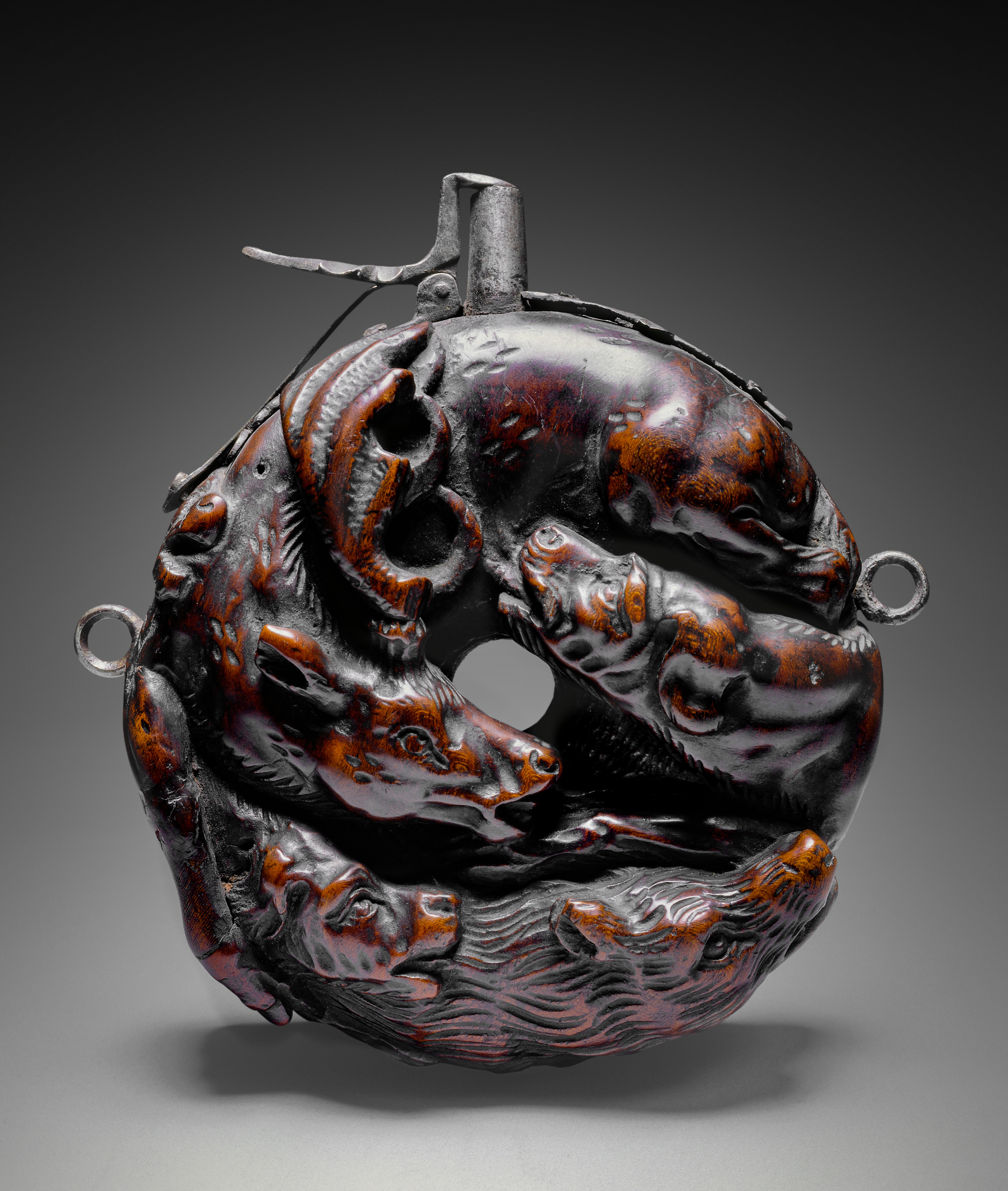
At Zoey Fashion Lab, we do not merely observe historical artifacts; we dissect them for their latent design DNA. The 17th-century German powder flask from Gmünd, Swabia—crafted from boxwood with a stag-and-hounds motif in high relief, fitted with steel funnel, mounts, and a springcatch—is not a relic of hunting culture but a blueprint for avant-garde fashion. This analysis will deconstruct its materiality, narrative, and mechanical precision to extract three core design principles: Relief as Structural Armor, Narrative as Wearable Tension, and Functional Mechanics as Kinetic Detail. These principles will inform a new DNA strand for Zoey Fashion Lab’s upcoming collection, merging historical craftsmanship with futuristic expression.
1. Materiality and High Relief: The Sculptural Body
The powder flask’s primary material, boxwood, is a dense, fine-grained hardwood that allows for intricate carving. In the 17th century, this was a testament to the artisan’s skill—a medium that demanded patience and precision. For Zoey Fashion Lab, boxwood’s legacy translates into a focus on sculptural textiles that mimic high-relief carving. Imagine garments where the fabric is not flat but built up in layers, creating three-dimensional forms that protrude from the body like the stag’s antlers or the hounds’ muscular flanks. This is not mere embroidery; it is structural armor.
Avant-garde application: We propose using laser-cut, multi-layered neoprene or recycled synthetic polymers, bonded to a base fabric, to create “relief panels” on jackets, bodices, and cuffs. These panels would be designed in organic, flowing patterns inspired by the stag’s anatomy—antler-like ridges, sinew-like grooves—but rendered in metallic or matte blacks to evoke a futuristic, post-human aesthetic. The boxwood’s warmth is replaced by a cool, industrial finish, yet the tactile depth remains. The steel funnel and mounts, functional yet ornamental, inspire the integration of hardware as soft structure: think steel-toned grommets, chainmail-like inserts, or articulated metal joints embedded into the garment’s seams, not as accents but as load-bearing elements that shape the silhouette.
This principle challenges the conventional flatness of fashion. The powder flask’s high relief is not decorative; it is integral to the object’s identity. Similarly, in our collection, relief becomes a form of body augmentation—a way to expand the wearer’s physical presence, turning the garment into a sculptural exoskeleton that both protects and provokes.
2. Narrative as Wearable Tension: The Stag and Hounds
The carved scene—a stag pursued by hounds—is a narrative of pursuit, endurance, and the cycle of life and death. In the 17th century, this motif served as a symbol of nobility and the hunt’s ritualistic power. For Zoey Fashion Lab, we deconstruct this narrative into a dynamic tension that can be worn. The stag and hounds are not static; they are caught in a moment of action, their bodies twisting and straining. This kinetic energy is a goldmine for avant-garde design.
Avant-garde application: We translate this narrative into garments that feature asymmetrical, directional lines—seams that pull the eye in a specific trajectory, like the hounds’ chase. For example, a dress might have a diagonal panel that starts at the left shoulder and cascades to the right hem, mimicking the stag’s flight. The “hounds” could be represented by cutouts or transparent mesh inserts that reveal glimpses of skin or underlayers, suggesting pursuit and exposure. The tension between concealment and revelation becomes a core theme: the stag is both hunted and hidden, the hounds both seen and sensed.
Furthermore, the narrative can be deconstructed and abstracted. Instead of literal animal forms, we use geometric shapes—triangles (antlers), ellipses (bodies), and sharp lines (paws)—arranged in a chaotic but intentional composition. This abstraction allows the wearer to become a canvas for story without being shackled to historical representation. The powder flask’s narrative is not about the hunt itself but about the emotional charge of the moment—fear, speed, instinct. Our garments capture this charge through color blocking (deep forest greens against stark whites, like snow against blood) and texture contrast (rough wool against smooth leather, echoing the stag’s fur and the hounds’ sleek coats).
3. Functional Mechanics as Kinetic Detail: The Springcatch and Funnel
The powder flask’s steel funnel, mounts, and springcatch are not merely practical; they are mechanical poetry. The springcatch, a precise locking mechanism, controls the release of gunpowder—a moment of tension and release. The funnel guides the powder, a conduit of transformation. For Zoey Fashion Lab, these mechanics inspire a focus on kinetic details that allow the garment to change, adjust, or reveal itself through wearer interaction.
Avant-garde application: We design garments with modular components that snap, twist, or slide, much like the springcatch. For instance, a jacket might have removable sleeves that attach via a spring-loaded mechanism, allowing the wearer to transform the silhouette from a structured blazer to a sleeveless vest in seconds. The “funnel” concept translates into directional zippers or drawstrings that cinch fabric into controlled volumes, like a funnel guiding powder. These details are not hidden; they are celebrated as visible engineering—exposed tracks, metallic clasps, and reinforced seams that echo the steel mounts’ raw functionality.
This principle also extends to wearable technology. Imagine a garment with embedded sensors that respond to movement—lights that pulse when the wearer runs, or fabric that stiffens when tension is detected, mimicking the springcatch’s locking action. The powder flask’s mechanics are about control and release; our garments should offer the same dichotomy: the wearer can lock a silhouette into place or release it into fluid motion. This creates a dialogue between the body and the garment, where the clothing is not passive but an active participant in the wearer’s kinetic narrative.
Conclusion: A New DNA Strand for Zoey Fashion Lab
The 17th-century German powder flask is a masterclass in how material, narrative, and mechanics can converge into a singular, powerful object. For Zoey Fashion Lab, its deconstruction yields a new DNA strand: Relief as Structural Armor, Narrative as Wearable Tension, and Functional Mechanics as Kinetic Detail. These principles are not historical pastiches but catalysts for avant-garde innovation. They challenge us to think of the body as a terrain for sculptural exploration, the garment as a story in motion, and the details as instruments of transformation.
By applying these principles, Zoey Fashion Lab can create a collection that honors the craftsmanship of the past while pushing the boundaries of future fashion. The powder flask’s legacy is not in its gunpowder but in its potential—a potential we now unleash into the world of wearable art. Let the stag run, the hounds chase, and the mechanisms click. The future of fashion is not flat; it is carved, tense, and alive.