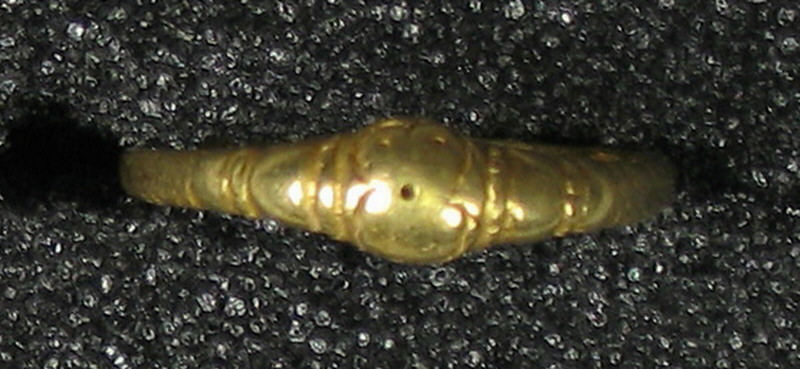
Deconstructing the Arc: The Ring with Divided, Pointed Arc as a Proto-Futurist Object
The artifact in question—a gold ring from Central Java, characterized by a divided, pointed arc—is not merely an ornament. It is a frozen architectural proposition, a microcosm of tension between the organic and the engineered. For Zoey Fashion Laboratory’s SS26 collection, this object serves as a critical pivot point, challenging the conventional hierarchy of jewelry as a secondary, decorative afterthought. Instead, this ring demands to be read as a structural manifesto, a blueprint for reimagining the human silhouette through the lens of deconstructive aesthetics and futuristic garment architecture.
The Divided Arc: A Study in Negative Space and Tension
The ring’s defining feature—its divided, pointed arc—is a masterclass in negative space as active form. Unlike a continuous band that encloses the finger, this arc deliberately breaks the circle, creating an aperture that is not empty but charged. The gap is not a flaw; it is a deliberate void of potential. This principle translates directly into garment construction for SS26. We must consider the silhouette not as a closed, protective shell, but as a series of interrupted lines that define the body through what they omit. The pointed termination of the arc introduces a vector of aggression, a sharpness that cuts through the organic softness of the human form. This is not jewelry that sits passively; it is jewelry that pierces space, that redefines the boundary between the wearer and the environment.
Materially, the gold is not a symbol of opulence but of precise weight and tensile strength. The metal’s density is necessary to hold the arc’s rigid geometry. In our SS26 context, this suggests a move away from fluid, draping fabrics toward rigid, sculptural textiles—metallic organzas, thermoformed polymers, and laser-cut leathers that can hold a sharp edge. The ring’s gold surface, when polished, becomes a mirror of the environment, reflecting and distorting the world around it. This aligns with the archive node’s reference to a “光洁银镜” (smooth silver mirror) and “黄金镶嵌的纷繁棕叶纹” (gold-inlaid palm leaf patterns). The ring is a hybrid: a reflective, cold surface that simultaneously bears the trace of organic, botanical ornament. This duality is the core of our SS26 narrative.
From Micro-Object to Macro-Silhouette: Scaling the Arc
The ring’s architecture must be scaled to the human body. Imagine a shoulder piece that mimics the divided arc: a rigid, pointed crescent that hovers above the clavicle, never touching the skin except at two anchor points. The void between the arc and the body becomes a negative space garment, a shadow that defines the wearer’s posture. Alternatively, consider a waist-cinching corset constructed from a series of overlapping, divided arcs. Each arc terminates in a sharp point, creating a silhouette that is both armored and skeletal. The points do not merely decorate; they re-align the body’s geometry, forcing the hips and shoulders into a new, futuristic proportion—elongated, predatory, and asymmetrical.
The pointed tip of the arc is not a gentle curve; it is a terminal node, a point of convergence where multiple forces meet. In garment construction, this translates to strategic stress points. Seams are not hidden but celebrated as structural lines. A jacket’s shoulder seam, for example, could be extended into a sharp, gold-tipped point that projects beyond the natural shoulder line, echoing the ring’s aggressive termination. This is not about comfort; it is about dynamic posture. The wearer becomes a living sculpture, their movement choreographed by the garment’s rigid architecture.
Contextual Weave: The Archive Node as Narrative Anchor
The provided archive node—“一面是光洁银镜上以黄金镶嵌的纷繁棕叶纹,另一面是冰冷石棺板上以浮雕诉说的生命叙事” (on one side, a smooth silver mirror inlaid with intricate gold palm leaf patterns; on the other, a cold sarcophagus lid telling a life narrative in relief)—deepens our reading. The ring is a bifacial object, like the mirror-sarcophagus. One face is reflective, immediate, and decorative (the gold arc in its polished state). The other face is narrative, funereal, and heavy with history (the divided, pointed form as a symbol of rupture). For SS26, this duality manifests as garments that are simultaneously surface and depth. A dress might have a front panel that is a smooth, reflective silver surface (echoing the mirror), while the back reveals a complex, skeletal structure of gold arcs and pointed ribs (echoing the sarcophagus). The wearer presents a unified, futuristic front, but the back tells a story of deconstruction and memory.
The “纷繁棕叶纹” (intricate palm leaf patterns) suggest an organic, almost chaotic underlay. This is the subversive texture beneath the cold geometry. In our SS26 collection, this translates to a layering system: a base layer of hand-embroidered, fractal-like leaf patterns in gold thread, over which a rigid, pointed arc structure is suspended. The leaf pattern is not visible at first glance; it is revealed only through movement or when the garment is opened. This is a hierarchy of revelation, where the structural arc dominates the visual field, but the organic pattern grounds it in a narrative of life and decay.
Structural Innovation for SS26: The Pointed Arc as a New Joint
The ring’s divided arc introduces a novel joint system. The two ends of the arc do not meet; they are held in tension by the material’s own rigidity. For SS26, we propose a new articulation mechanism for garments: the tension arc joint. Instead of hinges or elastic, seams are replaced by pre-stressed, pointed arcs that snap into place, creating a permanent, unyielding structure. A sleeve, for example, could be constructed from a single gold arc that wraps around the arm, leaving a gap at the inner elbow. The arm is not enclosed; it is framed. This challenges the very concept of a sleeve as a tube. The garment becomes a series of architectural frames that the body inhabits, rather than a fabric envelope.
Furthermore, the pointed arc allows for asymmetric weight distribution. A dress could be balanced by a single, massive pointed arc on one shoulder, counterweighted by a trailing, divided arc that extends down the opposite hip. The silhouette is no longer symmetrical; it is dynamic and off-kilter, a direct response to the ring’s broken circle. This is not about balance in the classical sense; it is about tension as a design principle. The garment is always on the verge of collapse, held together only by the precise engineering of its divided arcs.
Conclusion: The Ring as a Portal to the Future
The Ring with Divided, Pointed Arc from Central Java is not a relic; it is a prophetic object. Its architecture—the broken circle, the sharp point, the tension between reflective surface and organic underlay—provides a complete vocabulary for Zoey Fashion Laboratory’s SS26 collection. We are not borrowing from tradition; we are extracting its latent futurity. The ring teaches us that the most powerful forms are those that are incomplete, that point toward something beyond themselves. The divided arc is a gesture toward the future, a silhouette that has not yet been realized. Our task is to scale this gesture to the human body, to make the wearer a living testament to the power of deconstructive, pointed architecture. The body is the canvas; the arc is the cut. The result is a new species of garment: cold, sharp, and eternally unresolved.