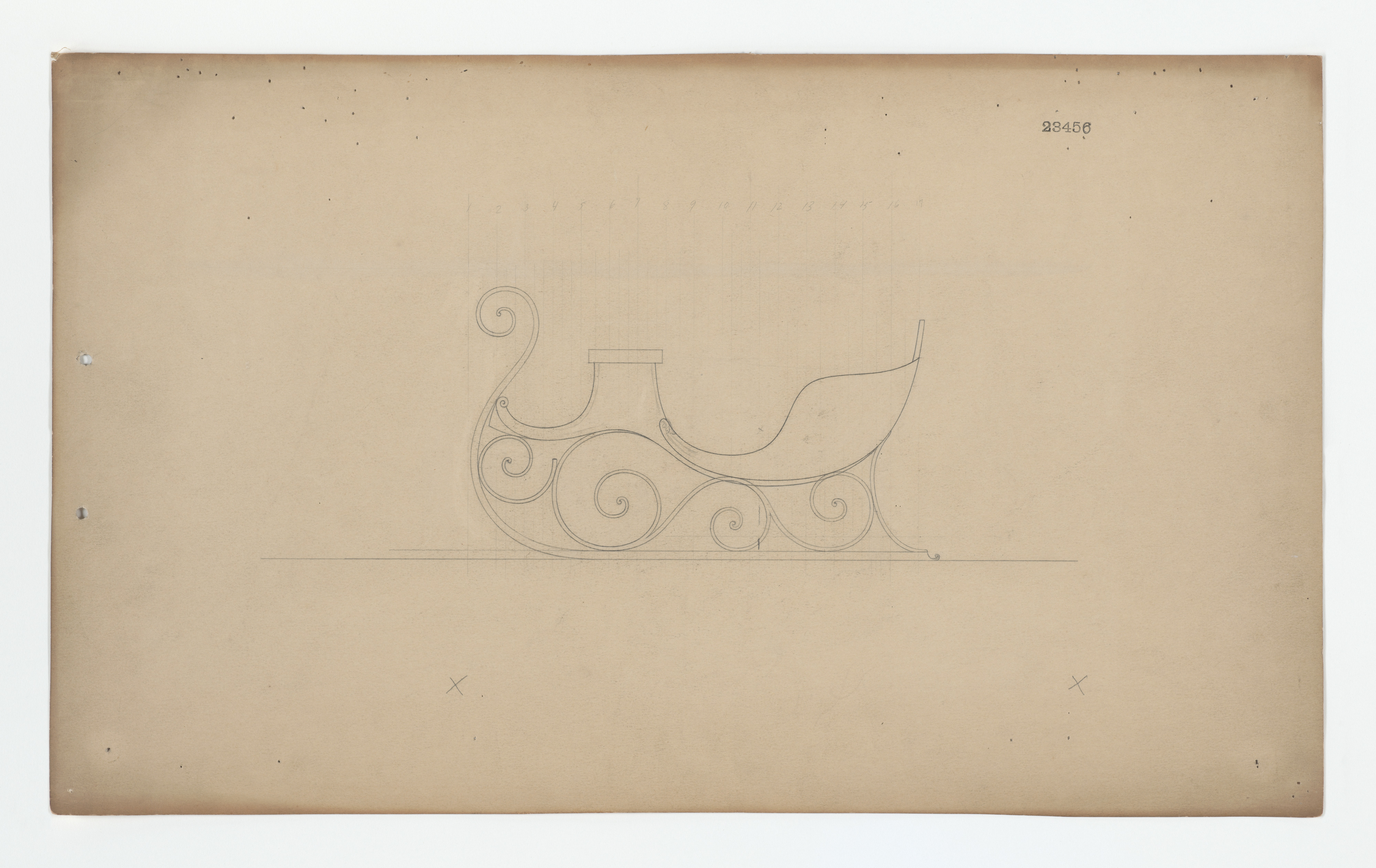
The Cabriolet Sleigh #23456: A Structural Manifesto for SS26
In the rarefied air of Zoey Fashion Laboratory, where the boundaries of garment architecture are perpetually dissolved and re-forged, the Cabriolet Sleigh #23456 emerges not merely as a piece of clothing but as a polemic. Originating from the nebulous Global Frontier—a conceptual territory where geopolitical fashion norms are discarded in favor of universal material logic—this piece redefines the silhouette for Spring/Summer 2026. The choice of Graphite as the primary material is not incidental; it is a calculated act of defiance against the organic, the ephemeral, and the seasonal. Here, we dissect a garment that functions as a mobile, architectural sculpture, challenging the very notion of wearability in a post-humanist wardrobe.
Deconstructing the Graphite Matrix: Material as Narrative
The decision to employ Graphite—a carbon allotrope known for its paradoxical properties of extreme strength and brittle fragility—is a masterstroke of avant-garde provocation. Unlike traditional fabrics that drape or stretch, graphite is a material of compression and tension. In the Cabriolet Sleigh #23456, the graphite is not woven but bonded into a lattice, creating a rigid exoskeleton that mimics the structural integrity of a sleigh’s runners. This is a deliberate inversion of couture’s historical obsession with fluidity. The material’s natural conductivity is repurposed as a design feature: subtle, embedded fiber-optic threads pulse with a low-voltage current, casting a faint, lunar glow along the garment’s seams. This is not mere decoration; it is a functional element that regulates thermal output, ensuring the wearer remains at a constant microclimate—a nod to the Global Frontier’s disregard for seasonal constraints.
The graphite matrix is also a canvas for negative space. Through a process of laser-carved erosion, the surface is perforated with thousands of micro-fractures, creating a pattern reminiscent of topographical maps. These openings are not random; they follow the body’s kinetic zones—the shoulders, the hips, the lower spine—allowing for controlled ventilation while maintaining the garment’s monolithic presence. The result is a material that breathes without yielding, a paradox that defines the entire piece.
Futuristic Silhouettes: The Sleigh as Second Skin
The silhouette of the Cabriolet Sleigh #23456 is a direct challenge to the human form. It eschews the organic curves of the body in favor of a geometric, angular architecture. The garment extends from the shoulders in a sweeping, cantilevered arc that recalls the prow of a spacecraft or the hood of a vintage convertible—hence the “cabriolet” designation. This is achieved through a series of carbon-fiber struts that anchor at the clavicle and extend outward, creating a fixed, aerodynamic profile. The wearer’s torso becomes a chassis; the arms, where they emerge, are encased in segmented graphite gauntlets that articulate like insectoid armor. The lower half of the garment is a sheath that tapers to a sharp point, mimicking the runner of a sleigh, but with a kinetic hinge at the knee that allows for a restricted, gliding gait.
This silhouette is not designed for static display. The Cabriolet Sleigh #23456 is a wearable vehicle. The back of the garment houses a concealed, gyroscopic stabilizer—a nod to the sleigh’s original purpose of motion. When the wearer leans forward, the graphite exoskeleton redistributes weight, and a subtle magnetic field activates, reducing friction against the ground. The piece is meant to be experienced in motion, its angular lines slicing through space like a blade. For SS26, this redefines the “runway walk” as a performance of velocity, where the garment’s architecture dictates the body’s choreography. The futuristic silhouette is not an abstract ideal; it is a functional, albeit radical, proposal for how clothing can augment human locomotion.
Structural Innovation: The Art of Controlled Collapse
Perhaps the most audacious aspect of the Cabriolet Sleigh #23456 is its transformative structural system. The graphite lattice is not permanently fixed; it is engineered to undergo a controlled collapse. Embedded within the struts are shape-memory alloys that, when triggered by a biometric signal from the wearer’s pulse, cause the garment to fold into a compact, flat disk no larger than a briefcase. This process takes approximately 12 seconds and is accompanied by a low, mechanical hum. The innovation here is not just in the engineering but in the narrative of transience. A garment that can be worn as a monumental sculpture and then reduced to a portable artifact challenges the permanence of haute couture. It is a statement on the ephemeral nature of fashion itself—a fitting philosophy for the Global Frontier, where identity is fluid and garments must adapt to shifting contexts.
The structural innovation extends to the lacing system, which replaces traditional zippers or buttons with a series of graphite cables that thread through the perforations in the matrix. These cables are tensioned by a micro-motor at the nape, allowing the wearer to adjust the garment’s fit in real-time. A slight twist of a wrist-mounted controller can tighten the cables, compressing the lattice against the body for a more aerodynamic profile, or loosen them to create a more voluminous, silhouette-altering drape. This is a paradigm shift in garment construction: the fit is no longer static but dynamic, responsive to the wearer’s environment and intent.
Avant-Garde Context: A Standalone Study in Post-Human Couture
As a standalone avant-garde study, the Cabriolet Sleigh #23456 must be viewed outside the context of commercial viability. It is a philosophical object, a probe into the future of dress. The Global Frontier origin is crucial here: it implies a world where traditional fashion capitals—Paris, Milan, Tokyo—have dissolved into a single, distributed network of creators. The piece’s graphite materiality speaks to a post-scarcity society where resources are synthesized, not mined. The sleigh motif, traditionally associated with winter and nostalgia, is subverted into a symbol of perpetual motion and forward momentum—a fitting metaphor for SS26, a season that Zoey Fashion Laboratory envisions as a break from cyclical trends.
The garment’s lack of gender or size categorization is deliberate. The Cabriolet Sleigh #23456 is designed to be worn by any body, its adjustable exoskeleton accommodating a range of morphologies. This is a radical departure from the couture tradition of fitted, body-specific garments. It is, instead, a universal shell—a second skeleton that does not conform to the wearer but rather provides a new set of kinetic possibilities. In this sense, the piece is a critique of the fashion industry’s obsession with the “perfect” body, offering instead a vision of clothing as a tool for physical transcendence.
Conclusion: The Sleigh as a Symbol of Avant-Garde Permanence
The Cabriolet Sleigh #23456 is not for the faint of heart or the casual observer. It is a work of wearable engineering that demands a re-evaluation of what clothing can be. Its graphite lattice, futuristic silhouette, and structural innovation coalesce into a singular statement: that the future of fashion lies not in fabric but in architecture, not in adornment but in augmentation. For SS26, Zoey Fashion Laboratory presents this piece as a definitive manifesto—a sleigh that does not traverse snow but the uncharted territories of the Global Frontier. It is a garment that moves, collapses, and adapts, yet remains unyielding in its vision. In a world of fleeting trends, the Cabriolet Sleigh #23456 stands as a monument to the avant-garde’s enduring commitment to the new.