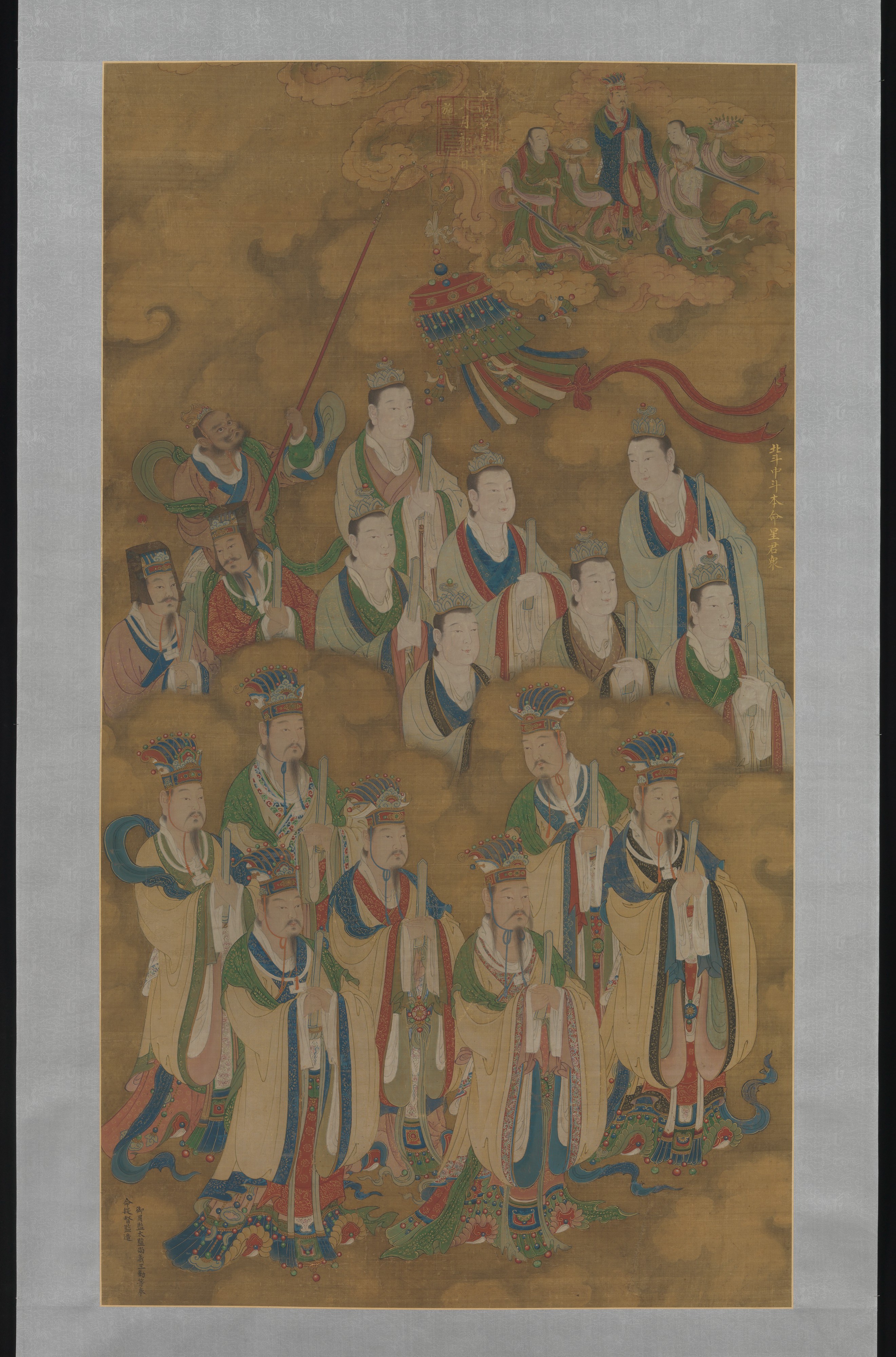
Deconstructing the Celestial Cartography: Star Deities of the Northern and Central Dippers as Avant-Garde Architectonics for SS26
The celestial cartography of ancient China, particularly the veneration of the Northern and Central Dippers, offers a profound lexicon for deconstructive aesthetics. For Zoey Fashion Laboratory’s SS26 collection, the hanging scroll—a medium of temporal suspension and vertical narrative—becomes a structural manifesto. The deities themselves, often depicted as custodians of cosmic order, are reimagined not as figurative motifs but as futuristic silhouettes that disrupt the gravitational pull of conventional garment architecture. This analysis dissects the scroll’s ink-and-color-on-silk composition into a three-dimensional syntax of asymmetry, negative space, and kinetic tension.
1. The Northern Dipper as a Framework of Asymmetrical Gravity
The Northern Dipper (Beidou) is traditionally a constellation of seven stars, each governing a facet of fate. In the scroll, these stars are rendered as luminous nodes against a dark, ink-washed sky. For the avant-garde, this translates into a deconstructed jacket architecture where the dipper’s shape is not a literal print but a structural lattice of carbon-fiber boning and laser-cut silk organza. The silhouette is deliberately lopsided: the left shoulder rises in a sharp, angular peak (representing the dipper’s handle), while the right side cascades into a waterfall of raw-edged, unhemmed silk panels (the bowl). This asymmetry is not decorative but functional—a wearable disruption of balance that forces the body into a new posture, as if caught in a celestial magnetic field. The ink-wash technique is reinterpreted through gradient-dyed technical mesh, where the darkest hues concentrate at the garment’s core (the dipper’s center) and fade into translucent, almost spectral edges. The result is a silhouette that appears to be in a state of quantum flux, perpetually shifting between solidity and dissolution.
2. The Central Dipper as a Study in Verticality and Suspension
Unlike the Northern Dipper’s horizontal sweep, the Central Dipper (Zhongdou) is often depicted as a vertical axis connecting heaven and earth. The scroll captures this through a hieratic composition where the deity stands in a static, elongated pose, their robes cascading like frozen waterfalls. For SS26, this becomes a vertical silhouette that defies the human form’s natural proportions. A columnar dress is constructed from multiple layers of bias-cut silk, each layer dyed in a monochromatic gradient from deep indigo at the hem to pale cerulean at the neckline. The structure is reinforced with invisible, magnetic seams that allow the garment to hold its shape without traditional stitching—a nod to the scroll’s seamless, continuous ink strokes. The deity’s headdress, often a crown of stars, is translated into a halo-like neckpiece made of hand-hammered titanium and resin, suspended from the collarbone by micro-chains. This accessory is not merely decorative; it functions as a counterweight that pulls the garment’s center of gravity upward, creating a tension between the wearer’s movement and the dress’s static, almost architectural form. The suspension effect is further emphasized by the use of liquid crystal panels embedded in the fabric, which shift from opaque to translucent in response to body heat, mimicking the scroll’s ink bleeding into silk.
3. Material Alchemy: Ink and Color as Structural Innovation
The scroll’s medium—ink and color on silk—is not merely a surface but a material philosophy. For the avant-garde, this translates into a hybrid textile system that combines traditional craftsmanship with futuristic technology. The ink is reimagined as a bio-responsive pigment printed onto recycled silk using algae-based dyes. When exposed to humidity or friction, the pigment shifts from matte black to iridescent silver, mirroring the scroll’s depiction of stars that appear to pulse with celestial energy. The color—primarily vermilion, azurite, and malachite—is translated into structural panels of hand-dyed, pleated organza that are laser-cut into geometric constellations. These panels are not sewn but magnetized to the garment’s base, allowing for modular reconfiguration. The wearer can thus alter the silhouette in real time, moving from a closed, protective form (the dipper’s bowl) to an open, radiating one (the dipper’s handle). This modularity is a direct response to the scroll’s narrative of cosmic order—a system that is both fixed and mutable, governed by the same forces it depicts.
4. Negative Space and the Deconstruction of the Body
The hanging scroll’s composition is defined by its negative space—the unpainted silk that suggests the infinite void between stars. For SS26, this void becomes a deconstructive tool that carves into the garment’s surface. A sheer, laser-cut bodysuit is created from a single piece of silk, with star-shaped cutouts that trace the Northern Dipper’s pattern across the torso. The cutouts are not random; they align with the body’s meridian points, creating a kinetic acupuncture effect that responds to the wearer’s breath and movement. The negative space is further emphasized by floating, detached sleeves that are connected to the bodice only at the shoulder and wrist, leaving the underarm and ribcage exposed. This architectural void challenges the traditional garment’s role as a covering, instead positioning the body as a celestial map where skin becomes the canvas for the deity’s narrative. The void is not absence but presence—a deliberate space for the wearer’s own starlight.
5. Futurist Silhouettes: The Dipper as a Kinetic System
The ultimate innovation for SS26 lies in the kinetic silhouette. The Northern and Central Dippers are not static forms; they rotate, shift, and realign over millennia. This celestial motion is captured through micro-motors embedded in the garment’s seams, which slowly rotate the star-shaped panels along the fabric’s surface. A cape inspired by the Central Dipper’s vertical axis is designed with shape-memory alloys that contract and expand in response to temperature changes, creating a living silhouette that breathes with the environment. The silhouette is not predetermined but emergent—a dialogue between the wearer, the garment, and the cosmic forces they embody. This is the ultimate deconstruction: the garment is no longer a fixed object but a temporal architecture, a hanging scroll that unfurls in real time.
In conclusion, the star deities of the Northern and Central Dippers, as depicted in the hanging scroll, provide a radical blueprint for SS26. Through asymmetrical gravity, vertical suspension, material alchemy, and kinetic systems, Zoey Fashion Laboratory redefines the avant-garde as a celestial cartography of the body. The collection is not a homage to the past but a structural prophecy—a vision of fashion as a living, breathing constellation.