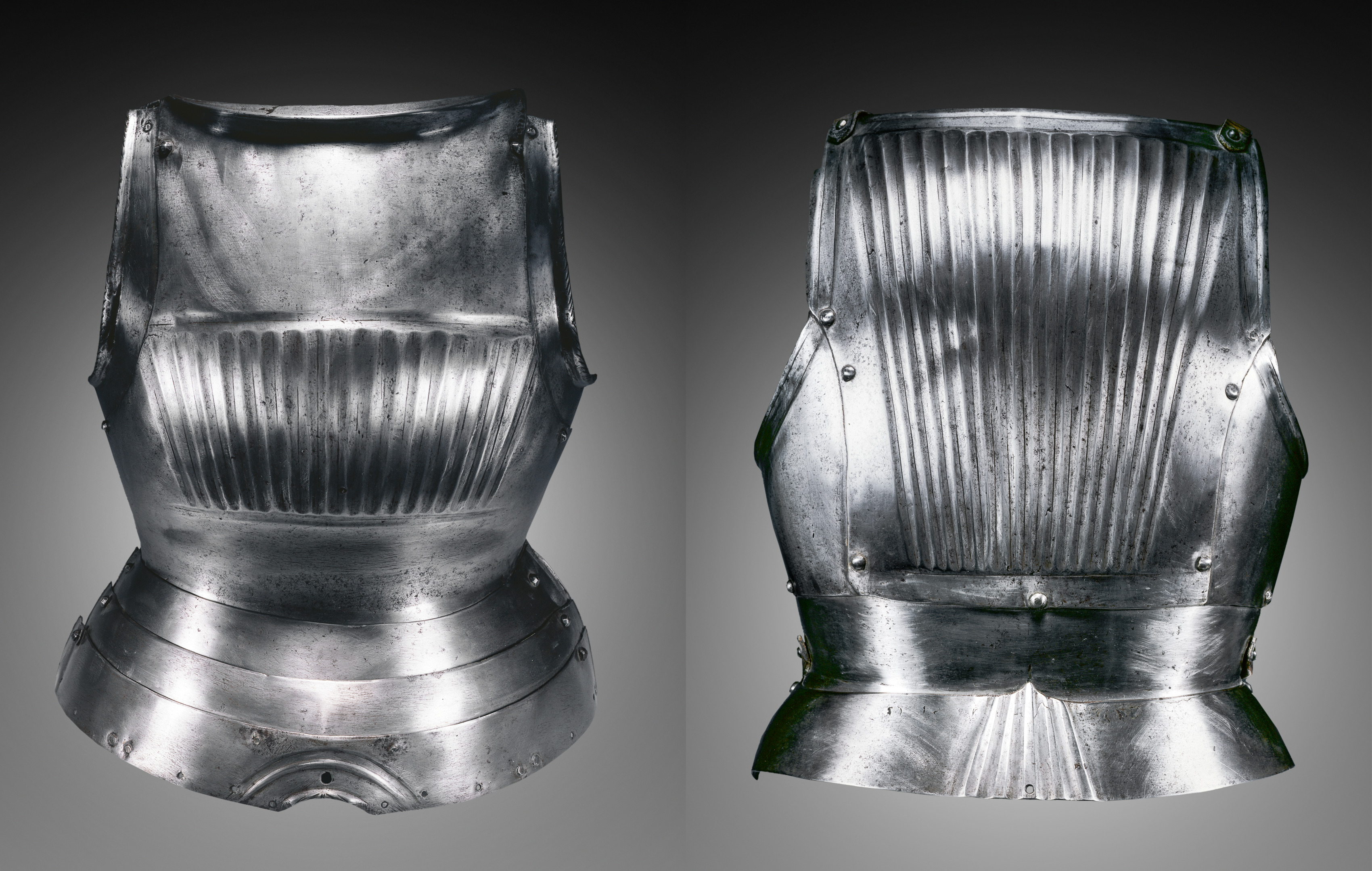
Deconstructing the Steel Silhouette: A Zoey Fashion Lab Analysis of the Maximilian Breast and Backplates
At Zoey Fashion Lab, our mission is to unearth the latent narratives embedded within historical artifacts, not merely as relics of the past, but as blueprints for the future of fashion. Today, we turn our analytical gaze to a pair of objects that embody a paradox: the Maximilian breast and backplates from early 16th-century Germany, likely Nuremberg. Forged from steel and bound with brass rivets, these are not just pieces of armor; they are a crystallized moment in the evolution of human protection, identity, and aesthetic ambition. Our deconstruction will not focus on their martial utility, but on their structural, textural, and symbolic DNA—a strand we will re-weave into an avant-garde garment concept. We will treat the steel as fabric, the rivets as seams, and the silhouette as a statement of power and vulnerability.
Technical Analysis: The Anatomy of a Second Skin
The Maximilian armor, named after the Holy Roman Emperor Maximilian I, represents a high-water mark in the art of the armorer. Its defining characteristic is the deliberate imitation of contemporary civilian clothing—specifically the pleated and slashed garments of the late Gothic and early Renaissance periods. The breastplate we examine is not a simple convex curve; it is a complex topography. The steel is hammered into a series of vertical ridges and fluting, mimicking the folds of a doublet or the pleats of a gown. This is not mere decoration. The fluting, often arranged in a fan-like pattern over the chest, is a structural innovation. It increases the plate's rigidity without adding weight, channeling the force of a blow along the ridges. The backplate mirrors this logic, with a more subtle curvature to accommodate the spine and shoulder blades.
The brass rivets are not afterthoughts. They are the primary fastening system, connecting the breast and backplates at the shoulders (via pauldrons) and along the sides. In the context of our deconstruction, these rivets are the seams of a garment. They are visible, functional, and decorative. Their golden hue against the dark, blued or polished steel creates a stark, intentional contrast. The rivet heads are often domed or rosette-shaped, adding a tactile, almost jewel-like quality to the intersection of plates. The edges of the plates are rolled or roped—a technique that both strengthens the vulnerable rim and prevents the sharp steel from cutting the wearer's clothing or flesh. This attention to the edge is a lesson in finishing: no detail is too small to be considered a point of design.
Structural DNA: The New Strand for Avant-Garde Fashion
The "New DNA Strand" we extract from this artifact is a fusion of three core concepts: Rigid Draping, Articulated Exoskeleton, and Paradoxical Softness.
1. Rigid Draping: The fluting of the Maximilian breastplate is a form of drapery executed in steel. For our avant-garde garment, we translate this into a technique of structural pleating using materials like resin-coated canvas, laser-cut stainless steel mesh, or carbon fiber. The pleats are not sewn; they are heat-set or molded into a permanent, three-dimensional architecture. The front of a jacket or bodice would feature a fan of these rigid pleats, radiating from the sternum to the shoulders, creating a silhouette that is both armored and fluid. The pleats would not be symmetrical; they would be asymmetrical, some folding inward, others flaring outward, mimicking the organic, dynamic nature of the original armor's fluting, which was often tailored to the individual wearer's body.
2. Articulated Exoskeleton: The brass rivets are our primary joinery. In the original armor, they allow for limited movement. In our avant-garde interpretation, we replace rivets with exposed, oversized hinges and mechanical joints. These are not hidden; they are celebrated. Think of a jacket where the back and front panels are connected by polished brass or titanium hinges at the shoulders and sides. The hinges are not merely functional; they are the focal point of the design, creating a visual rhythm of metal against fabric. The "seams" become kinetic sculptures. We can further this by using articulated plates—small, overlapping segments of hardened leather or polycarbonate—attached to a flexible base. This creates a second skin that moves with the wearer, clattering and shifting like the scales of a mythical creature, echoing the overlapping lames of the original armor’s gorget or fauld.
3. Paradoxical Softness: The most avant-garde element is the deliberate subversion of the armor's inherent hardness. We introduce soft, pliable materials where the steel would be. The fluting is mimicked by deeply channeled velvet or neoprene, creating the visual of steel pleats but with a tactile, yielding feel. The "rivets" are large, domed silicone orbs or polished wooden buttons, set into the soft fabric at the points of articulation. The backplate, originally a solid piece, is reinterpreted as a transparent, molded polyurethane shell with embedded LED lights that trace the fluting pattern. This shell is attached to a sheer, body-hugging mesh base, creating a ghost-armor effect. The wearer's spine becomes the central seam. The contrast between the rigid, transparent backplate and the soft, pleated front creates a dialogue between protection and exposure, strength and vulnerability.
Avant-Garde Garment Concept: The "Nuremberg Silhouette"
The final garment is a two-piece ensemble: a Bodice-Exoskeleton and a Fluted Skirt-Plate.
The Bodice-Exoskeleton: This is the direct descendant of the breast and backplates. The front is constructed from a single piece of molded, matte-black carbon fiber, featuring asymmetrical, radiating pleats that are polished to a high gloss on the crests and left matte in the valleys. The back is a clear, flexible polycarbonate sheet with a subtle, laser-etched pattern of the original fluting. The two are connected at the shoulders by large, polished brass hinges that are fully visible and functional. The side seams are replaced by adjustable, leather-and-brass corset lacing, allowing the wearer to control the tension and fit. The rivets are reinterpreted as oversized, dome-shaped magnets that hold the front and back together at the waist, allowing for quick release and reconfiguration. The entire bodice is worn over a sheer, high-neck base layer of liquid latex, which provides a second-skin feel and a subtle, reflective sheen.
The Fluted Skirt-Plate: This is not a skirt in the traditional sense. It is a series of articulated, vertical panels that hang from a wide, structured waistband. Each panel is made of layered, heat-set organza and laser-cut stainless steel mesh, creating a fluted, fan-like shape that moves independently. The panels are connected by thin, brass chains that clink and sway with motion. The front panel is the longest, creating a dramatic, asymmetrical hem that echoes the original armor's fauld. The back panels are shorter, revealing the transparent backplate of the bodice. The entire ensemble is anchored by platform boots with articulated, metal-clad toes, completing the transformation from historical armor to wearable sculpture.
Conclusion: The Reforged Armor
The Maximilian breast and backplates are not dead metal. They are a conversation between the human form and the desire for transcendence. By deconstructing their technical DNA—the rigid draping, the exposed joinery, the paradoxical softness—we have created a new strand of design. The "Nuremberg Silhouette" is not a costume; it is a statement. It says that protection can be beautiful, that strength can be vulnerable, and that history is not a museum piece but a living, breathing source of innovation. At Zoey Fashion Lab, we do not replicate the past. We reforge it. The steel of the armorer becomes the fabric of the future. The brass rivets become the hinges of a new, articulated way of wearing power.