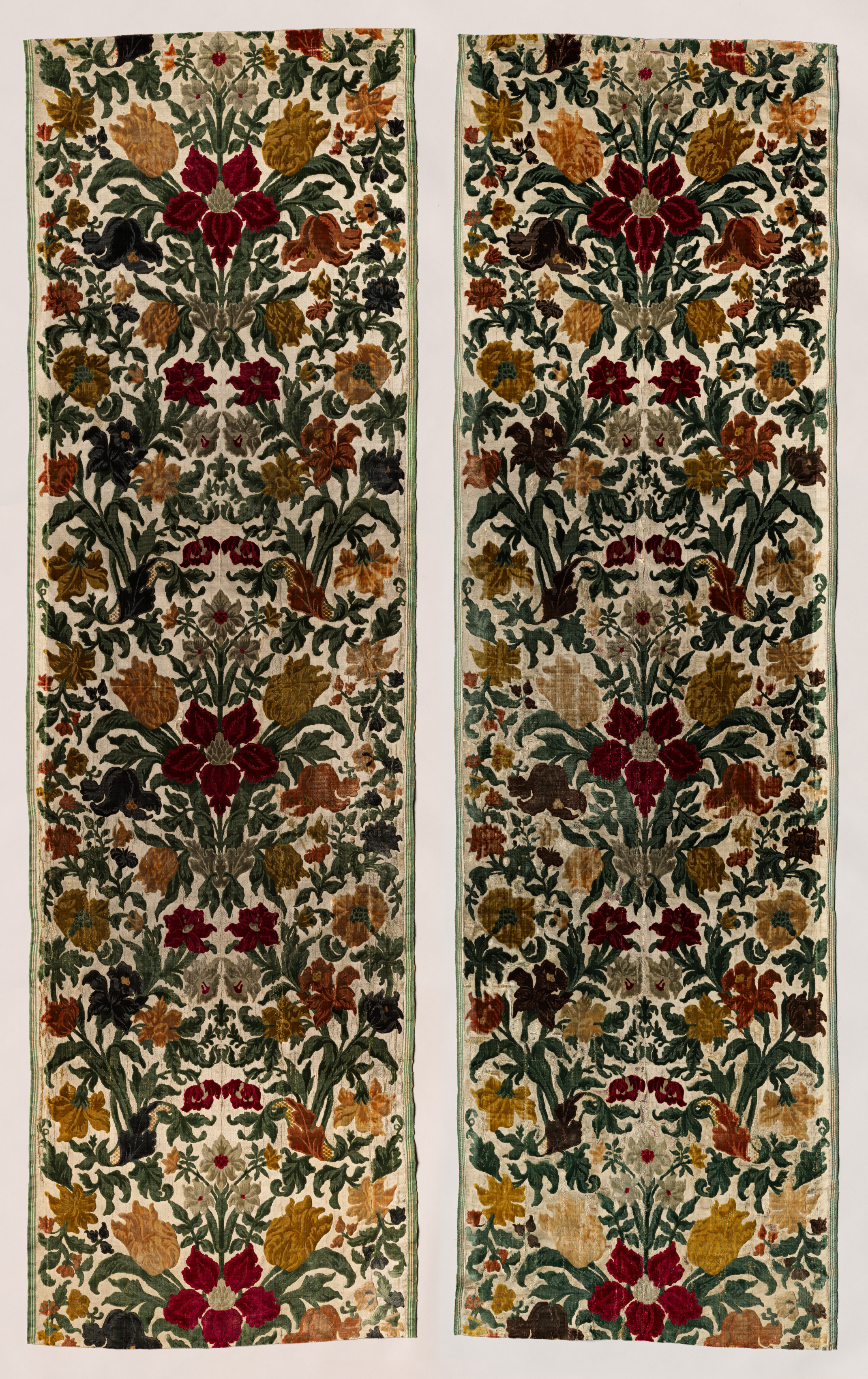
Deconstructing the Genetic Code: An Analysis of Genoese Floral Velvet Lengths for Zoey Fashion Lab
As the Chief Fabric Deconstructionist for Zoey Fashion Lab, my mandate is to dissect materials not merely as textiles, but as living systems—archives of history, technology, and latent potential. The subject of this analysis, a collection of floral velvet lengths originating from Genoa, Italy, presents a unique opportunity. These are not simple remnants of a bygone era; they are a New DNA Strand—a genetic blueprint waiting to be re-coded. Our deconstruction will focus on the technical interplay of cut, uncut, and voided velvet techniques in silk, and how their inherent structural properties can be manipulated to forge an avant-garde aesthetic that challenges the very perception of fabric as a static medium.
I. The Genoese Origin: A Historical Matrix
Genoa, from the 15th to the 18th centuries, was a powerhouse of velvet production, famed for its high-luster, densely woven silks. The city’s weavers perfected the art of creating complex, multi-level surfaces. These floral velvet lengths are not merely decorative; they are a record of a specific technological and economic nexus. The floral motifs, often pomegranates, thistles, or stylized blossoms, were not chosen at random. They were symbols of wealth, power, and religious devotion, woven into the very structure of the cloth. For Zoey Fashion Lab, this historical context is not a cage but a launchpad. We must view the Genoese origin as a genetic marker—a foundational sequence that dictates the fabric’s tensile strength, drape, and light-refracting properties. The silk itself, with its long, continuous filaments, provides a protein-based polymer that is both incredibly strong and luxuriously soft. This is the raw material upon which we will perform our deconstructive surgery.
II. Technical Deconstruction: The Trinity of Velvet Construction
The true genius of these lengths lies in the simultaneous use of three distinct velvet techniques: cut, uncut, and voided. Each represents a different state of material existence, and their interplay creates a dynamic, almost holographic surface.
Cut Velvet (Velluto Cesellato): This is the most recognizable form, where the pile loops are sheared open to create a dense, plush surface. In our Genoese lengths, the cut velvet forms the primary floral motifs. The shearing creates a deep, absorbent surface that traps light, resulting in a rich, dark, and velvety appearance. From a deconstructionist perspective, cut velvet represents completion and finality. The loop is broken, the surface is defined. It is the "expressed" gene in our DNA strand—the visible, dominant trait.
Uncut Velvet (Velluto Tirato): Also known as "terry velvet," this technique leaves the pile loops intact. These loops act as tiny, cylindrical lenses. They catch light from multiple angles, creating a shimmering, almost metallic effect that is lighter and more reflective than the cut pile. In our floral lengths, uncut velvet often forms the background or secondary foliage. It represents potential and latency. The loop is a closed circuit, a reservoir of light and texture that has not yet been "expressed." This is the recessive gene, waiting to be activated.
Voided Velvet (Velluto Vuoto): This is the most radical technique, where areas of the fabric are left with no pile at all, exposing the ground weave. In our Genoese specimens, the voided areas create the negative space around the floral forms. This is not a failure of weaving but a deliberate act of erasure and absence. The voided sections are flat, matte, and structurally minimal. They act as a foil to the exuberant pile, creating a visual and tactile silence. In our New DNA Strand, voided velvet is the non-coding sequence—the intergenic region that, while not expressing a protein, is crucial for regulating the expression of the genes around it. It defines the boundaries and creates the syntax of the fabric's language.
III. The New DNA Strand: Re-coding for Avant-Garde Expression
An avant-garde aesthetic does not accept materials at face value. It demands a re-contextualization, a mutation of the original form. For Zoey Fashion Lab, we will treat these velvet lengths not as finished cloth, but as a genetic library of structural possibilities. Our deconstruction will focus on three key manipulations:
1. Selective Pile Ablation: Using laser or chemical etching, we will selectively remove the pile in precise, non-floral patterns. This will create a new, abstract voided velvet—not as a background, but as a primary design element. We will "silence" certain genes (cut and uncut pile) in specific areas, creating a topographic map of absence. This technique allows us to write a new code onto the fabric, one that speaks of decay, erosion, and the passage of time. The resulting surface will be a palimpsest of the original floral motif, overlaid with our own deconstructive script.
2. Tension and Draping as Structural Mutation: The inherent stiffness of the heavy silk velvet, due to its dense pile and ground weave, is a constraint. We will exploit this constraint. By slicing the fabric into long, narrow strips or irregular geometric shards, we can re-weave them using tension as a structural force. The cut edges will fray, exposing the raw silk core. The uncut loops will be pulled taut, flattening into linear ridges. The voided areas will become translucent. This is not a gentle drape; it is a forced mutation—a re-folding of the protein chain under stress. The resulting garment forms will be architectural, angular, and almost skeletal, revealing the fabric's inner structure as an exoskeleton.
3. Hybridization with Non-Textile Materials: The New DNA Strand must be spliced with alien elements. We will embed thin, flexible metal wires (e.g., nitinol or copper) into the voided areas, creating a shape-memory alloy that allows the velvet to "remember" a specific form. The floral motifs, once static, can now be programmed to curl, unfurl, or stand erect in response to body heat or electrical current. This is the ultimate avant-garde act: transforming a historical textile into a responsive, kinetic sculpture. The cut velvet becomes a sensor, the uncut loops become actuators, and the voided ground becomes the circuit board. The garment is no longer worn; it performs.
IV. Conclusion: From Relic to Prototype
These Genoese floral velvet lengths are not artifacts to be preserved. They are a starting point—a primordial soup of structural and textural possibilities. By deconstructing them through the lens of cut, uncut, and voided velvet, and by re-coding their DNA through ablation, tension, and hybridization, Zoey Fashion Lab can create garments that are not merely avant-garde in style, but avant-garde in substance. They will be living fabrics that challenge the boundary between the organic and the engineered, the historical and the futuristic. The floral motif, once a symbol of static wealth, will become a dynamic expression of a new, mutable identity. This is the future of fashion: not the creation of new fabrics, but the radical re-engineering of the ones we already have. The New DNA Strand has been sequenced; it is time to express it.