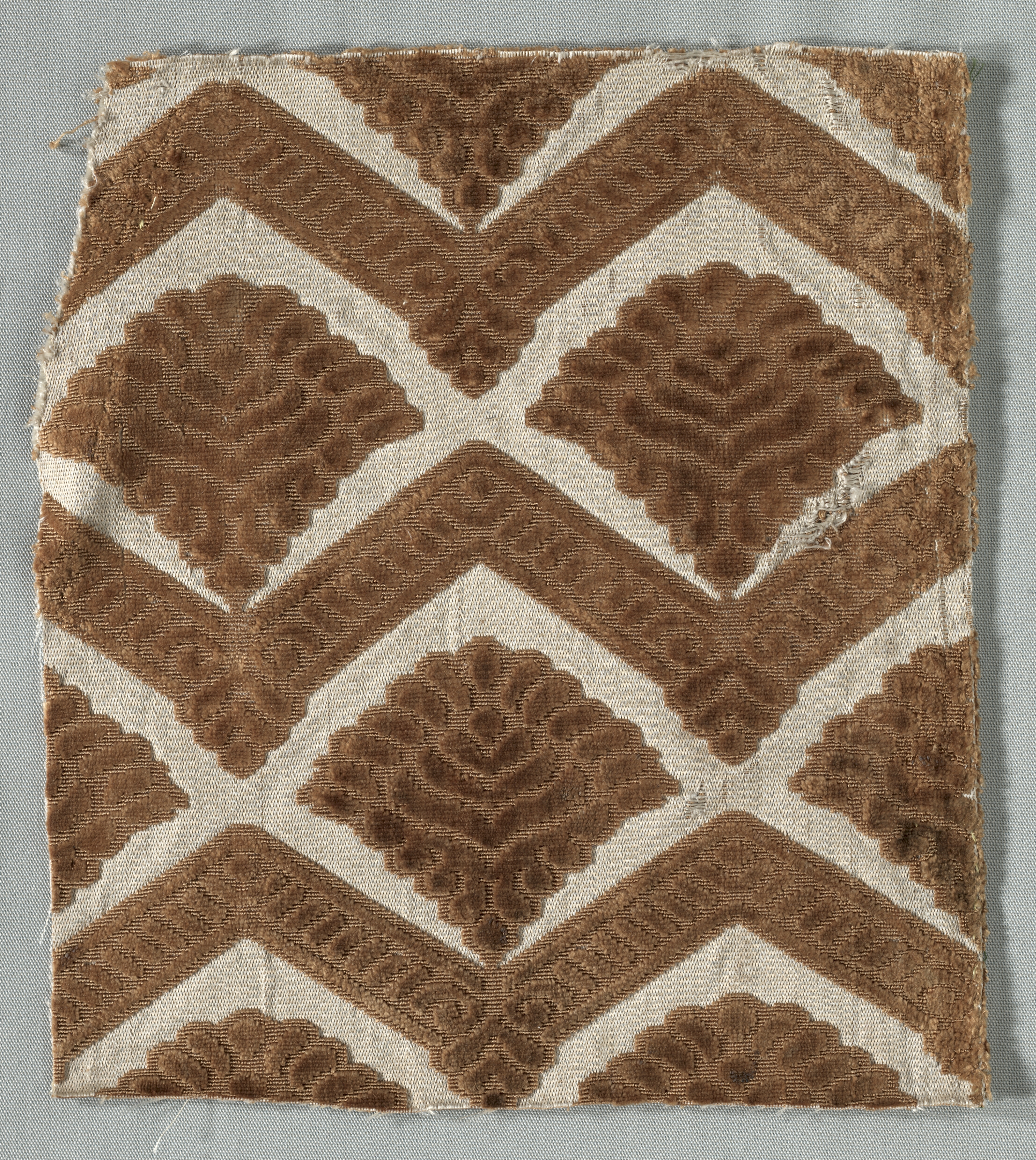
Deconstructing the Velvet Fragment: A Technical and Aesthetic Analysis for Zoey Fashion Lab
This analysis examines a 17th-century Italian velvet fragment, designated as a New DNA Strand for Zoey Fashion Lab’s avant-garde collections. The fragment, composed of cut and uncut silk velvet, represents a pivotal moment in textile history—a convergence of artisanal mastery and material innovation. By deconstructing its technical, historical, and aesthetic properties, we can extract design principles that resonate with contemporary avant-garde fashion, where tradition is not merely preserved but subverted.
Technical Composition and Construction
The fragment’s foundation is silk, a protein fiber prized for its luster, strength, and dye affinity. The velvet structure employs a cut and uncut pile technique, a hallmark of Italian Renaissance weaving. In this method, two warp systems are used: a ground warp for the base fabric and a pile warp for the loops. The uncut pile creates a dense, matte surface, while the cut pile produces a glossy, raised pattern. This dual-pile approach allows for intricate relief effects, where light interacts differently with each surface, generating depth and movement.
The weave itself is a satin or twill ground, typical of 17th-century Italian velvets, providing a stable foundation for the pile. The fragment’s condition—frayed edges, faded dye, and partial pile loss—reveals the degradation of silk over time, a factor Zoey Fashion Lab can exploit. Rather than viewing wear as a flaw, we see it as a textural archive: the exposed ground weave, the uneven pile heights, and the subtle color shifts from oxidation offer a palette of decay that aligns with avant-garde aesthetics.
Historical and Cultural Context
This velvet fragment originates from Italy’s Lombardy or Venice region, where velvet production reached its zenith in the 17th century. Velvet was a symbol of power and wealth, reserved for ecclesiastical vestments, aristocratic robes, and courtly furnishings. The cut and uncut technique was particularly prized for its ability to mimic architectural reliefs, such as those in Baroque churches and palaces. The fragment’s original design likely featured floral or geometric motifs, common in Italian velvets of the period, rendered in deep reds, greens, or golds—colors derived from costly natural dyes like cochineal, weld, and indigo.
For Zoey Fashion Lab, this historical weight is a narrative catalyst. The fragment embodies a tension between opulence and fragility, permanence and decay. By extracting its DNA—the weave structure, the dye chemistry, the tactile memory—we can create garments that question the very notion of luxury. The fragment’s decontextualized state—a severed piece of a larger whole—mirrors the avant-garde practice of deconstruction, where garments are deliberately unfinished, asymmetrical, or fragmented.
Material Properties and Tactile Experience
Silk velvet is inherently sensuous and responsive. The cut pile feels soft and plush, while the uncut pile offers a napped, almost frosted texture. This dual tactility is a design tool for avant-garde fashion, where garments are experienced as much through touch as sight. The fragment’s aging process has introduced additional textures: brittle edges, stiffened threads, and a slight sheen from years of handling. These imperfections can be replicated or exaggerated in modern production, creating fabrics that feel “lived-in” or “archaeological.”
From a structural standpoint, the fragment’s weight and drape are critical. Silk velvet is heavier than modern synthetics, with a fluid yet substantial fall. This makes it ideal for sculptural silhouettes—capes, cocoon coats, or draped gowns that hold their shape while moving. The cut and uncut pile can be manipulated to create directional texture: for example, using the uncut pile for matte, grounded areas and the cut pile for raised, reflective accents. This technique echoes the high-contrast drama of Baroque design, but with a contemporary, deconstructed twist.
Design Implications for Avant-Garde Fashion
Zoey Fashion Lab’s avant-garde ethos demands that historical references be reimagined, not replicated. The velvet fragment offers several pathways:
1. Deconstructed Silhouettes: The fragment’s frayed edges and missing pile suggest a garment in a state of becoming. Designers can incorporate raw hems, exposed seams, and deliberate “holes” that reveal the ground weave. This creates a visual dialogue between construction and decay, a core tenet of deconstructionist fashion. For instance, a gown might feature a velvet bodice with cut-out sections that expose a contrasting silk organza underneath, mimicking the fragment’s partial pile loss.
2. Hybrid Textures: By combining cut and uncut velvet with modern materials—neoprene, latex, or metallic mesh—designers can create tactile collisions. The fragment’s soft, aged silk could be juxtaposed with rigid, high-gloss surfaces, producing a tension between tradition and futurism. This hybridity aligns with the New DNA Strand concept, where historical fibers are spliced with contemporary synthetics.
3. Color and Patina: The fragment’s faded dyes—now muted greens, browns, and ochres—offer a palette of impermanence. Zoey Fashion Lab can explore photochemical dyeing or natural pigment degradation to achieve similar effects. Garments might be treated with UV-reactive dyes that shift color over time, or with plant-based mordants that produce uneven, “stained” surfaces. This approach celebrates the organic life cycle of fabric, rejecting the sterile perfection of fast fashion.
4. Pattern and Motif: The fragment’s original pattern, though partially lost, can be reconstructed through digital imaging and then abstracted. Using generative design software, designers can create lattice-like or biomorphic patterns that echo the Baroque floral motifs but in a fragmented, pixelated form. These patterns could be laser-cut into velvet or embroidered with metallic threads, creating a layered, multidimensional surface.
Conclusion: The Fragment as a Catalyst
The 17th-century Italian velvet fragment is not a relic to be preserved but a living blueprint for innovation. Its cut and uncut pile, silk foundation, and historical patina offer a rich vocabulary for avant-garde fashion—one that prioritizes texture, imperfection, and narrative depth. For Zoey Fashion Lab, this fragment is a New DNA Strand: a genetic code that can be spliced, mutated, and re-expressed in garments that challenge conventional beauty. By embracing the fragment’s decay, we honor its history while forging a future where fashion is archaeological, tactile, and profoundly human.