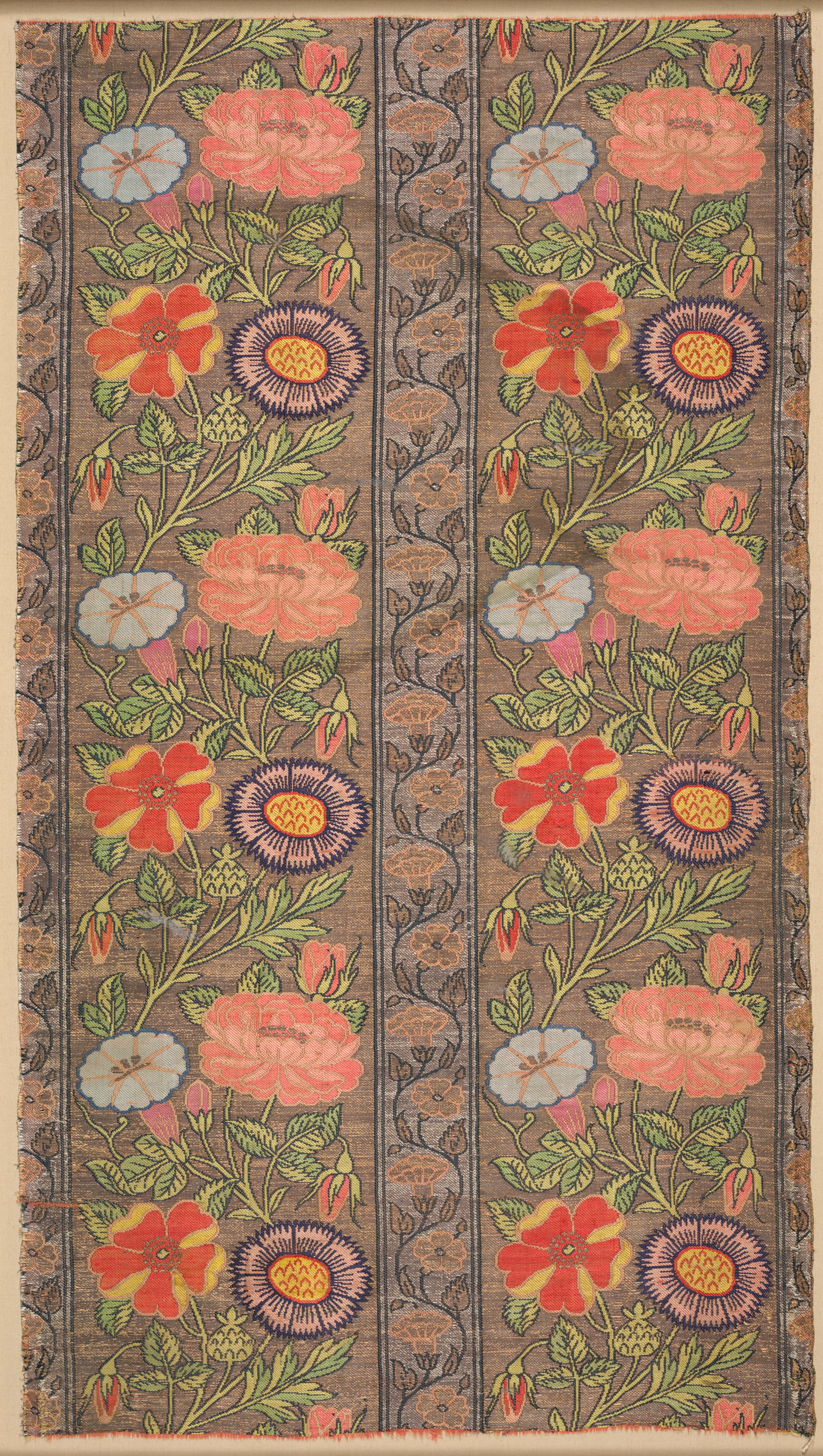
Deconstructing the Threads of Time: The Safavid Floral-Striped Silk as Avant-Garde DNA
At Zoey Fashion Lab, our mission is to dissect the structural and narrative DNA of historical textiles, re-synthesizing them into forms that challenge contemporary fashion paradigms. The subject of this analysis—a floral striped silk on a golden ground from the Safavid period (1501–1722), crafted in samite with silk, gilt, and silver-metal thread—presents a paradox of opulence and restraint. On the surface, it is a relic of imperial Persian courts. Beneath the weave, however, lies a New DNA Strand that, when decoded through an Avant-garde lens, reveals radical principles of asymmetry, material subversion, and temporal dislocation. This report deconstructs the textile’s technical, aesthetic, and philosophical components, proposing a blueprint for a collection that redefines luxury through deconstructionist rigor.
Technical Architecture: The Samite Matrix
The fabric’s construction—samite, a heavy, twill-weave silk compound—is a masterclass in structural complexity. Samite, historically woven on a drawloom, employs a warp-faced weave with supplementary wefts of gilt and silver-metal thread. The golden ground is not a dye but a metallic foundation: strips of gilded animal membrane or silver-gilt thread wrapped around a silk core. This creates a luminous, reflective surface that shifts with light, a precursor to modern lamé but with a tactile density that contemporary metallics lack. The floral stripes are not printed but woven in, using weft floats of silk in contrasting colors (crimson, lapis, emerald) that interrupt the gold field. The result is a dual-layer visual: a rigid, linear stripe structure overlaid with organic, curvilinear floral motifs—a tension between geometry and nature that resonates with Avant-garde deconstruction.
From a technical deconstructionist perspective, the samite weave is a system of controlled chaos. The metallic threads introduce a structural weakness—they are brittle and prone to tarnishing—yet the weaver exploited this fragility to create a fabric that ages deliberately. The tarnishing of silver threads over centuries is not a flaw but a feature: it introduces a patina of time, a third dimension of color. For Zoey Fashion Lab, this suggests a New DNA Strand where materials are selected for their capacity to evolve, not merely to endure. We propose a re-engineering of samite using oxidized copper threads and bio-engineered silk, where the “flaws” of oxidation become intentional design elements, creating garments that shift in appearance with humidity, light, and wear.
Visual Syntax: Stripes as Rebellion, Florals as Decay
The Safavid aesthetic was one of controlled excess—a courtly language of power expressed through pattern. The floral stripe is a paradoxical motif. Stripes, in pre-modern Persian textiles, often signified order, hierarchy, and the linear progression of dynastic time. Florals, conversely, represented the ephemeral, the natural, and the divine garden. By merging them, the Safavid weaver created a visual dissonance: the rigid stripe is repeatedly interrupted by the organic, sprawling floral. This is not harmony but a deliberate rupture. The floral elements—lotus, palmette, and arabesque—are not confined to vertical bands; they bleed into the golden ground, dissolving the stripe’s authority. This is an early form of deconstructionist patterning, where the structure is both asserted and denied.
For an Avant-garde collection, this visual syntax translates into garment construction that defies linearity. We envision a dress where the stripe is a structural seam, but the floral motif is cut away, leaving negative space. The golden ground becomes a sheer, metallic organza, while the floral stripes are appliquéd in raw, frayed silk—a technique that mimics the decay of the original textile. The New DNA Strand here is the concept of pattern as disturbance: the floral does not decorate the stripe but disrupts it, creating a visual rhythm that is syncopated, unpredictable. This is a direct challenge to the symmetrical, grid-based fashion of the 20th century, offering instead a baroque deconstruction where ornamentation is a form of structural rebellion.
Material Alchemy: Gilt and Silver as Temporal Agents
The use of gilt- and silver-metal thread in Safavid samite was not merely decorative; it was a philosophical statement. Gold and silver were symbols of the divine, the eternal, and the imperial. Yet, these metals are chemically unstable. Silver tarnishes to black; gold flakes and wears. The original textile, now centuries old, likely exhibits areas where the metallic threads have darkened or disappeared, leaving ghost patterns of the original design. This material decay is a form of temporal performance. The textile is not a static object but a record of its own aging—a concept that aligns perfectly with Avant-garde fashion’s fascination with impermanence and the abject.
Zoey Fashion Lab’s analysis proposes a reversal of this alchemy. Instead of using precious metals to simulate eternity, we use them to simulate transience. We develop a fabric where the gilt threads are coated with a water-soluble polymer, so that the golden ground dissolves upon contact with moisture, revealing a second layer of oxidized, blackened silk beneath. The floral stripes are woven with silver threads treated with a chemical catalyst that accelerates tarnishing, creating a garment that “ages” over the course of a single evening. This is the New DNA Strand—a textile that enacts its own history in real time, forcing the wearer and viewer to confront the ephemerality of luxury. The Safavid original becomes a blueprint for a fashion that is not about preservation but about controlled decay, a subversion of the fashion industry’s obsession with permanence and perfection.
Avant-Garde Synthesis: The Deconstructed Garden
The final layer of analysis is the philosophical synthesis. The Safavid floral-striped silk represents a worldview where the garden (paradise) and the court (order) coexist in tension. The Avant-garde reinterpretation must preserve this tension but invert its meaning. The garden is no longer a divine paradise but a post-industrial ruin. The stripes are no longer hierarchical but fragmented, spliced, and reassembled like a broken DNA helix. The golden ground is not wealth but a gilded cage that the floral motifs are breaking free from.
In practice, this translates into a collection where each garment is a deconstructed tapestry. A coat might be constructed from panels of the re-engineered samite, with seams left raw and metallic threads trailing like roots. The floral motifs are not woven but embroidered in a disrupted, glitch-like pattern, using a mix of traditional silk and recycled plastic filaments. The golden ground is achieved not through metal but through iridescent, dichroic films that shift from gold to green, mimicking the patina of aged brass. The silhouette is asymmetrical and architectural, with one shoulder padded and the other bare, referencing the imbalance between the stripe’s rigidity and the floral’s fluidity.
This is not a revival of Safavid art but a mutation. The New DNA Strand is a hybrid: part historical artifact, part speculative future. It rejects the notion of fashion as a linear progression from past to present. Instead, it proposes a temporal collage, where the 16th-century weaver and the 21st-century deconstructionist are collaborators. The floral-striped silk on a golden ground is no longer a relic but a living code, waiting to be rewritten. At Zoey Fashion Lab, we do not preserve history; we deconstruct it into its elemental threads, then weave them into forms that have never existed before. This is the Avant-garde imperative: to take the most opulent, the most rigid, the most “finished” textile and reveal its internal fractures, its potential for collapse, and its strange, beautiful capacity for rebirth.