Deconstructing the Divine: A Futurist Homage to Saint Adalbert and Saint Procopius
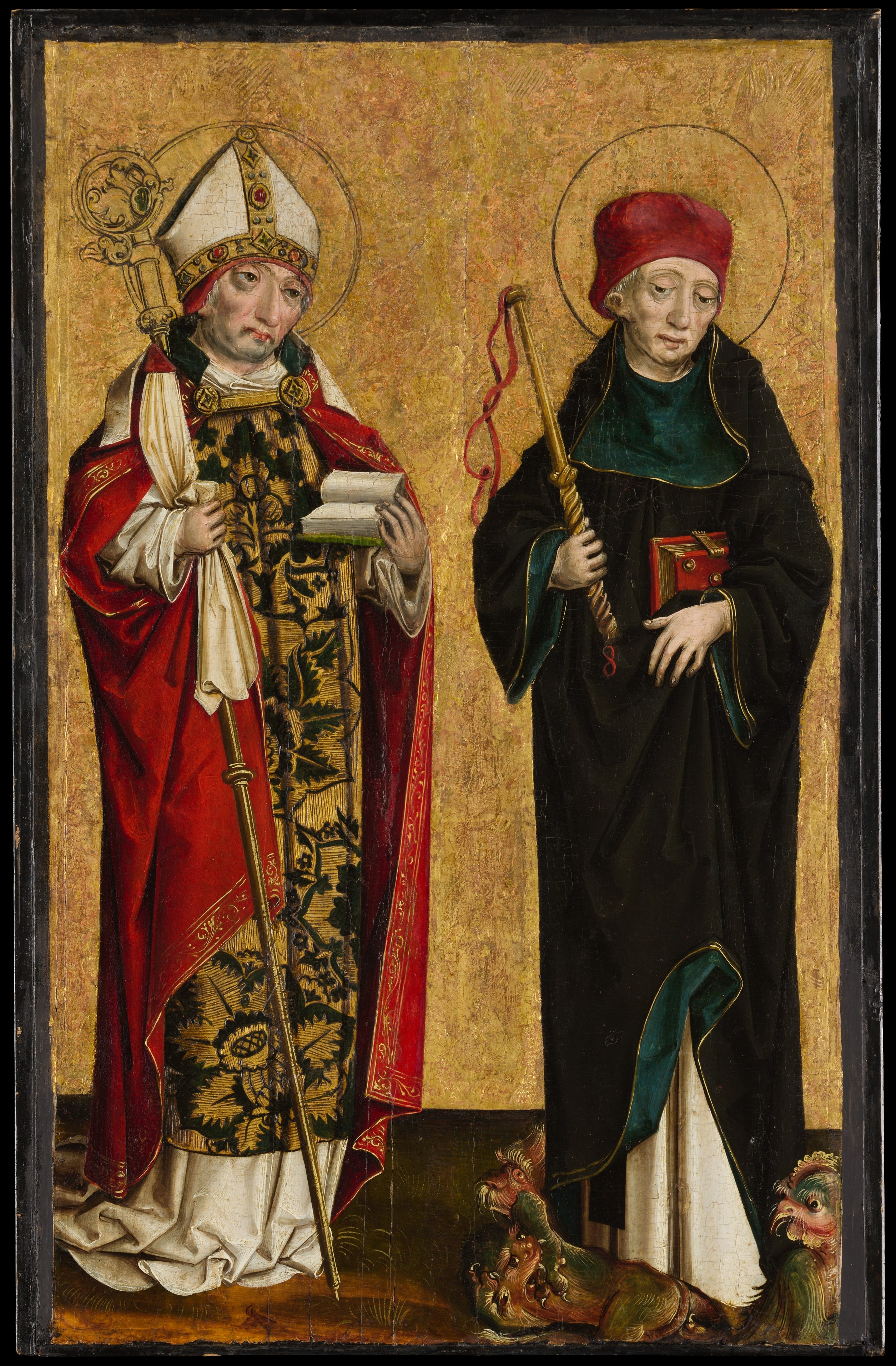
In the relentless pursuit of the next frontier in garment architecture, Zoey Fashion Laboratory turns its gaze not toward the ephemeral trends of the digital age, but to the enduring, almost alien rigor of medieval iconography. The subject—Saint Adalbert and Saint Procopius, rendered in oil on spruce with a gold ground—presents a paradox: a static, sacred tableau that, upon deconstruction, reveals a blueprint for radical, futuristic silhouettes. This analysis for SS26 posits that the gold ground is not a relic but a radical material proposition, and the saints’ vestments are not historical artifacts but proto-architectural forms waiting to be liberated. We propose a collection that treats the panel as a structural diagram for a new kind of sartorial transcendence, where spirituality is expressed through engineered volume and sacred light becomes a physical textile.
The Gold Ground as a Structural Membrane
The immediate provocation is the gold ground itself. In traditional iconography, this is a flat, luminous backdrop signifying the uncreated light of heaven. For Zoey, we reinterpret this not as a background but as a primary structural membrane—a rigid, reflective exoskeleton that defines the silhouette from the inside out. The SS26 silhouette must reject soft draping in favor of metallic, laminated panels that are laser-cut and heat-bonded to create a continuous, almost liquid-gold carapace. This is not ornamentation; it is the garment’s load-bearing architecture. We propose a series of asymmetrical cuirasses and geometric shoulder cages that mimic the halos’ radial symmetry, but with a brutalist twist—sharp, angled extrusions that catch light at oblique angles, creating a dynamic interplay of shadow and reflection. The gold ground becomes a wearable environment, a portable aura that redefines the wearer’s relationship to space.
Saint Adalbert: The Missionary as Cyborg Architect
Saint Adalbert, the missionary martyr, is depicted with the attributes of a bishop—a mitre, a crozier, and a pallium. Our analysis sees these not as symbols of office but as functional appendages for a futuristic nomad. The mitre, traditionally a tall, bifurcated hat, is reimagined as a kinetic headpiece with articulated, carbon-fiber fins that can be raised or lowered to modulate the wearer’s presence. The crozier, a shepherd’s crook, becomes a wearable exoskeletal armature—a curved, titanium spine that extends from the shoulder to the hip, providing structural support for a series of expandable, pleated volumes that recall the saint’s vestments. These volumes are engineered from a new smart textile: a lightweight, oiled linen bonded with a micro-thin layer of polished brass, giving it the appearance of aged gold leaf while remaining flexible. The silhouette is severe, linear, and almost robotic, yet the pleats allow for a surprising fluidity in motion—a cyborg’s grace.
Saint Procopius: The Ascetic’s Deconstructed Habit
In stark contrast, Saint Procopius, the ascetic and abbot, is often depicted in a simple, dark monastic habit. Here, the avant-garde intervention lies in deconstructive volume. We take the habit’s fundamental geometry—a long, columnar tunic—and fracture it into a series of independent, floating panels. The material is a matte, charcoal-grey silicone with a granular texture, reminiscent of the spruce wood’s grain. These panels are suspended from a central, articulated spine made of burnished steel, allowing each panel to shift independently, creating a silhouette that is both monolithic and fragmented. The gold ground here is not present in the garment itself but is evoked through internal illumination: fiber-optic threads woven into the silicone panels emit a soft, ambient glow from within, mimicking the spiritual light of the icon. The result is a garment that breathes, moves, and shines from inside—a wearable reliquary for a post-human ascetic.
Futuristic Silhouettes: The Inverted Halo and the Floating Mantle
The most radical structural innovation emerges from the halos that surround the saints’ heads. Traditionally, these are perfect circles. We propose an inverted halo—a toroidal, translucent ring that wraps around the lower torso, suspended by a network of ultra-thin, tensioned cables. This ring, made from a bio-resin embedded with gold leaf fragments, hovers several inches away from the body, creating a negative space that is both sacred and sci-fi. The silhouette is hourglass-like but inverted, with volume concentrated at the hips rather than the shoulders. For the floating mantle, we reinterpret the saint’s outer cloak as a kinetic, air-filled structure. Using a series of micro-compressors, the garment can inflate or deflate in response to the wearer’s movement or environmental data, transforming from a sleek, second skin into a billowing, gold-lined envelope. This is not mere costume; it is a responsive architecture that adapts to the wearer’s spiritual or navigational journey.
Material Alchemy: Oil on Spruce as Textile Narrative
The original medium—oil on spruce with a gold ground—is not simply a reference; it is a material directive. The spruce wood is translated into a compressed cellulose fiber that is laser-engraved with the icon’s original cracklure patterns, then treated with a hydrophobic resin to create a durable, lightweight textile. The oil paint becomes a pigmented, thermochromic coating applied to the fabric, allowing the garment to shift color from deep ochre to vibrant vermilion in response to body heat. The gold ground is realized as a nanoparticle-infused mylar that is heat-laminated to the garment’s internal structure, providing a reflective, insulating layer that also serves as a canvas for projected digital imagery. The entire ensemble becomes a living icon, where the sacred is not depicted but embodied through material innovation.
Structural Innovation for SS26: The Wearable Reliquary
The definitive structural innovation for SS26 is the wearable reliquary—a garment that is both a container and a display. Drawing from the saints’ reliquaries, we design a series of transparent, cast-acrylic compartments integrated into the silhouette. These compartments house micro-robotic elements—tiny, gold-plated gears and pendulums that move in response to the wearer’s heartbeat, creating a mesmerizing, almost liturgical rhythm. The compartments are framed by hand-finished brass filigree, a direct homage to the icon’s gold ground. The silhouette is deliberately asymmetrical and unbalanced, with one side of the body encased in a rigid, architectural shell, while the other remains fluid and transparent. This duality—the sacred vs. the profane, the static vs. the kinetic—is the core of the collection’s narrative. The wearer is not just a person; they are a living artifact, a vessel for a future spirituality that is as much about engineering as it is about faith.
Conclusion: The Avant-Garde as a New Iconography
In conclusion, the analysis of Saint Adalbert and Saint Procopius for Zoey Fashion Laboratory is not an exercise in historical costume design. It is a radical re-reading of sacred form through a futurist lens. The gold ground becomes a structural membrane. The halo becomes a toroidal volume. The habit becomes a deconstructed, illuminated skin. For SS26, we propose a collection that is austere yet luminous, rigid yet kinetic—a dialogue between the eternal and the ephemeral. The avant-garde, in this context, is not about shock value but about revelation: revealing the latent modernity within ancient forms, and constructing a new sartorial theology for a global frontier. The saints are no longer icons to be venerated; they are prototypes to be worn.