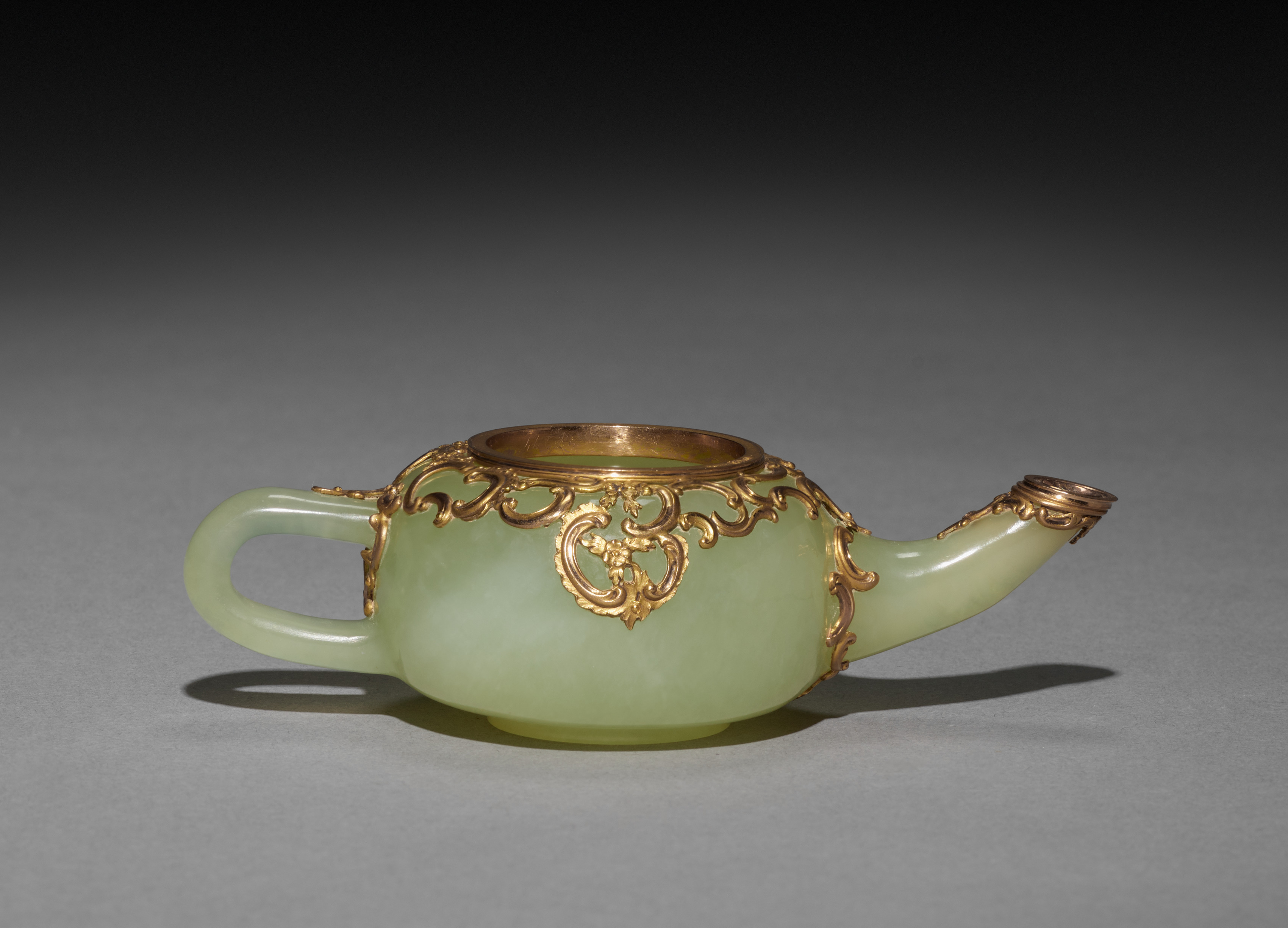
Deconstructing the Avant-Garde: The St. Petersburg Miniature Teapot as a Narrative Artifact
At Zoey Fashion Lab, our core methodology revolves around the deconstruction of form, material, and narrative to extract the latent energy within an object. The subject of this analysis—a miniature teapot from St. Petersburg, Russia, crafted from gold and bowenite—presents a particularly rich case study. This object is not merely a vessel; it is a condensed archive of cultural tension, material paradox, and avant-garde expression. By examining its technical execution, its geographic origin, and its resonance with the archival reference—“一面是光洁银镜上以黄金镶嵌的纷繁棕叶纹,另一面是冰冷石棺板上以浮雕诉说的生命叙事——《Mirror with Split-Lea...”—we can decode its potential as a catalyst for future fashion and design concepts.
Material Paradox: The Dialogue Between Gold and Bowenite
The choice of materials is the first and most potent narrative layer. Gold, a metal of eternal luster, wealth, and permanence, is traditionally associated with opulence and the divine. In the context of a miniature teapot, gold suggests a precious, almost ceremonial object—a relic of a bygone aristocratic tea ritual. However, its pairing with bowenite introduces a disruptive, earthy counterpoint. Bowenite, a serpentine mineral often mistaken for jade, carries connotations of the geological, the ancient, and the organic. Its cool, smooth, and often opaque green or gray-green surface evokes stone, earth, and the passage of deep time.
This juxtaposition is not merely aesthetic; it is a philosophical collision. The gold represents the human desire for immortality, surface perfection, and decorative excess (the "光洁银镜" or polished silver mirror). The bowenite represents the raw, unyielding, and silent weight of the earth (the "冰冷石棺板" or cold stone coffin slab). In the miniature teapot, these two elements are fused into a single, functional form. The gold likely serves as the lid, spout, or handle—the active, interactive parts of the teapot—while the bowenite forms the body, the passive vessel that holds the potential for liquid and life. This material dialogue creates a tension between the ephemeral and the eternal, the decorative and the primordial.
Geographic and Cultural Context: The St. Petersburg Avant-Garde
St. Petersburg is not merely a location; it is a conceptual framework. As the former imperial capital of Russia, it is a city built on a swamp, a monument to human will against nature. Its architecture is a blend of Baroque opulence, Neoclassical rigor, and the stark, revolutionary forms of the Russian Avant-Garde (Malevich, Tatlin, Rodchenko). The miniature teapot from this city inherits this complex legacy. It is not a folk artifact from a rural village; it is a product of an urban, intellectual, and often subversive design tradition.
The Avant-Garde in St. Petersburg was characterized by a rejection of mere decoration in favor of functional abstraction and material honesty. A miniature teapot made of gold and bowenite, however, seems to contradict this. Yet, it embodies the Avant-Garde spirit through its scale and intention. It is miniature—not for practical use, but as a conceptual object. It is a reduction of a familiar form to its essential, almost absurd, core. The gold and bowenite are not chosen for their beauty alone; they are chosen for their symbolic weight. The teapot becomes a compressed narrative of St. Petersburg itself: the gold of the imperial palaces, the stone of the Neva River embankments, and the cold, hard logic of the Constructivist grid.
Archive Resonance: The Mirror and the Coffin
The reference from the Archive Resonance—“一面是光洁银镜上以黄金镶嵌的纷繁棕叶纹,另一面是冰冷石棺板上以浮雕诉说的生命叙事”—is the key to unlocking the teapot’s deeper meaning. This description evokes a dual-faced object: one side a polished silver mirror with intricate gold palm-leaf motifs (a symbol of luxury, vanity, and the fleeting nature of beauty), the other a cold stone coffin slab with a relief narrative of life (a symbol of death, memory, and the permanence of history).
The miniature teapot embodies this duality. Its gold surface functions as the "mirror"—reflecting light, wealth, and the viewer’s own desire for the beautiful. The intricate palm-leaf motifs (棕叶纹) suggest a colonial or exoticist fantasy, a layer of decorative history that is both alluring and problematic. Conversely, the bowenite body acts as the "stone coffin"—cold, heavy, and silent. Its surface, if carved or polished, could bear a "relief" narrative: perhaps the story of the tea trade, the labor of mining, or the geological history of the stone itself. The teapot, therefore, is not a single object but a threshold between two states of being: the reflective, decorative surface of imperial culture and the deep, unyielding substrate of the earth and history.
Avant-Garde Fashion Implications: From Object to Wearable Concept
For Zoey Fashion Lab, this analysis is not an end in itself but a generative tool. The miniature teapot offers several direct pathways into avant-garde fashion design:
- Material Collision: The gold-bowenite pairing suggests a new material language for garments. Imagine a fabric that combines metallic thread (gold) with a stone-like, matte resin or mineral-infused textile (bowenite). A jacket might have a polished gold lapel (the "mirror") and a heavy, textured stone-fiber body (the "coffin").
- Structural Duality: The teapot’s dual nature—one side reflective, one side narrative—can be translated into reversible or modular garments. One side of a coat could be a smooth, reflective surface (metallic foil or patent leather), while the reverse side could be a sculpted, relief-textured surface (like a 3D-printed bas-relief of a tea leaf or a geological stratum).
- Scale and Intimacy: The miniature scale of the teapot challenges the viewer’s perception of value and function. In fashion, this translates to micro-details, hidden pockets, or detachable miniaturized accessories that carry the same narrative weight. A brooch could be a tiny gold-and-bowenite teapot, a wearable artifact that invites close inspection.
- Narrative Silhouette: The "mirror vs. coffin" duality can inform silhouette. A garment could have a rigid, architectural front (the stone coffin) and a flowing, reflective back (the gold mirror). The asymmetry creates a visual and conceptual tension, embodying the conflict between life and death, surface and depth.
Conclusion: The Teapot as a Portal
The St. Petersburg miniature teapot in gold and bowenite is far more than a decorative curiosity. It is a compressed, avant-garde artifact that speaks to the fundamental tensions of material culture: the desire for beauty versus the acceptance of mortality, the human urge to decorate versus the earth’s silent permanence. By deconstructing its materials, its origin, and its resonance with the Archive, we uncover a blueprint for a new fashion language—one that embraces paradox, honors material honesty, and refuses to choose between the mirror’s reflection and the coffin’s story. At Zoey Fashion Lab, we do not simply analyze; we transmute. This teapot is now a source code for garments that are as much about philosophical weight as they are about aesthetic form.