Deconstructing the Dragon and Tiger: An Avant-Garde Analysis for Zoey Fashion Lab
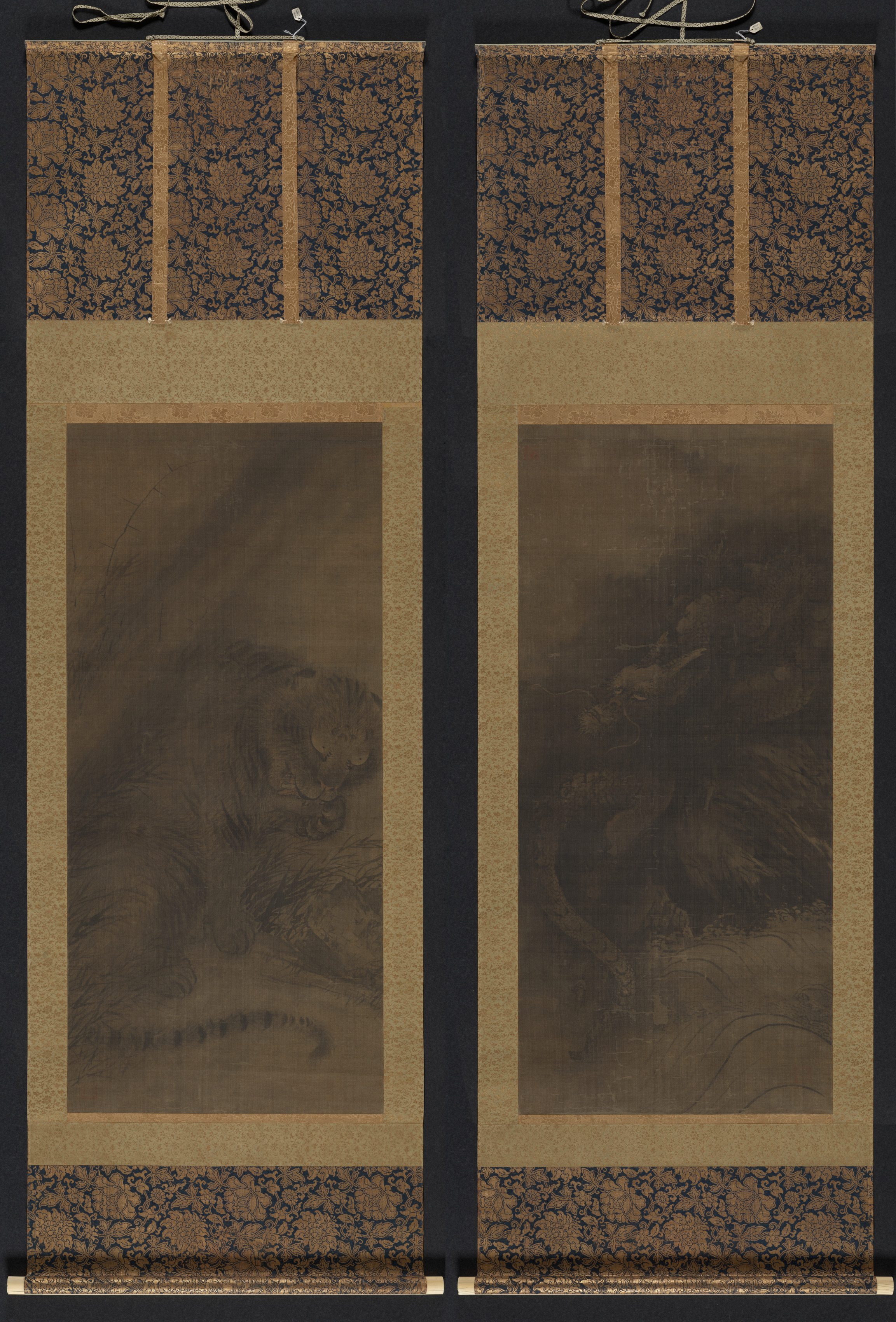
At Zoey Fashion Lab, our mission is not merely to observe historical artifacts but to deconstruct them—to rip apart their technical, symbolic, and material DNA and reassemble them into a new, avant-garde lexicon for contemporary fashion. The subject of this analysis is a pair of hanging scrolls from the Southern Song dynasty (1127-1279), depicting the Dragon and the Tiger in ink on silk. These are not mere paintings; they are a genetic blueprint of power, balance, and ephemeral energy. By treating these scrolls as a "New DNA Strand," we will extract their core aesthetic and philosophical codes, translating them into a radical, wearable language for the modern body.
I. Technical Deconstruction: The Ink, The Silk, The Void
The technical foundation of these scrolls—ink on silk—is our first point of departure. In the Southern Song tradition, ink is not a solid color but a spectrum of vibrational intensity. The artist manipulated the ink’s water-to-pigment ratio to create mo (ink wash) that ranges from deep, almost velvet black to ethereal, translucent gray. For Zoey Fashion Lab, this is not a painting technique; it is a fabric manipulation principle. We envision garments where the "ink" is not applied but grown into the fabric. Imagine a silk dress where the density of a digital print or a reactive dye mirrors the brushstroke’s gradient—from a pitch-black, matte neckline that absorbs all light to a sheer, almost invisible hem that dissolves into the air. This is the Deconstructed Ink Wash technique: a garment that visually fades from solid to void, mimicking the scroll’s interplay of presence and absence.
The silk itself is a critical element. Southern Song silk was prized for its luminosity and tensile strength. It was a surface that both absorbed and reflected light, creating a subtle sheen. In our avant-garde reinterpretation, we will not use pristine silk. Instead, we will distress, burn, and layer the silk to mirror the scroll’s age and the cracks in the ink. A jacket, for instance, might be constructed from multiple layers of silk organza, each laser-cut with the negative space of a tiger’s stripe or a dragon’s scale. These layers will be partially fused, creating a three-dimensional topography that shifts with movement. The "void" of the scroll—the unpainted silk—becomes a transparent window in the garment, revealing the wearer’s skin or an underlayer of raw, unbleached linen. This is a direct translation of the Chinese aesthetic principle of liu bai (leaving white), which we rebrand as Negative Space Architecture.
II. Symbolic DNA: The Dragon and Tiger as Binary Forces
The Dragon and Tiger are not mere animals; they are archetypal opposites in Chinese cosmology. The Dragon (Yang) represents heaven, power, and dynamic, spiraling energy. The Tiger (Yin) represents earth, courage, and grounded, striated force. Their pairing in a Southern Song scroll is a meditation on balance through conflict. For Zoey Fashion Lab, this is a binary design philosophy. We will not depict these creatures literally. Instead, we will abstract their core visual and energetic DNA into two distinct yet complementary garment lines.
The Dragon Strand: Its energy is spiral, fluid, and ascending. In the scroll, the dragon’s body is a continuous, undulating line that seems to breathe. We translate this into garments defined by asymmetrical draping, spiral seams, and tensile structures. A dress might have a single, continuous seam that wraps around the body like a dragon’s tail, starting at the left shoulder and spiraling down to the right ankle. The fabric would be a high-gloss, liquid-like material (perhaps a coated silk or a bio-engineered cellulose) that catches light in a snake-like shimmer. The "scales" of the dragon are not printed but constructed—small, overlapping panels of stiffened organza that are hand-stitched to create a protective, armor-like surface. This is the Dragon’s Ribbon silhouette: a garment that feels both powerful and in constant motion.
The Tiger Strand: Its energy is striated, grounded, and explosive. The tiger’s stripes are not random; they are a rhythmic pattern of tension and release. We deconstruct this into garments defined by sharp, angular cuts, horizontal banding, and raw edges. A coat might be constructed from panels of heavy, felted wool, each cut with a jagged, stripe-like hem that is left unfinished. The stripes themselves are not painted but woven—alternating bands of matte black and glossy charcoal yarns create a subtle, tactile rhythm. The silhouette is boxy and powerful, with exaggerated shoulders and a cinched waist, evoking the tiger’s coiled power. We call this the Tiger’s Grip silhouette: a garment that feels anchored and ready to pounce.
III. The New DNA Strand: Merging the Binary into a Third Form
The true avant-garde innovation lies not in separating the Dragon and Tiger but in fusing their DNA. The Southern Song scrolls, though separate, are meant to be viewed together, creating a third energy—a dynamic equilibrium. For Zoey Fashion Lab, this is the Hybrid Strand. We will create a single garment that embodies both forces, not through literal combination but through transformative structure.
Imagine a modular bodysuit constructed from a single piece of smart textile that changes opacity and texture based on body heat or movement. When the wearer is still, the fabric is matte black and heavily textured with tiger-like stripes. As the wearer moves, the fabric’s surface activates, revealing a hidden, dragon-like spiral pattern in a high-gloss silver. This is achieved through a thermochromic ink or a shape-memory polymer that responds to kinetic energy. The garment is not a static object; it is a living, breathing second skin that oscillates between the Tiger’s grounded presence and the Dragon’s ethereal flow.
Furthermore, we will deconstruct the scroll’s hanging format. The scroll is a vertical, linear object meant to be unrolled and viewed in a specific sequence. We translate this into a garment’s verticality and narrative. A long, floor-length coat might have a "scroll-like" opening—a series of hidden snaps or magnetic closures that allow the wearer to "unroll" the garment from the shoulder to the hem, revealing a hidden layer of ink-wash print or a different texture. This is the Narrative Garment, where the act of dressing becomes a performance of revealing and concealing.
IV. Conclusion: The Avant-Garde as a Return to Essence
For Zoey Fashion Lab, the Dragon and Tiger scrolls are not historical artifacts to be preserved under glass. They are raw data—a DNA sequence of aesthetic principles that we can splice, mutate, and re-express. By deconstructing their technical use of ink and silk, their symbolic binary of Yin and Yang, and their structural format as hanging scrolls, we have generated a new fashion language: one that values gradient over solidity, tension over comfort, and transformation over stasis. The garments we propose are not costumes; they are wearable philosophies. They are the Tiger’s explosive power and the Dragon’s fluid grace, fused into a single, avant-garde strand of fabric that challenges the very definition of what clothing can be. This is the New DNA Strand—a thread that connects the Southern Song dynasty to the future of fashion, one deconstructed brushstroke at a time.