Deconstructing the Avant-Garde: The Octagonal Pendant with Corinthian Column Spacers
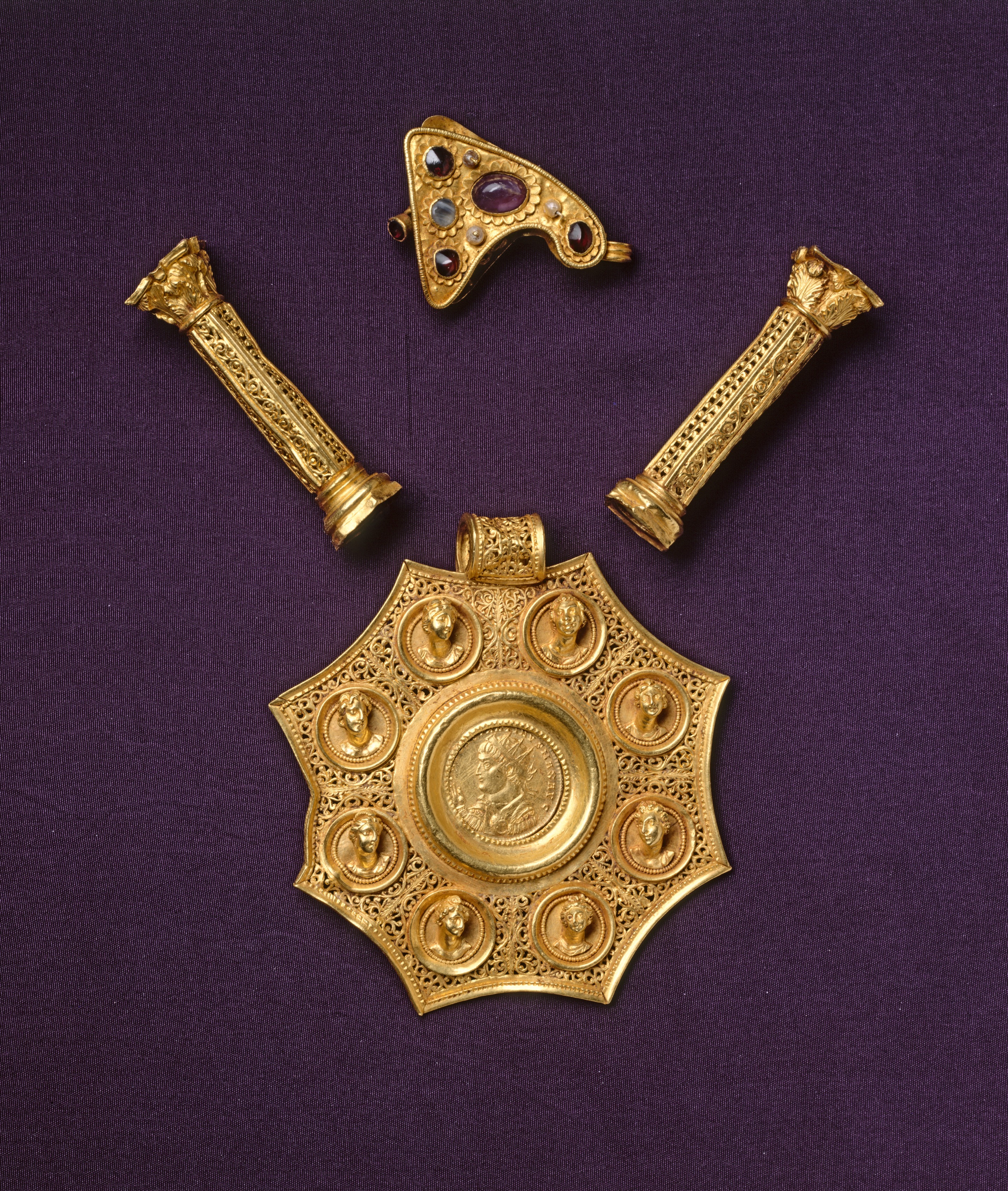
At Zoey Fashion Lab, we approach historical artifacts not as relics to be preserved, but as raw materials for radical reinterpretation. The Octagonal Pendant with Corinthian Column Spacers and Clasp Set, a gold pendant from the Byzantine period, likely originating from Sirium or Nicomedia in the Eastern Mediterranean, presents a profound paradox. Its technical execution—pure gold—and its architectural vocabulary—Corinthian columns—speak of imperial power and sacred order. Yet, the pendant’s form, an octagon, and its function as a personal adornment, suggest a more intimate, almost subversive narrative. This analysis will dissect the pendant’s inherent tensions, revealing how its very structure embodies the collision between rigid tradition and the nascent avant-garde impulse that defines Zoey Fashion Lab’s creative ethos.
I. The Octagon as a Fractured Mandala: Geometry of Dissent
The octagonal shape is the first point of departure. In Byzantine art, the octagon often symbolizes resurrection and the celestial Jerusalem, a perfect, enclosed geometry. However, in our avant-garde reading, the octagon is not a closed circle but a series of eight discrete, angular planes. Each side is a facet, a potential breaking point. This is not a mandala of unity but a prism of multiplicity. The pendant’s eight sides do not simply hold the Corinthian columns; they fragment them. The column, a symbol of vertical, linear authority, is here multiplied and segmented, forced to conform to the pendant’s angular logic. The clasp set, a functional necessity, becomes a deliberate interruption of the column’s continuous line. We see this as a deconstruction of architectural syntax: the column is no longer a load-bearing element but a decorative sign, its structural logic subverted by the very object it adorns. This is the first avant-garde gesture—the use of classical form as a found object, stripped of its original meaning and repurposed within a new, dissonant framework.
II. The Corinthian Column Spacers: From Sacred Order to Secular Fragment
The Corinthian column, with its acanthus leaf capitals, is the quintessential symbol of Graeco-Roman civilization and, by extension, the Byzantine Empire’s claim to that legacy. In this pendant, however, these columns are not supporting a temple or a basilica. They are spacers. Their function is not structural but ornamental, a mere division between the pendant’s eight faces. This is a critical shift. The column, once a marker of cosmic and political order, is reduced to a decorative element, a signifier of absence. The pendant’s design suggests that the columns are not holding up anything; they are merely separating empty space. This echoes the avant-garde practice of negative space and decontextualization. The pendant’s gold, a material of immense value and permanence, is used to frame nothing, or rather, to frame the potential for something new. The column spacers become a grid of interruption, a deliberate break in the continuity of the pendant’s surface. This is not a harmonious whole but a series of discrete, almost confrontational, elements. The viewer is forced to see the columns not as part of a unified system but as isolated, almost absurd, objects.
III. The Clasp Set as a Rupture: The Functional as the Transgressive
The clasp set, the mechanism that allows the pendant to be worn, is typically a minor, utilitarian detail. In this piece, however, it becomes a site of transgression. The clasp is not hidden or integrated; it is a prominent, structural element. It is the point where the pendant’s eight sides meet, where the columns are interrupted, where the geometry is most unstable. This is a deliberate inversion of hierarchy. The functional is elevated to the formal. The clasp is not a solution but a problem, a visible scar on the object’s surface. This aligns with the avant-garde fascination with exposed structure and the unfinished. The clasp, in its raw, mechanical presence, breaks the illusion of the pendant as a seamless, sacred object. It reminds the wearer and the viewer that this is a constructed, contingent artifact. It is a deconstructive gesture, a refusal to allow the pendant to be a simple, closed form. The clasp becomes a metaphor for the act of wearing itself—the body as a disruptive force that completes and simultaneously destabilizes the object.
IV. The Gold as a Paradox: Immateriality and Weight
The material—pure gold—is perhaps the most complex element. Gold, in Byzantine culture, signified the divine, the eternal, the unchangeable. It was a material of transcendence. In our avant-garde reading, gold is not a symbol of the eternal but a material of extreme weight and presence. The pendant’s gold is not a spiritual substance but a dense, heavy, almost oppressive mass. The octagonal form, with its sharp angles, creates a play of light and shadow that emphasizes the material’s physicality. The gold does not float; it anchors. This is a materialist reading that challenges the pendant’s original symbolic function. The pendant is not a window to the divine but a tactile, bodily object. Its weight on the chest is a constant reminder of its materiality. This is the avant-garde’s insistence on the object itself, stripped of its metaphysical pretensions. The gold is not a sign of something else; it is a sign of itself, a dense, shimmering, and ultimately, mute presence. This paradox—the spiritual material rendered as a physical burden—is the core of the pendant’s avant-garde potential.
V. The Mirror with Split-Leaf Reference: A Dialogue of Surfaces
The reference to the Mirror with Split-Leaf is crucial. The mirror, with its polished silver and gold-inlaid acanthus, presents a reflective, illusory surface. The pendant, by contrast, is a solid, non-reflective object. The mirror is about surface and illusion; the pendant is about structure and presence. The split-leaf motif on the mirror is a fracture within the decorative, a moment of asymmetry. The pendant’s octagonal form and column spacers are a fracture within the architectural. Both objects, from the same cultural moment, betray a restlessness with classical order. The mirror’s split leaf is a subtle subversion; the pendant’s column spacers are a more overt one. The pendant, in its geometric rigidity and its functional clasp, is a hardened, three-dimensional version of the mirror’s two-dimensional, illusory play. It is as if the mirror’s surface has been folded into a solid, angular form, its reflective potential turned inward. This is the ultimate avant-garde transformation: the conversion of surface into structure, of illusion into presence.
VI. Conclusion: The Pendant as a Proto-Avant-Garde Artifact
The Octagonal Pendant with Corinthian Column Spacers and Clasp Set is not a mere decorative object. It is a proto-avant-garde artifact, a site of radical formal and conceptual experimentation. Its octagonal geometry fractures the classical column; its prominent clasp exposes the mechanics of adornment; its heavy gold materializes the sacred. The pendant is a deliberate, almost violent, assembly of contradictions. It is at once a symbol of imperial order and a deconstruction of that order. It is a sacred object that insists on its own physicality. For Zoey Fashion Lab, this pendant is not a source of inspiration but a template for action. It teaches us that the avant-garde is not a modern invention but a recurring impulse within history itself. The pendant’s creators, working within the constraints of Byzantine culture, were already pushing against those constraints, using the language of tradition to articulate a new, dissonant vision. Our task is to continue this work, to deconstruct, fragment, and re-assemble the forms of the past into the unsettling, beautiful objects of the future. The pendant is not a relic; it is a provocation, a challenge to see the past not as a closed book but as a living, volatile archive.