Deconstructing the Chimú Legacy: An Avant-Garde Analysis of Pre-Columbian Textile Technology
At Zoey Fashion Lab, our mission is to excavate the forgotten technologies of dress and reanimate them within the framework of contemporary avant-garde design. The subject of this analysis—a collection of Chimú-style textiles from Peru’s North Coast (1200–1460s)—represents a profound convergence of structural engineering, symbolic coding, and material subversion. These are not mere artifacts; they are blueprints for a radical reimagining of fabric. The ensemble, comprising a mantle or hanging, loincloth, turban, padded hat, and a band with tassels, offers a complete system of bodily adornment that challenges modern notions of garment construction, surface texture, and wearability.
Technical Foundation: The Matrix of Plain Weave and Gauze
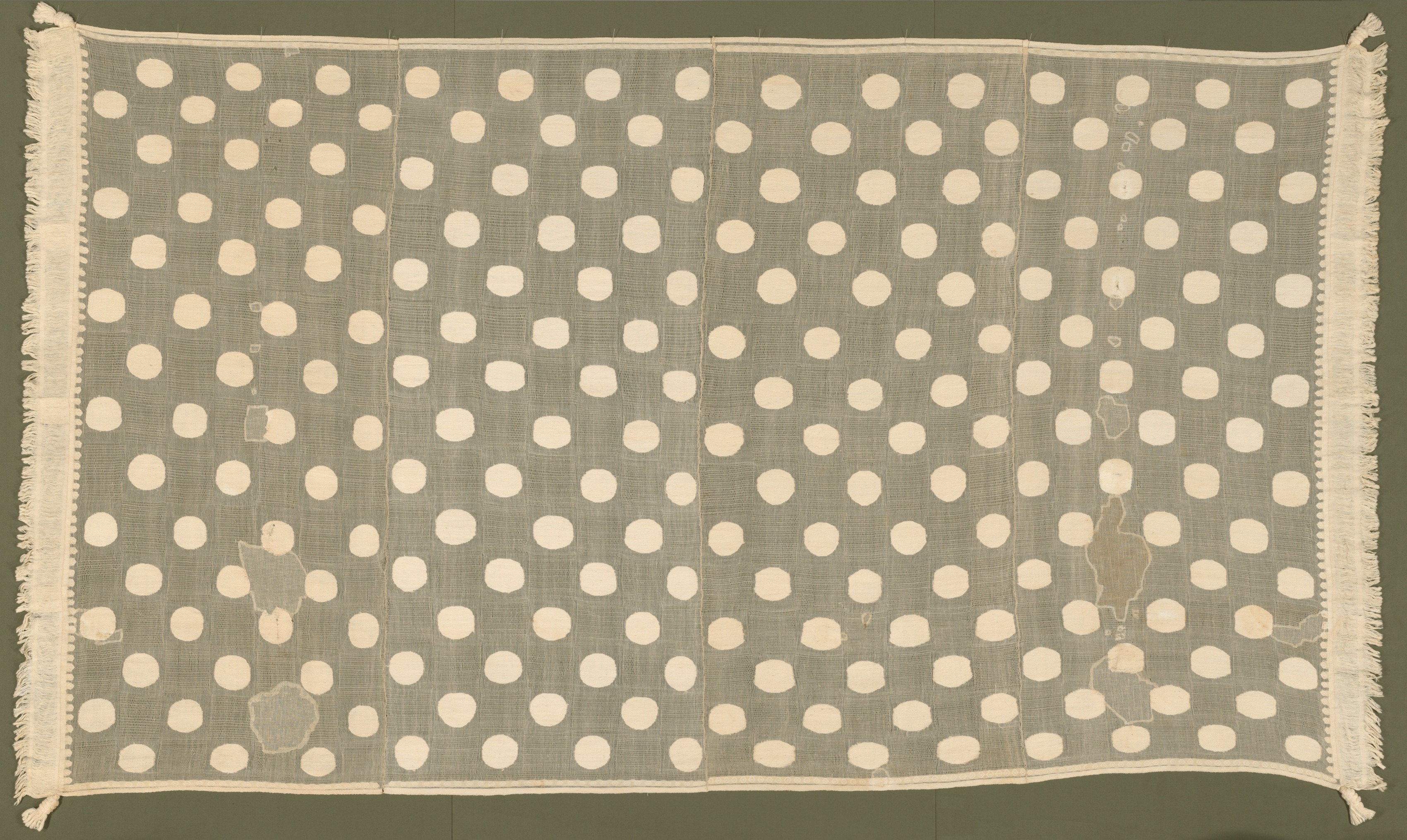
The technical specification—cotton; plain weave, brocaded and complex alternating gauze with 3 or 5 shots of plain weave between gauze shots—is the critical point of departure for our deconstruction. This is not a simple weave structure; it is a rhythmic, engineered interplay of tension and release. The alternating gauze technique, where warp threads are twisted around each other between shots of plain weave, creates a fabric that is simultaneously open and structured. The insertion of three or five plain-weave shots between each gauze shot introduces a deliberate, almost musical, pause into the textile’s surface. This is a technology of controlled instability, where the fabric breathes and shifts, yet remains rigidly defined by its own internal logic.
For the avant-garde designer, this structure is a manifesto against the flatness of modern textiles. The gauze sections create negative space, while the brocaded areas—where supplementary wefts are introduced to form patterns—build dense, raised relief. The result is a fabric that oscillates between transparency and opacity, between a net and a solid. This is not decoration applied to a surface; the surface is the decoration, generated from within the weave itself. The Chimú artisan was a textile architect, and the loom was their drafting table.
Garment by Garment: A System of Bodily Architecture
The five components of this ensemble function as a unified system, each piece addressing a different zone of the body with a distinct structural and symbolic purpose.
The Mantle or Hanging: This is the largest element, a rectangular field of woven information. In the Chimú context, the mantle served as a cloak, a wall hanging, or a ceremonial drape. Its scale and construction—large enough to envelop the body or a space—demand that the viewer confront the weave’s complexity at a distance. The alternating gauze and plain-weave bands create horizontal or vertical rhythms that articulate the surface like a musical score. For Zoey Fashion Lab, the mantle becomes a wearable environment, a piece that redefines the boundary between garment and architecture. Its brocaded motifs, often depicting sea creatures or abstract geometric forms, are not merely decorative but serve as a visual language of power and cosmology. In an avant-garde context, this mantle can be reimagined as a cape that is also a screen, a portable territory that announces the wearer’s presence through texture and void.
The Loincloth: The most intimate of the garments, the loincloth is a minimal intervention that carries maximal weight. Constructed from the same complex weave, it is a band of fabric that wraps the lower torso. Its structural integrity is paramount—it must hold the body while allowing movement. The use of brocading in such a small, high-stress area demonstrates a sophisticated understanding of tension points. The Chimú loincloth is not a simple covering; it is a structural harness that anchors the entire ensemble. In a contemporary deconstruction, this piece can be recontextualized as a foundational element, a belt or a codpiece that emerges from the body rather than being applied to it. The alternating gauze here becomes a feature of breathability and flexibility, a precursor to modern performance fabrics.
The Turban and Padded Hat: These two headpieces represent a dual approach to cranial adornment. The turban, a wrapped length of the woven textile, creates a soft, voluminous form that can be manipulated into various shapes. The padded hat, in contrast, is a rigid, sculptural object, likely constructed from layers of fabric and stuffing. The Chimú used these to denote status, rank, and ethnic identity. The technical weave of the turban allows it to drape and fold without losing its patterned surface, while the padded hat’s brocading would have been visible from a great distance, a crown of woven authority. For the avant-garde, these become experiments in form versus function. The turban is a fluid, mutable sculpture; the padded hat is a fixed, architectural statement. Together, they question the relationship between the head, the garment, and the space around them.
The Band with Tassels: This final component is a line of termination, a border that both finishes and activates the garment system. The tassels, likely made from twisted or frayed warp ends, introduce a kinetic element—they move, sway, and catch light. The band itself, woven with the same alternating gauze and brocading, serves as a connector, perhaps tying the loincloth or securing the mantle. In the Chimú aesthetic, the tassel is not an afterthought; it is a formal punctuation mark. In our avant-garde reinterpretation, the band with tassels becomes a key piece of hardware—a belt, a strap, or a hanging ornament that draws the eye to the edges of the garment, where the fabric meets the air.
Archive Resonance: The Chimú as Proto-Avant-Garde
Referencing the concept of Archive Resonance—the idea that objects from the past speak to the present through their technical and aesthetic choices—the Chimú textile system resonates deeply with the avant-garde ethos. The Chimú were not bound by the Western dichotomy of art versus craft. Their textiles were simultaneously functional, symbolic, and experimental. The use of complex alternating gauze is a form of structural subversion: it creates a fabric that is both fragile and strong, open and closed. This is the same tension that drives contemporary avant-garde fashion—the desire to make the body visible through the garment, to reveal and conceal in a single gesture.
The Chimú palette, dominated by the natural browns, creams, and beiges of unbleached and dyed cotton, also aligns with a minimalist, material-focused aesthetic. There is no excess; every thread serves a purpose. This is a lesson in radical economy—the idea that complexity arises from restraint, not accumulation. The brocaded patterns, often executed in a limited range of colors, are not narrative illustrations but abstract codes. They are the Chimú equivalent of a pixelated grid or a binary system, communicating through repetition and variation.
Conclusion: Weaving the Future from the Past
For Zoey Fashion Lab, the Chimú mantle, loincloth, turban, padded hat, and band with tassels are not historical curiosities. They are a technical and conceptual toolkit for the future of garment design. The alternating gauze technique offers a method for creating fabrics that are both lightweight and structurally complex, ideal for contemporary performance wear or sculptural fashion. The system of five pieces suggests a modular approach to dressing, where garments are not fixed but can be assembled, layered, and reconfigured. The brocading provides a surface that is tactile and visual, a terrain for exploration.
In deconstructing these textiles, we are not mimicking the past; we are activating its latent potential. The Chimú artisan, working on a backstrap loom six hundred years ago, understood that fabric is not a passive material. It is an active agent in the construction of identity, space, and power. By studying their techniques—the rhythmic alternation of gauze and plain weave, the strategic placement of brocading, the articulation of the body through multiple, interconnected pieces—we can begin to weave a new vocabulary for the avant-garde. The Chimú mantle is not a relic; it is a manifesto, waiting to be read by those who understand the language of the loom.