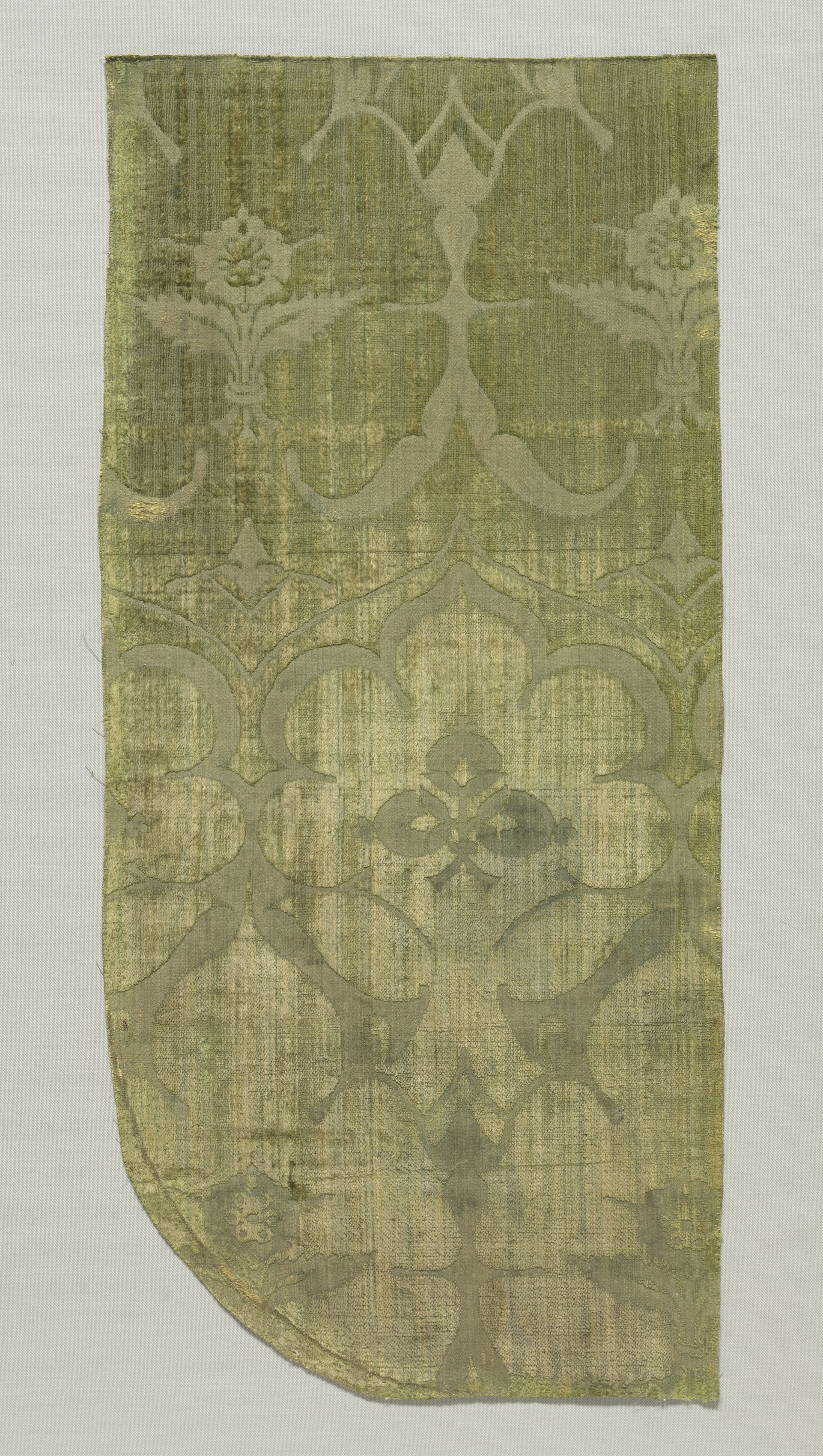
Deconstructing the Sacred: An Avant-Garde Analysis of a Fragmentary Italian Chasuble for Zoey Fashion Lab
At Zoey Fashion Lab, our mission is to unravel the narratives embedded within textile artifacts, transforming historical remnants into catalysts for avant-garde design. The subject of this analysis—a fragment, likely from a 16th or 17th-century Italian chasuble, composed of silk with cut and voided velvet—presents a paradox of sacred origin and radical potential. This piece, which we have designated as Reference: New DNA Strand, is not merely a relic of ecclesiastical opulence; it is a blueprint for deconstruction, a codex of material intelligence that challenges contemporary fashion’s relationship with history, texture, and meaning.
Technical Analysis: The Paradox of Cut and Voided Velvet
The fragment’s technical construction is its primary narrative device. Cut velvet, achieved through the meticulous shearing of loops in a silk pile, creates a dense, plush surface that absorbs and reflects light differently than the flat, voided ground. The voided areas—where the pile is absent—expose the underlying silk weave, often a satin or taffeta, producing a stark contrast between opulent relief and stark emptiness. This technique, perfected in Renaissance Italian workshops like those of Venice or Florence, was a testament to technical mastery. Yet, for Zoey Fashion Lab, this duality is a design manifesto.
The cut velvet represents accumulation—a tactile memory of ritual, wealth, and the labor of anonymous artisans. The voided areas, conversely, signify absence—the spaces where gold thread once shimmered, where the chasuble’s original form has been erased by time. This interplay of presence and void is inherently avant-garde. It mirrors the deconstructivist ethos of tearing down established forms to reveal the skeletal structure beneath. In our hands, this fragment becomes a study in tension: the soft, raised pile against the flat, almost fragile ground; the sacred geometry of the original vestment against the chaotic, organic edges of its fragmentation.
Historical Context: From Liturgical Vestment to Deconstructivist Icon
The chasuble, as a liturgical garment, was designed to be a vessel for the divine. Its form—a poncho-like vestment worn over the alb—was both functional and symbolic, its ample fabric intended to envelop the priest in a shroud of sanctity. The cut and voided velvet patterns, often featuring pomegranates, thistles, or stylized floral motifs, were not merely decorative; they were iconographic, referencing fertility, immortality, and the Eucharist. The fragment we possess, likely from the back or front panel, retains traces of these motifs, now eroded by centuries of use, storage, and decay.
For the avant-garde designer, this historical weight is not a burden but a resource. The chasuble’s original purpose—to mediate between the earthly and the sacred—is subverted when its fragment is repurposed. The garment’s inherent sacred geometry—its symmetry, its hierarchical arrangement of motifs—becomes a foil for disruption. We can imagine this fragment as a “New DNA Strand” because it carries the genetic code of a bygone aesthetic while being radically open to mutation. The voided areas, where the velvet pile is missing, become sites of intervention—places to insert new materials, to stitch, to tear, or to leave deliberately empty as a comment on loss and renewal.
Materiality as Avant-Garde Language
The silk itself is a material of contradictions. It is strong yet delicate, luxurious yet vulnerable to light and moisture. The cut velvet’s pile, once vibrant with cochineal red or madder, has likely faded to a muted, dusty hue—a patina of time that no modern dye can replicate. This aging is not a defect but a feature. In the avant-garde lexicon, decay is a narrative tool. The fragment’s frayed edges, its missing threads, its uneven surface—each imperfection tells a story of use, of ritual, of the passage from sacred object to archaeological specimen.
Zoey Fashion Lab’s approach to this material would be to amplify its contradictions. The cut velvet could be juxtaposed with industrial materials like neoprene or laser-cut acrylic, creating a dialogue between handcraft and machine precision. The voided areas could be re-imagined as negative space, perhaps filled with transparent organza or left as deliberate holes, referencing the deconstructivist techniques of Rei Kawakubo or Martin Margiela. The fragment’s original function as a covering for the body is inverted: it becomes a surface for exposure, for revealing the structural bones of a new garment.
Design Implications: The Fragment as Generative Tool
As a “New DNA Strand,” this fragment is not a pattern to be copied but a genetic sequence to be recombined. Its cut and voided velvet structure suggests a modular approach to design: one could isolate the pile areas as tactile islands on a smooth ground, or use the voided regions as windows onto underlying layers. The fragment’s asymmetry—the result of its partial survival—encourages a non-linear design process. Instead of seeking balance, we embrace imbalance. Instead of repair, we celebrate rupture.
Consider a garment inspired by this fragment: a jacket where the left sleeve is rendered in dense, cut velvet, while the right sleeve is voided, exposing a sheer mesh. The back panel might retain the fragment’s original motif, now partially obscured by digital prints or hand-stitched interventions. The collar could be left raw, echoing the fragment’s frayed edges. This is not nostalgia; it is archaeological futurism—a practice that mines the past for formal and conceptual tools to build something unprecedented.
Conclusion: The Fragment as a Manifesto
This fragment from an Italian chasuble is more than a textile sample; it is a manifesto for the avant-garde. Its cut and voided velvet embodies the tension between construction and destruction, between the sacred and the profane, between historical reverence and creative violence. For Zoey Fashion Lab, it serves as a reminder that the most radical designs often emerge from the most unlikely sources—not from a blank slate, but from the careful, deliberate deconstruction of what came before. By treating this fragment as a “New DNA Strand,” we honor its origins while refusing to be bound by them. We do not restore; we re-imagine. We do not preserve; we provoke.
The fragment’s journey from liturgical vestment to avant-garde catalyst is a testament to the transformative power of material intelligence. In our hands, its silk and velvet become a language of resistance against the ephemeral, a declaration that the past is not a museum but a laboratory. And in that laboratory, the sacred becomes a site of rebellion, and the fragment becomes a whole new beginning.