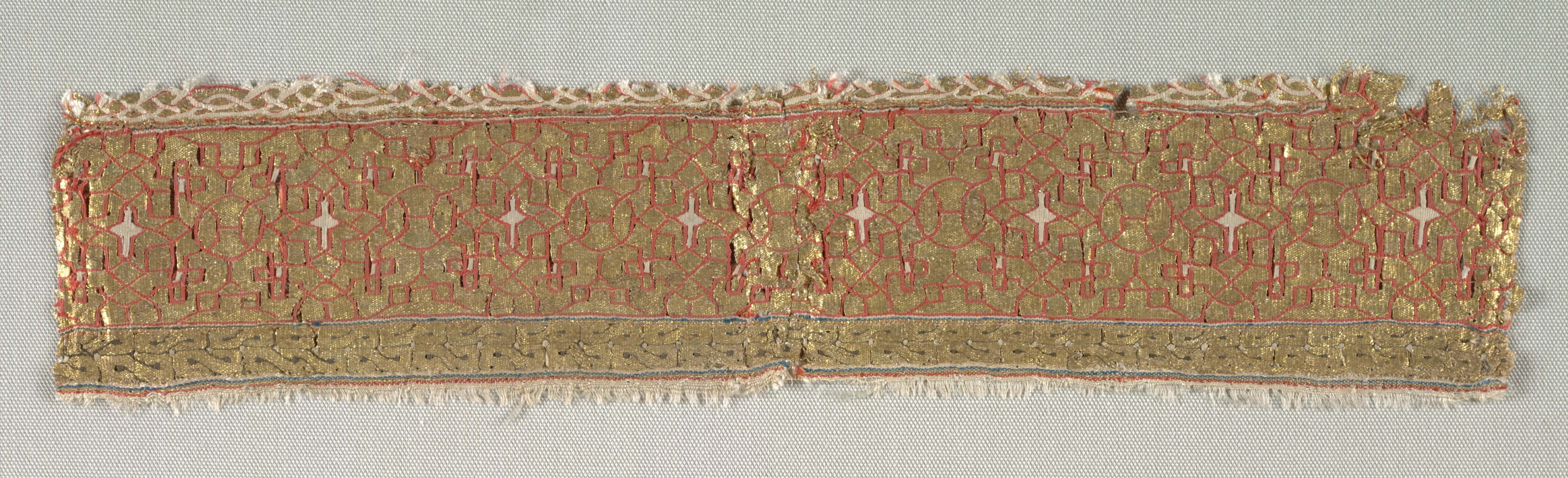
Deconstructing the Guilloche Band: A Tapestry of Avant-Garde DNA for Zoey Fashion Lab
As Chief Fabric Deconstructionist for Zoey Fashion Lab, my mandate is to dissect historical textiles not merely as artifacts, but as living blueprints for avant-garde innovation. The subject of this analysis—a guilloche band from a dalmatic of San Valero, originating in 11th-13th century Spain, probably Almeria—is a profound case study. Woven in tapestry technique using silk and gold thread, this fragment is more than a decorative trim. It is a New DNA Strand for our lab, a genetic code of luxury, structure, and subversion. This report deconstructs its technical, symbolic, and aesthetic properties to propose a radical recontextualization within an avant-garde framework.
Part I: The Original DNA – Technical and Material Analysis
The guilloche band is a product of extraordinary technical mastery. The tapestry weave itself is the foundational gene. Unlike brocade or embroidery, where supplementary wefts float on a ground weave, tapestry weave integrates the pattern directly into the fabric’s structure. The weft threads—here, lustrous silk and hammered gold—are packed tightly to create a weft-faced surface that is both rigid and supple. This creates a unique physical paradox: the band is structurally resilient, almost like a woven metal ribbon, yet it retains a soft, pliable hand due to the silk core.
The guilloche pattern—a continuous, interlocking series of circles or ovals—is the visual gene. In its original context, this motif symbolized infinity, eternity, and divine order, perfectly suited for a dalmatic, a liturgical vestment worn by deacons. The gold thread, likely a gilded silver strip wrapped around a silk core, adds a third dimension: light. The interplay of matte silk and reflective metal creates a shimmering, moiré effect that changes with movement. This is not a static pattern; it is a kinetic, optical illusion.
For Zoey Fashion Lab, the key takeaway is the structural integrity of the tapestry weave. This is not a fragile, decorative appliqué. It is a self-supporting textile architecture. The gold thread is not merely an embellishment; it is a load-bearing element that defines the band’s rigidity and drape. This challenges our contemporary understanding of “luxury” as softness or fluidity. Here, luxury is hard, precise, and engineered.
Part II: Deconstructing the Guilloche – An Avant-Garde Re-Reading
To recontextualize this band for an avant-garde collection, we must sever it from its religious and historical moorings. The guilloche pattern, once a symbol of celestial order, becomes a digital error, a glitch in the fabric of time. The interlocking circles can be read as a pre-industrial QR code, a fractal pattern that repeats into infinity. The gold thread, once a sign of divine wealth, becomes a metallic data stream, a conduit for a new kind of information—the tension between the handcrafted and the algorithmic.
Our deconstruction strategy involves three key operations:
- Fragmentation and Re-assembly: We will not preserve the band as a complete, intact strip. Instead, we will laser-cut the guilloche pattern to isolate individual “cells” of the interlocking circles. These cells will be reassembled into a non-linear, chaotic grid—a deconstructed lattice that mimics the original pattern’s logic but disrupts its symmetry. This creates a visual tension between order and entropy, a hallmark of avant-garde design.
- Material Hybridization: The original silk and gold will be fused with contemporary technical fibers. We propose weaving a new version of the band using a warp of recycled carbon fiber (for structural memory) and a weft of liquid-crystal polymer (LCP) threads. The LCP threads, when exposed to body heat or electrical current, will shift in opacity and color, making the guilloche pattern morph in real-time. The gold thread will be replaced with a nano-thin layer of vapor-deposited gold on a flexible polyimide substrate, creating a conductive, luminous surface that can be programmed to emit light pulses.
- Scale and Proportion: The original band is narrow, perhaps 2-3 centimeters. For an avant-garde silhouette, we will scale the pattern exponentially. The guilloche motif will be blown up to a macro scale—each circle measuring 30 centimeters in diameter—and woven into a full-length, floor-sweeping coat. This gigantism transforms the motif from a decorative trim into the entire garment’s architecture. The coat’s structure will be self-supporting, like a woven exoskeleton, with the gold thread providing structural rigidity.
Part III: The New DNA Strand – A Proposed Avant-Garde Garment
Based on this deconstruction, I propose a prototype for Zoey Fashion Lab: The “San Valero Glitch” Coat. This is not a garment in the traditional sense; it is a wearable artifact that interrogates the boundary between the sacred and the digital, the historical and the futuristic.
Silhouette and Form: The coat will be a long, asymmetrical duster, cut on the bias to create a fluid, almost liquid drape. The body will be constructed from the macro-scale guilloche tapestry, using the carbon fiber and LCP hybrid weft. The sleeves will be detached, connected only by a series of gold-plated magnetic clasps that echo the interlocking circles of the pattern. This creates a fragmented, modular silhouette that can be worn in multiple configurations—full, deconstructed, or as a cape.
Surface and Light: The coat’s surface will be a dynamic canvas. The LCP threads will be programmed to react to the wearer’s body heat, causing the guilloche pattern to pulse and shift in color from deep burgundy (referencing the dalmatic’s original silk) to a cool, metallic silver. The vapor-deposited gold elements will be connected to a low-voltage battery, allowing the wearer to activate a slow, rhythmic glow along the pattern’s contours. This transforms the coat into a living, breathing organism, a textile that communicates through light and color.
Construction and Deconstruction: The coat will be constructed using a hybrid of hand-weaving and digital jacquard technology. The original tapestry weave’s weft-faced structure will be replicated, but the weft threads will be individually addressable by a computer-controlled loom. This allows for programmable pattern variations—the guilloche can be rendered perfectly symmetrical in one section, then glitched into a distorted, pixelated version in another. The hem and cuffs will be left raw, with the carbon fiber threads fraying outward like digital tendrils, suggesting a garment caught between creation and decay.
Part IV: Conclusion – The Avant-Garde as Historical Re-Engineering
The guilloche band from the dalmatic of San Valero is not a relic to be preserved in a museum case. For Zoey Fashion Lab, it is a New DNA Strand—a set of instructions for creating a garment that exists in a state of perpetual tension. The original tapestry weave taught us that luxury is structural, not soft. The guilloche pattern taught us that infinity can be rendered as a glitch. The gold thread taught us that light is a material to be woven, not just reflected.
Our proposed “San Valero Glitch” Coat embodies this philosophy. It is an avant-garde garment that honors historical craftsmanship while violently recontextualizing it for a digital, post-human era. It is a wearable argument that the past is not a static source of inspiration, but a living code that can be rewritten. By deconstructing this band, we are not destroying history; we are re-engineering its DNA to create a new species of textile—one that is both sacred and subversive, ancient and algorithmic, luminous and fragile. This is the future of fashion, woven from the threads of the past.