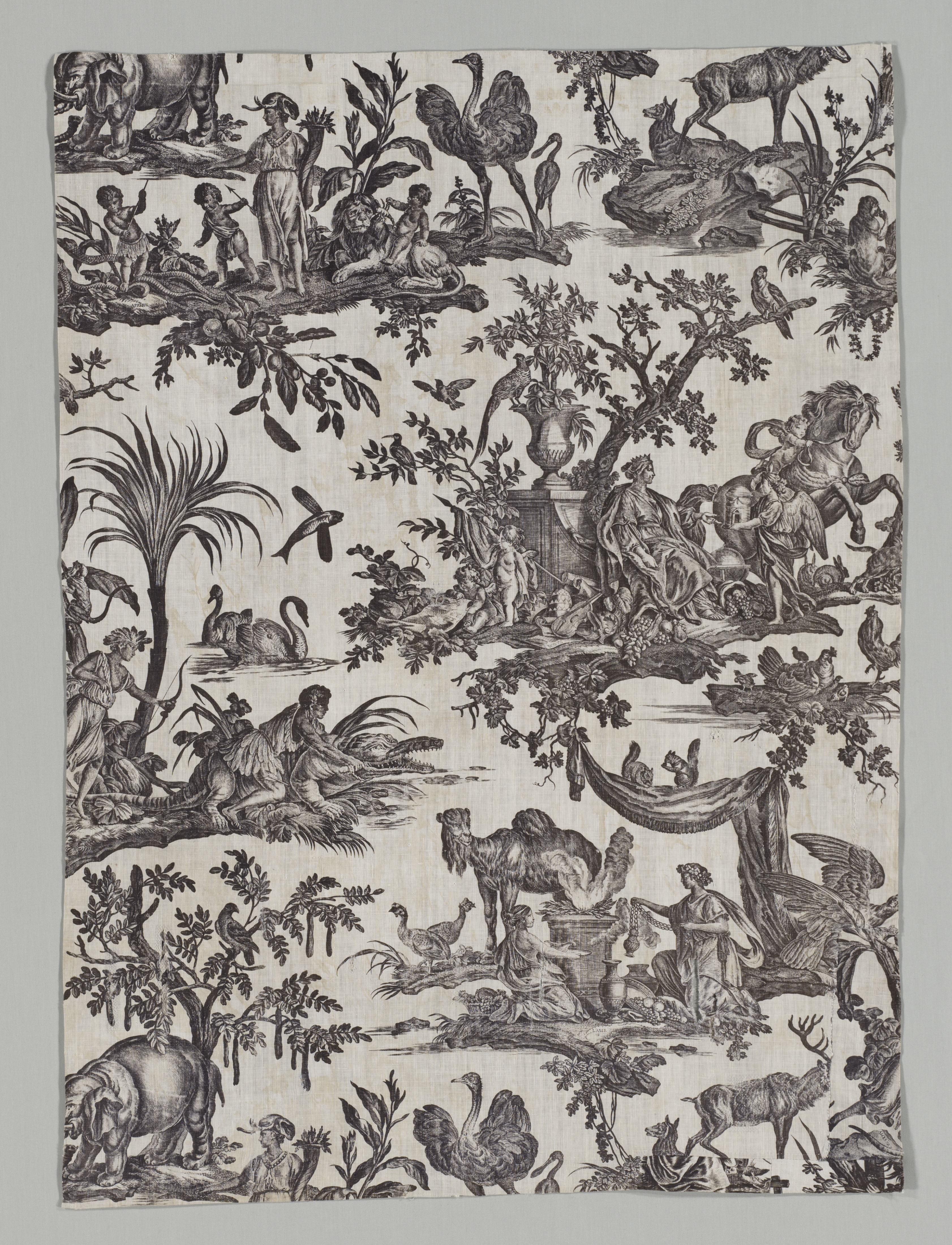
Deconstructing the Archive: The Four Continents as an Avant-Grade Textile Blueprint
At Zoey Fashion Lab, our mission is to excavate historical artifacts not as relics, but as radical blueprints for the future. The subject of this analysis—a French, 18th-century copperplate-printed cotton textile depicting "The Four Continents"—is a prime candidate for such deconstruction. This piece, originating from a period of intense colonial expansion and Enlightenment classification, is far more than a decorative fabric. It is a cartographic tapestry of power, a botanical lie, and a technical marvel. As the Chief Fabric Deconstructionist, I will dissect this object not to preserve its original meaning, but to identify the fault lines where we can insert our own avant-garde narratives. We will analyze its technical genesis, its ideological burden, and its potential for aesthetic rupture.
Technical Genesis: The Copperplate's Democratic Revolution
The technical choice of copperplate printing on cotton is the first critical point of entry. In the 18th century, this was a revolutionary technology. Unlike woodblock printing, the engraved copperplate allowed for an unprecedented fluidity of line, a tonal range that mimicked wash drawings, and a level of detail previously reserved for fine art on paper. This was not mere pattern-making; it was the mechanization of pictorial narrative. The cotton itself—a material that was both exotic (imported from India) and increasingly industrial (produced in European mills)—serves as a substrate of global trade.
For Zoey Fashion Lab, this technical genesis is a lesson in material agency. The copperplate process is a form of controlled violence: the burin cuts into the metal, the ink is forced into the grooves, and immense pressure transfers the image. This is a metaphor for our own deconstruction. We must apply the same pressure to the fabric's original context. The fluid lines of the 18th-century engraver, which so gracefully depicted allegorical women representing Europe, Asia, Africa, and America, become the very lines we must sever and re-stitch. The technical perfection of the original is not a limitation but a challenge—a perfectly smooth surface upon which we can project our disruptive geometries.
Ideological Burden: The Cartography of Colonial Desire
Your reference, "Archive Resonance," speaks of objects as "silent witnesses to cultural collision and aesthetic fusion." This textile is a prime witness, but its testimony is one of hierarchy. "The Four Continents" is a classic allegorical theme of the 17th and 18th centuries, but its depiction on a fabric meant for domestic interiors (bed hangings, dresses, waistcoats) transforms it from a philosophical concept into a consumer product of empire.
Let us deconstruct the iconography. Europe is typically central, crowned, and armored, holding a scepter or a book—the embodiment of reason and power. Asia is often draped in luxurious silks, surrounded by exotic animals like camels or elephants, representing opulence and mystery. Africa is frequently depicted as a dark-skinned woman, often semi-nude, sometimes with a sunburst or a lion, signifying heat and raw nature. America is shown as a feathered warrior, a cannibal, or a woman with a bow, embodying savagery and untamed wilderness. This is not a neutral geographic survey; it is a visual taxonomy of subjugation. The cotton itself, often grown by enslaved labor in the Americas, printed in Europe, and sold globally, completes the circuit of exploitation.
For the avant-garde, this ideological burden is not a reason to discard the piece, but rather the primary material for critique. We cannot look at this textile with romantic nostalgia. We must see it as a map of violence. The "silent witness" is screaming. Our task is to amplify that scream through deconstruction. We will not reproduce the allegory; we will fragment it. The European queen's crown becomes a cage; the African figure's bow is broken and re-forged into a weapon of resistance; the Asian elephant is abstracted into a pattern of chains. The original fabric's intention was to domesticate the world for European consumption. Our intention is to un-domesticate it, to reveal the seams of colonial desire that hold this image together.
Aesthetic Rupture: From Pictorial Surface to Avant-Garde Structure
The 18th-century textile is a pictorial surface. The design is meant to be read as a coherent scene, a window into an idealized world. The avant-garde aesthetic we will apply at Zoey Fashion Lab is one of structural fragmentation. We will treat the fabric not as a picture to be looked at, but as a system of signs to be dismantled.
Our deconstruction will operate on three levels:
1. Chromatic Subversion: The original copperplate print is typically a single color—indigo blue, madder red, or sepia brown. This monochrome quality gives it a graphic, almost map-like clarity. We will invert this palette. We will over-dye sections with neon, industrial colors—acid yellows, cyber-pinks, and toxic greens. This is not a gentle fade; it is a chemical assault. The historical indigo will be forced into conversation with synthetic, post-industrial hues. The subtle tonal gradations of the copperplate will be shattered by blocks of pure, unmodulated color. This creates a visual friction between the "natural" world of the 18th century and the "artificial" world of the 21st.
2. Geometric Disruption: The 18th-century design relies on organic, flowing lines—the curve of a woman's arm, the undulation of a drape, the sinuous body of a serpent. We will cut against this grain. Using digital pattern-cutting and laser scoring, we will impose rigid, geometric grids onto the fabric. The allegorical figures will be sliced, diced, and reassembled into non-representational forms. A European queen's face becomes a tessellated polygon; an African lion's mane is reduced to a series of sharp, angular spikes. This is a direct attack on the Enlightenment's love of organic, natural order. We are imposing a brutalist, digital logic onto a pastoral, hand-drawn world.
3. Tactile Deconstruction: The original fabric is smooth, flat, and two-dimensional. It is a surface for the eye. We will make it three-dimensional. We will use techniques of deconstruction and reconstruction: tearing, fraying, burning, and re-stitching. The fabric will be pulled, gathered, and pleated to create topographical relief. The "continents" will no longer be flat representations but physical, tactile landscapes. We will insert foreign materials—metal wires, plastic filaments, recycled rubber—into the cotton weave. This creates a hybrid textile that is part historical artifact, part industrial waste, part digital interface. The fabric will no longer be a passive backdrop for a garment; it will be an active, sculptural element that challenges the wearer's body.
Conclusion: The Archive as a Weapon
In conclusion, the 18th-century French copperplate cotton of "The Four Continents" is not a relic to be preserved in a museum archive. It is a weapon to be repurposed. The "Archive Resonance" you reference is not a gentle hum; it is a dissonant chord. Our analysis at Zoey Fashion Lab reveals a textile that is technically brilliant, ideologically toxic, and aesthetically ripe for destruction. The avant-garde does not seek to destroy the past; it seeks to re-contextualize it with such violence that its hidden meanings are forced into the light.
By applying chromatic subversion, geometric disruption, and tactile deconstruction, we will transform this object from a silent witness of colonial desire into a loud, critical, and future-facing garment. The Four Continents will not be a map of the world as it was; it will be a fragmented, chaotic blueprint of the world as it could be—a world where the hierarchies of the 18th century are literally torn apart and re-stitched into a new, uncomfortable, and radical form. This is the work of the Chief Fabric Deconstructionist. The archive is not a tomb; it is a laboratory. And the experiment has begun.