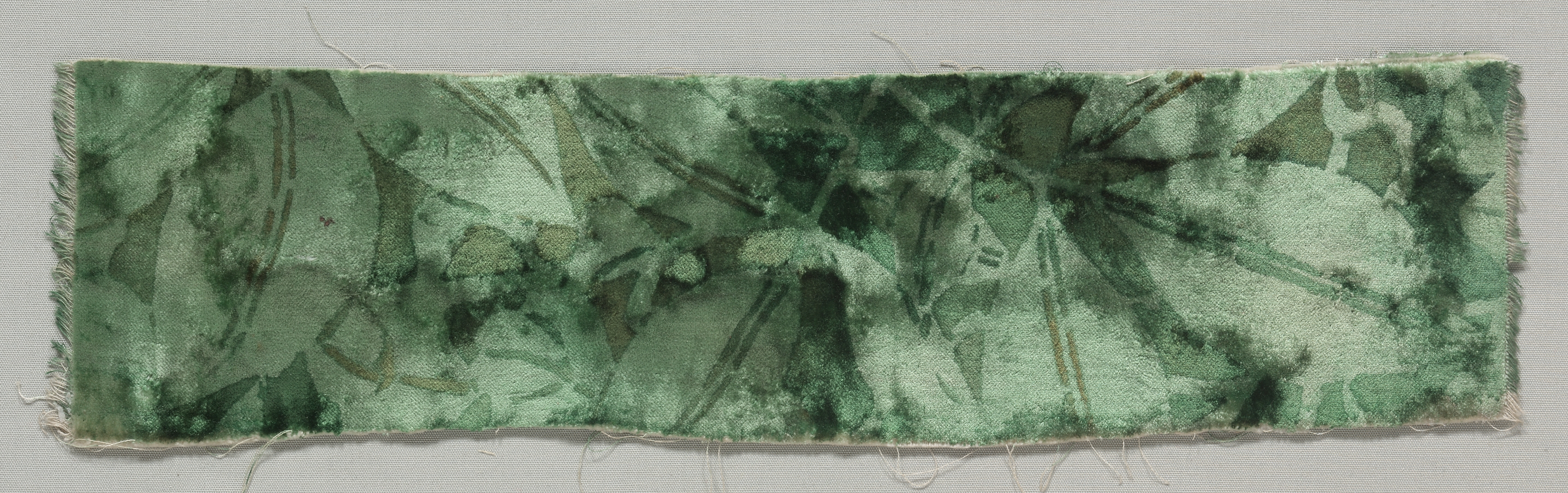
Deconstructing the Avant-Garde: An Analysis of Stenciled Velvet at Zoey Fashion Lab
At Zoey Fashion Lab, the role of the Chief Fabric Deconstructionist is to dissect not merely the physical composition of a textile, but its cultural, technical, and aesthetic DNA. Our latest subject, a specimen of Stenciled Velvet, presents a compelling paradox. Originating from the crucible of American innovation—New York City—this fabric represents a deliberate collision of ancient handcraft and futuristic vision. Its technical foundation is deceptively simple: a plain silk cloth, transformed through the application of vegetable dyes via stenciling. Yet, the reference point for this creation is not a historical pattern or a natural form, but a New DNA Strand. This analysis will deconstruct the fabric’s materiality, its technical genesis, and its stylistic implications within the avant-garde framework of Zoey Fashion Lab.
Material Deconstruction: The Plain Silk Substrate
The journey begins with the substrate itself: a plain-woven silk cloth. At first glance, this appears to be a conservative choice, a nod to luxury and tradition. However, within the context of avant-garde design, silk serves as a neutral, high-performance canvas. Its natural protein fibers possess a unique affinity for vegetable dyes, allowing for deep, saturated color penetration that synthetic fabrics cannot replicate. More critically, silk’s inherent luster and drape create a dynamic interplay with light. When a stencil is applied, the un-dyed areas retain the fabric’s natural sheen, while the dyed sections absorb and diffuse light differently. This creates a subtle, kinetic surface that shifts with movement, a quality essential for the avant-garde’s fascination with ephemerality and transformation.
The choice of a plain weave—rather than a satin or twill—is also strategic. Plain weave offers a uniform, non-directional surface, which is ideal for the precise application of stenciled patterns. It eliminates the risk of dye bleeding along prominent weave lines, ensuring that the stenciled “DNA strand” remains crisp and legible. This technical precision is a hallmark of the New York design ethos: a marriage of industrial rigor with artisanal sensitivity. The fabric is not merely a luxury good; it is a laboratory specimen, prepared for a controlled experiment in color and form.
Technical Genesis: Vegetable Dyes and Stenciling
The application method—stenciling with vegetable dyes—is where the fabric’s true innovation lies. Vegetable dyes, derived from plants, roots, and insects, are inherently unpredictable. They react differently to varying pH levels, water hardness, and fiber types. In the hands of a skilled artisan, this unpredictability is not a flaw but a source of organic variation. Each yard of this velvet is technically identical in design but unique in execution. The stencil, which is likely a hand-cut or digitally fabricated template, imposes a rigid, geometric structure—the “New DNA Strand.” Yet, the vegetable dye introduces a soft, bleeding edge, a halo of color that softens the hard lines of the stencil.
This tension between control and chaos is the fabric’s core conceptual driver. The “New DNA Strand” reference is not merely a visual motif; it is a philosophical statement. In biology, DNA is the blueprint for life, a code that is both precise and mutable. Similarly, the stencil acts as a blueprint, but the vegetable dye introduces mutations—subtle shifts in hue, depth, and saturation. The result is a fabric that appears to be alive, evolving, and in a state of becoming. It challenges the viewer to reconsider the relationship between the designed and the natural, the synthetic and the organic. This is not a fabric that simply covers the body; it is a fabric that encodes a narrative of creation and transformation.
Stylistic Implications: The Avant-Garde Aesthetic
Within the avant-garde style, this Stenciled Velvet operates on multiple levels. First, it subverts the traditional association of velvet with opulence and comfort. Velvet is typically a fabric of luxury, of deep, uniform color and plush texture. Here, the velvet is dissected and re-presented as a surface of scientific inquiry. The stenciled pattern, reminiscent of a double helix, introduces a clinical, almost sterile geometry that contrasts with the fabric’s tactile softness. This juxtaposition is a classic avant-garde tactic: creating cognitive dissonance to provoke thought.
Second, the use of vegetable dyes aligns with the avant-garde’s historical interest in primitivism and authenticity. By rejecting synthetic aniline dyes in favor of natural, plant-based colors, the fabric references pre-industrial methods of textile production. Yet, the pattern is resolutely futuristic. This creates a temporal paradox: the fabric is simultaneously ancient and speculative. It suggests that the future of fashion lies not in abandoning the past, but in re-contextualizing its techniques within a new conceptual framework. The “New DNA Strand” becomes a symbol of this hybridization—a genetic code that merges the wisdom of traditional craftsmanship with the vision of scientific discovery.
Finally, the fabric’s application in garment design is inherently sculptural. The stenciled pattern, when draped over the body, will warp and distort, creating a three-dimensional expression of the DNA motif. The sleeves, the torso, the folds—each becomes a site of pattern deformation. This is not a flaw but a feature, as the avant-garde celebrates the body as a dynamic, living armature for textile art. The garment is not a static object; it is a performance, a living diagram of genetic code in motion.
Conclusion: A New DNA for Fashion
In conclusion, the Stenciled Velvet from New York is a masterclass in deconstructive design. It takes a classic luxury fabric and subjects it to a rigorous, conceptual transformation. The plain silk cloth, the vegetable dyes, and the stencil technique are all chosen for their ability to create a dialectic between precision and imperfection. The “New DNA Strand” reference is not a superficial pattern; it is the fabric’s ideological core, a statement about the nature of creation, mutation, and evolution in fashion.
For Zoey Fashion Lab, this fabric represents a critical tool for avant-garde expression. It challenges the wearer and the viewer to see fabric not as a passive surface, but as an active participant in a larger narrative. It is a fabric that asks questions: What is the code of our clothing? How do we mutate tradition to create the new? And in the answer, we find the true DNA of the avant-garde: a relentless, fearless pursuit of the unknown, stenciled in vegetable dye on a field of silk.