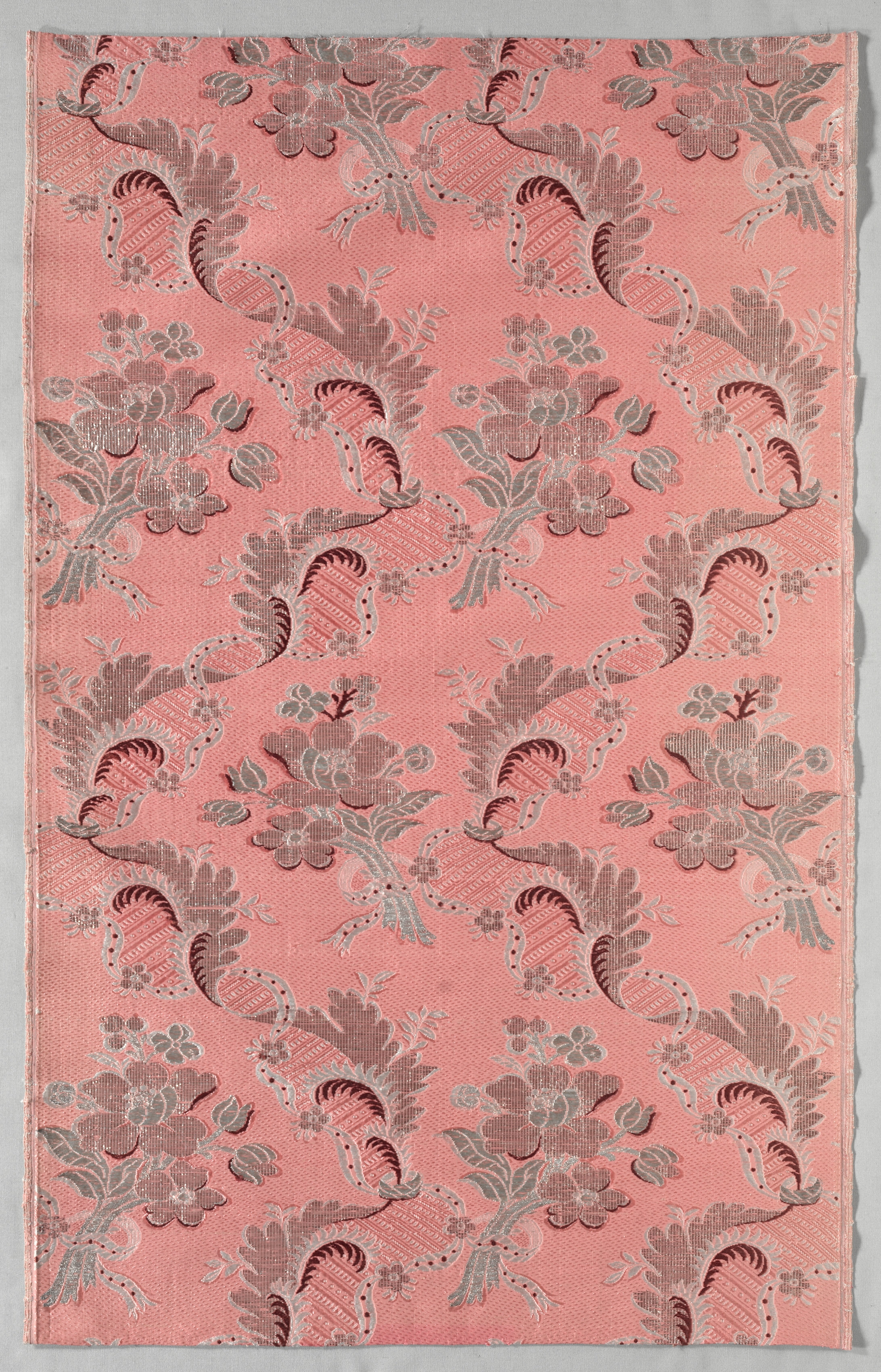
Deconstructing the Silken Timeline: A Zoey Fashion Lab Analysis of an 18th-Century French Brocade
Introduction: The Avant-Garde as a Lens for Historical Textiles
At Zoey Fashion Lab, we operate under the axiom that true avant-garde design is not a rejection of history, but a radical re-interpretation of its foundational elements. The subject of this analysis—an 18th-century French brocade from the reign of Louis XV (1723-1774)—is not merely a relic of aristocratic splendor. It is a complex, multi-layered text whose “length” is far more than a physical measurement. Through the lens of our Chief Fabric Deconstructionist, we will dissect this textile’s temporal, technical, and aesthetic dimensions, revealing how its very structure embodies a silent, resonant dialogue between the past and the future of fashion.
Our reference point, Archive Resonance, posits that objects and paintings are “silent witnesses” to cultural collision and aesthetic fusion. This brocade, woven from silk and metal threads in France’s most opulent century, is precisely such a witness. Its “length” is not linear but a spiral, connecting the rigid hierarchies of the Ancien Régime to the fluid, disruptive potential of contemporary design. We will deconstruct this textile across three axes: temporal length (historical context and production), technical length (the mechanics of brocade and its structural implications), and aesthetic length (its visual language and potential for avant-garde re-appropriation).
Temporal Length: The Empire of Silk and the Clock of the Court
The “length” of this textile is first and foremost a measure of time. The reign of Louis XV, the Bien-Aimé, was a period of immense artistic production, where the decorative arts—particularly textiles—served as instruments of state power and personal pleasure. The silk industry of Lyon was the epicenter of European luxury, and brocade was its most prestigious product. To commission such a fabric was to participate in a global network of trade and exploitation: raw silk from the Levant, gold and silver threads from the Americas, and designs inspired by the rococo’s playful asymmetry and naturalistic motifs (shells, acanthus leaves, and floral garlands).
This textile’s temporal length is also one of labor. A single meter of high-quality brocade could require months of work on a drawloom, operated by a team of weavers. The metal threads (often silver-gilt or gold-wrapped silk) were not merely decorative; they were a literal investment, a store of wealth that could be melted down in times of crisis. The fabric’s “length” thus encodes the social and economic structures of its time: the power of the monarchy, the ingenuity of the artisan, and the silent labor of the anonymous weaver.
For the avant-garde designer, this temporal length is a resource. To cut into this fabric is to cut into history itself. The act of deconstruction—of splicing, layering, or reversing the brocade—is not destruction but a form of chronological collage. It allows us to compress 300 years of cultural meaning into a single garment, creating a temporal dissonance that challenges the viewer’s perception of time.
Technical Length: The Loom’s Grammar and the Fabric’s Structure
Technically, “length” refers to the warp (the longitudinal threads) and the weft (the transverse threads). In brocade, the weft is the primary vehicle for pattern, with supplementary weft threads (often metal) floating across the back of the fabric to create the raised, figured design. This structure creates a distinct front/back dichotomy: the obverse is a shimmering, tactile landscape; the reverse is a chaotic, tangled web of floating threads.
This technical length is a grammar of constraints and possibilities. The point repeat (the vertical and horizontal repetition of the pattern) dictates the fabric’s visual rhythm. The density of the metal threads (often 100-200 picks per inch) creates a stiff, architectural quality that resists draping. The silk ground, while lustrous, is fragile and prone to fraying. These are not flaws but design parameters. For the avant-garde practitioner, understanding these parameters is the first step in subverting them.
Consider the act of unweaving. By selectively removing the metal weft threads, one can create a negative-space pattern, revealing the silk ground as a luminous void. Or, by cutting the fabric along the warp and re-weaving the strips with contemporary materials (e.g., recycled polyester, conductive fibers), one can create a hybrid textile that speaks to both the past and the future. The technical length of this brocade is not a prison but a generative algorithm, waiting to be hacked.
Aesthetic Length: The Rococo’s Play of Light and the Avant-Garde’s Play of Form
The aesthetic length of this textile is its visual and tactile journey. The rococo style, epitomized by the asymmetrical rocaille motif, is a celebration of movement, lightness, and illusion. The interplay of silk and metal creates a surface that shifts with every angle of light—a chameleonic shimmer that defies static representation. The colors, often pastel (pink, celadon, sky blue) with accents of gold and silver, evoke a sense of ethereal luxury.
Yet, this aesthetic length is also a form of visual overload. The density of the pattern, the reflective quality of the metal, and the tactile richness of the silk can be overwhelming. For the avant-garde designer, this excess is a resource to be strategically deployed or radically negated.
Imagine a garment that uses the brocade as a focal point—a sculptural collar, a cuffed sleeve, or a dramatic train—while the rest of the silhouette is constructed from raw, unfinished linen or industrial felt. This creates a dialogue between the hyper-ornamented past and the minimalist, functional present. Alternatively, one could digitally scan the brocade’s pattern and project it onto a garment made from smart textiles, creating a fluid, ever-changing surface that mimics the rococo’s love of illusion.
The aesthetic length is also about scale. The original brocade was designed for the robe à la française, a garment of immense volume that transformed the wearer into a walking tableau. By re-scaling the pattern—enlarging a single floral motif to monumental proportions or reducing it to a micro-print—one can alter the fabric’s perceptual impact, moving from the intimate to the architectural.
Conclusion: The Fabric as a Time-Thread
In the spirit of Archive Resonance, this 18th-century French brocade is not a static object but a time-thread, a conduit through which the past speaks to the present. Its “length” is a multidimensional construct: temporal, technical, and aesthetic. For Zoey Fashion Lab, the task is not to preserve this textile in a vitrine but to activate it through deconstruction and re-imagination.
The avant-garde is not about novelty for its own sake; it is about re-contextualizing the familiar to reveal its hidden complexities. By cutting, unweaving, re-scaling, and hybridizing this brocade, we transform it from a relic of courtly splendor into a tool for critical inquiry. The silken timeline of Louis XV’s France becomes a fabric of possibility, a material that challenges us to rethink the relationship between ornament and structure, history and innovation, labor and luxury.
At Zoey Fashion Lab, we do not merely analyze textiles; we resonate with them. And in this resonance, we find the blueprint for a future that is as rich, complex, and disruptive as the past from which it is woven.