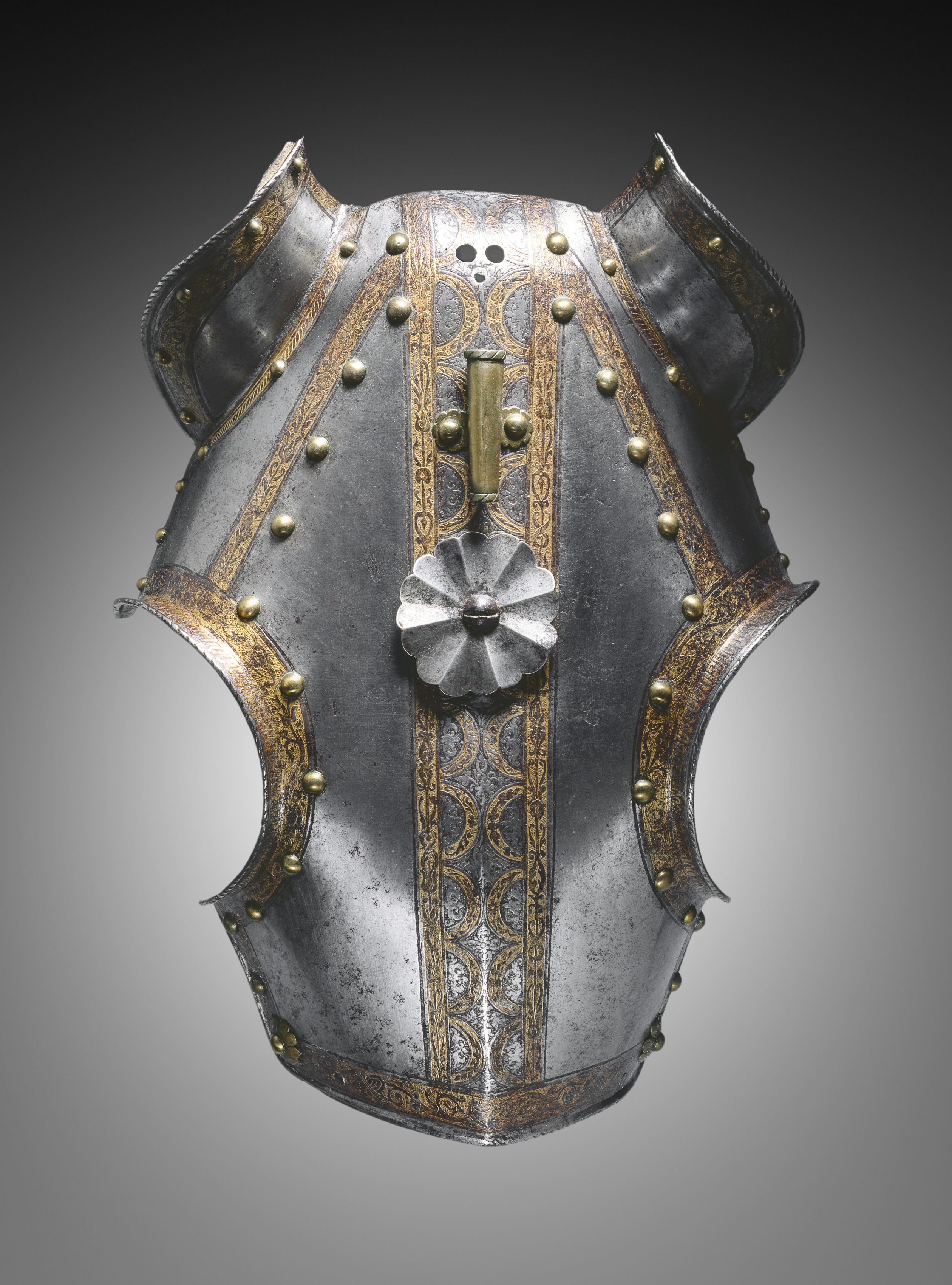
Technical Deconstruction: The Augsburg Armorer's Art
The Demi-Chanfron, originating from the armorer's workshops of 16th-century Augsburg, represents a pinnacle of functional metallurgy transformed into art. As a piece designed to protect a horse's face in battle and tournament, its base material is hardened steel—a canvas chosen for its life-preserving properties. The technical execution is where we begin our deconstruction. The etching process was not mere decoration; it was a deliberate, corrosive technique that removed layers of steel to create recessed designs. Into these recessed channels, the artisans would painstakingly hammer and burnish thin sheets of gold, a technique known as fire-gilding. This created a stunning visual contrast: the dark, formidable ground of the steel against the luminous, narrational lines of gold. The leather components, now largely perished, speak to an understanding of articulated movement, connecting the rigid plates to the living, breathing animal. This is not applied ornamentation; it is integrated narrative, where material, technique, and function are inseparably fused.
Narrative Strands: From Equestrian Armor to Genetic Blueprint
The reference to a "New DNA Strand" is profoundly apt. The etched and gilded patterns on the chanfron—often depicting floral scrolls, mythical creatures, or heraldic emblems—are not random. They are a coded language of power, lineage, and belief. We can deconstruct this as the visual DNA of its owner, a genetic code of social and political identity worn into battle. Each curl of a vine, each fierce gaze of a griffin, is a nucleotide in this sequence. For Zoey Fashion Lab, this translates beyond literal imagery. It proposes that avant-garde fashion must encode its own narrative DNA. This could be a unique, recurring structural motif (a "base pair" of seams or folds), a proprietary textile manipulation, or a symbolic color palette that runs through every collection, mutating and adapting but always identifiable as part of the brand's core genetic material.
Avant-Garde Synthesis: Recombining Historical Code
The directive to interpret this through an avant-garde lens requires us to move beyond historical replication. Avant-garde fashion is not about wearing history; it is about conversing with it through radical reconstruction. The Demi-Chanfron's purpose was deflection and intimidation. How does that translate to modern identity? We propose a collection where garments are structured to deflect societal gaze or to intimidate convention.
Structural Manifestation: The Exoskeletal Silhouette
Imagine the curved, articulated plates of the chanfron abstracted into fashion architecture. This leads to pieces that suggest an exoskeletal framework. Think not of rigid suits of armor, but of garments that use boning, thermoformed polymers, or intricately layered and stiffened textiles to create assertive, protective silhouettes that articulate at the joints. A jacket's shoulders might extend in a graceful, defiant curve, echoing the chanfron's shape protecting the horse's poll. Seams could be emphasized with gilded, chain-stitched embroidery, replicating the etched and filled channels of the original, tracing new genetic codes along the body's topography.
Surface Genome: Etched Textiles & Gilded Layers
The etched-and-gilded technique offers a universe of textile development. We can achieve this through laser-cutting and etching on layered fabrics, where a top layer is precisely ablated to reveal a contrasting underlayer in intricate patterns—our new DNA sequences. "Gilding" can be reimagined as hot-foil application on technical fabrics, or the use of metallic lamé threads woven into specific pathways. Leather, a primary component of the original's assembly, can be used as a contrasting element—hardened and shaped or deliberately distressed, showing its own history and wear, its own genetic memory.
Conceptual Translation: The Protected Self
Most critically, the demi-chanfron was a demi-piece; it protected only the front, the face, the identity. This is a powerful avant-garde concept: asymmetric protection. Design could focus on shielding or accentuating one side of the body, leaving the other exposed. A garment might feature a high, structured collar or mask-like detail on one shoulder, cascading into soft, fluid drapery on the other. This speaks to the modern dichotomy of public armor versus private vulnerability, a highly relevant narrative for contemporary identity.
Collection Proposal: "Augsburg Sequence"
For Zoey Fashion Lab, this analysis culminates in the conceptual framework for a collection titled "Augsburg Sequence."
Core Aesthetic: A stark dialogue between the severe, dark resilience of forged steel and the luminous, precious trace of gold. Color palette: anthracite, oxidized black, cold silver, punctuated with bursts of burnished gold and warm brass.
Key Pieces:
- The Chanfron Corset: A torso piece using structured, curved panels reminiscent of armor plates, joined with leather straps or gilded eyelets. Surface detail features laser-etched geometric patterns revealing metallic underlays.
- Asymmetric Capes & Cowls: Garments that offer dramatic, sculptural protection to one side of the head and shoulder, flowing away on the other.
- Articulated Trousers & Sleeves: Incorporating strategic seaming and flexible, rigid inserts to suggest functional articulation at knees and elbows.
- The "Strand" Dress: A piece where a single, continuous gilded chain or ribbon of embroidery traces a path around the body like a DNA helix, connecting various structural points.
Material Innovation: Development of a proprietary "etched neoprene," composite jacquards with metallic narrative threads, and vegetable-tanned leather treated to show tooling and age.
In conclusion, the 16th-century Demi-Chanfron from Augsburg is far more than a historical artifact. It is a complete design philosophy encapsulated in steel and gold: the integration of technical mastery with profound narrative, creating an object of both ultimate function and potent symbolism. By deconstructing its material DNA and recombining its strands through an avant-garde prism, Zoey Fashion Lab can develop a collection that is intellectually rigorous, visually stunning, and deeply resonant—offering not just clothing, but contemporary armor for the modern self.