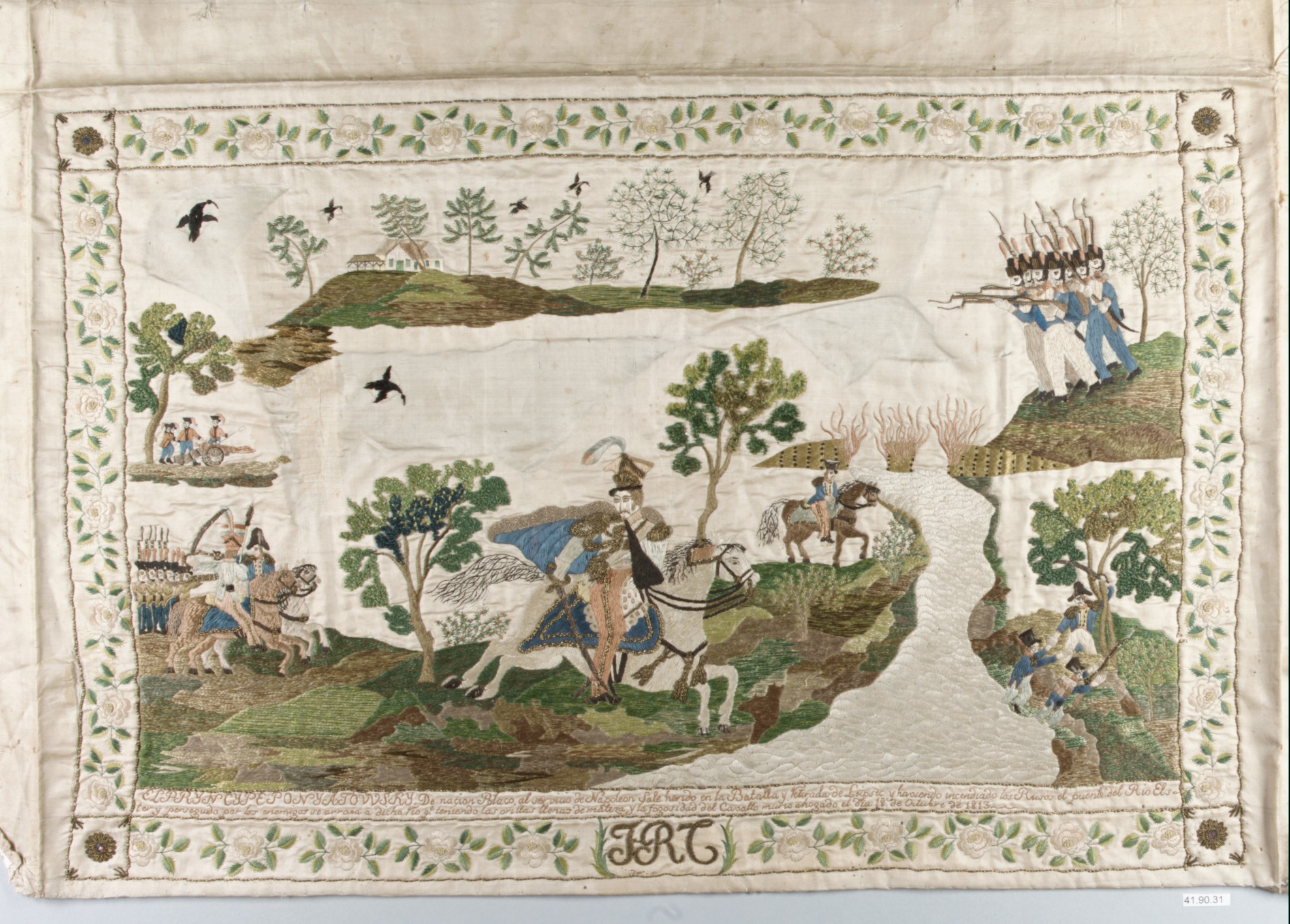
Deconstructing Mortality: Poniatowski’s Final Silhouette as SS26 Avant-Garde Blueprint
The death of Prince Joseph Poniatowski on October 19, 1813, at the Battle of Leipzig is not merely a historical footnote of Napoleonic hubris—it is a radical text for the SS26 frontier. The Polish prince, a cavalry commander of extraordinary bravura, drowned in the Elster River while covering the Grande Armée’s retreat, his body never recovered from the icy waters. For Zoey Fashion Laboratory, this absence—this ghost of a uniform, this vanished body—becomes the generative void for a new architectural garment language. We are not commemorating a man; we are interrogating the moment when structure fails, when the hero’s silhouette dissolves into the elemental. The material brief—silk and metal thread on silk—is our primary dialect. This is not a costume. This is a deconstructive manifesto for the post-human uniform, a garment that exists at the threshold of disappearance and emergence.
Futuristic Silhouettes: The Waterlogged Torsion
The central silhouette of this SS26 study is what we term the “Drowned Hussar’s Torsion.” It rejects the stiff, high-collared, gold-braided glory of a Napoleonic uniform. Instead, the garment’s architecture is predicated on asymmetrical collapse. The left shoulder is built up with a rigid, sculpted epaulette of layered silk and metal thread—a memory of the prince’s rank. Yet this structure disintegrates as it moves across the torso. The right side of the jacket is intentionally unfinished, the silk fraying into long, water-like tendrils that mimic the current of the Elster. The metal thread is not used for ornamentation but as a structural armature: it is woven into the fabric in a pattern of hydrodynamic torsion, creating spiral seams that visually pull the garment downward and inward, as if the wearer is being sucked into a vortex. The waist is cinched not by a belt but by a floating corset made of tensioned silk cords, leaving a negative space between the fabric and the body—an architectural gap that suggests the absence of the prince’s torso.
Materiality as Narrative: Silk, Metal, and the Unrecoverable Body
The choice of silk and metal thread is deliberate and subversive. Silk, historically, is the fabric of luxury, of life, of dynastic power. Here, it is treated with deconstructive chemical washes to create a patina of decay—a surface that is simultaneously luminous and rotting. The metal thread, typically a symbol of military valor, is repurposed as a conductive skeleton. We envision a garment that, when worn, generates a faint electromagnetic field through the metal weave, causing the silk to subtly vibrate. This is not a gimmick; it is a poetic reanimation. The garment shimmers with the memory of movement, but the movement is not that of a living body. It is the tremor of water, the last twitch of a drowning man. The metal thread also creates a crackled, armor-like panel on the left pectoral—a hardened, protective zone that contrasts with the fluid, dissolving right side. This duality, solid versus liquid, life versus dissolution, is the core structural innovation. The garment is not a uniform; it is a frozen moment of transition.
Structural Innovation: The Negative Volume Principle
The most radical architectural innovation for SS26 is the Negative Volume Principle, derived directly from Poniatowski’s missing body. Traditional couture builds volume outward—padding, draping, layering. We invert this. The garment is constructed from internal, hollow chambers of silk that are inflated with air, creating pockets of negative space within the silhouette. These chambers are visible through strategic, laser-cut apertures in the outer silk layer. The metal thread is used to stitch these chambers into a geodesic grid, maintaining their shape without external boning. The result is a garment that appears to be hollowed out from within. The wearer’s body is not the support; it is the ghost that haunts the fabric. The sleeves, for instance, are not sleeves at all. They are fabric tubes that end in open, frayed cuffs, with no shoulder seam attachment on the right side—the arm simply passes through a gap in the structure. This is a direct reference to Poniatowski’s final, futile gesture: reaching for a horse that had already sunk beneath him.
Color Palette and Surface Treatment
The palette is monochromatic but not flat. We use a spectral white—the color of silk before dye, the color of bones, the color of foam. Overlaid on this is a silver-gray patina achieved through the metal thread, which catches light like a wet surface. The only accent is a single, deep arterial crimson stain on the left sleeve, applied via a bio-resin transfer that is both permanent and tactile—it feels like dried blood, but it is actually a crushed cochineal pigment suspended in a flexible polymer. This is not a splash; it is a geometric wound, a precise line that traces the path of a saber cut that never happened. The stain is a fiction, a memory implanted in the fabric. The entire surface is then cryo-treated—exposed to extreme cold during the finishing process—to create micro-fractures in the silk, mimicking the ice that would have formed on the prince’s uniform as he sank into the winter river.
Deconstructive Aesthetics: The Unfinished Uniform
The deconstructive gesture is not about destruction for its own sake. It is about exposing the process of becoming. The back of the jacket is left completely raw-edged, with the silk selvedge visible and the metal thread ends hanging loose, like the frayed nerves of a severed connection. The collar is missing on one side; the remaining collar piece is a sculpted, rigid crescent that rises unnaturally high, almost like a prosthetic device. This is the uniform of a man who is no longer there to button it. The asymmetry is not decorative—it is structural, forcing the garment to hang off-center, creating a constant, unsettling tension. The wearer’s body must compensate, must engage in a constant micro-adjustment, making the garment an active, living dialogue between absence and presence.
Conclusion: A Garment for the Post-Heroic Frontier
This SS26 study is not a costume for a historical reenactment. It is a philosophical prototype for the future of fashion: a garment that does not celebrate triumph but interrogates collapse. Poniatowski’s death—his body lost, his uniform erased—gives us permission to design for the disappearing body, for the moment when the human form is subsumed by environment. The silk and metal thread are not materials of nostalgia; they are agents of structural entropy. The futuristic silhouette is not about flying cars or cyborg limbs; it is about the architecture of loss, the beauty of the unravelling, the elegance of the void. This garment is a monument to the unfinished, a silent scream frozen in silk, a blueprint for a new kind of heroic fashion—one that finds its power not in conquest, but in the quiet, inevitable surrender to the current.