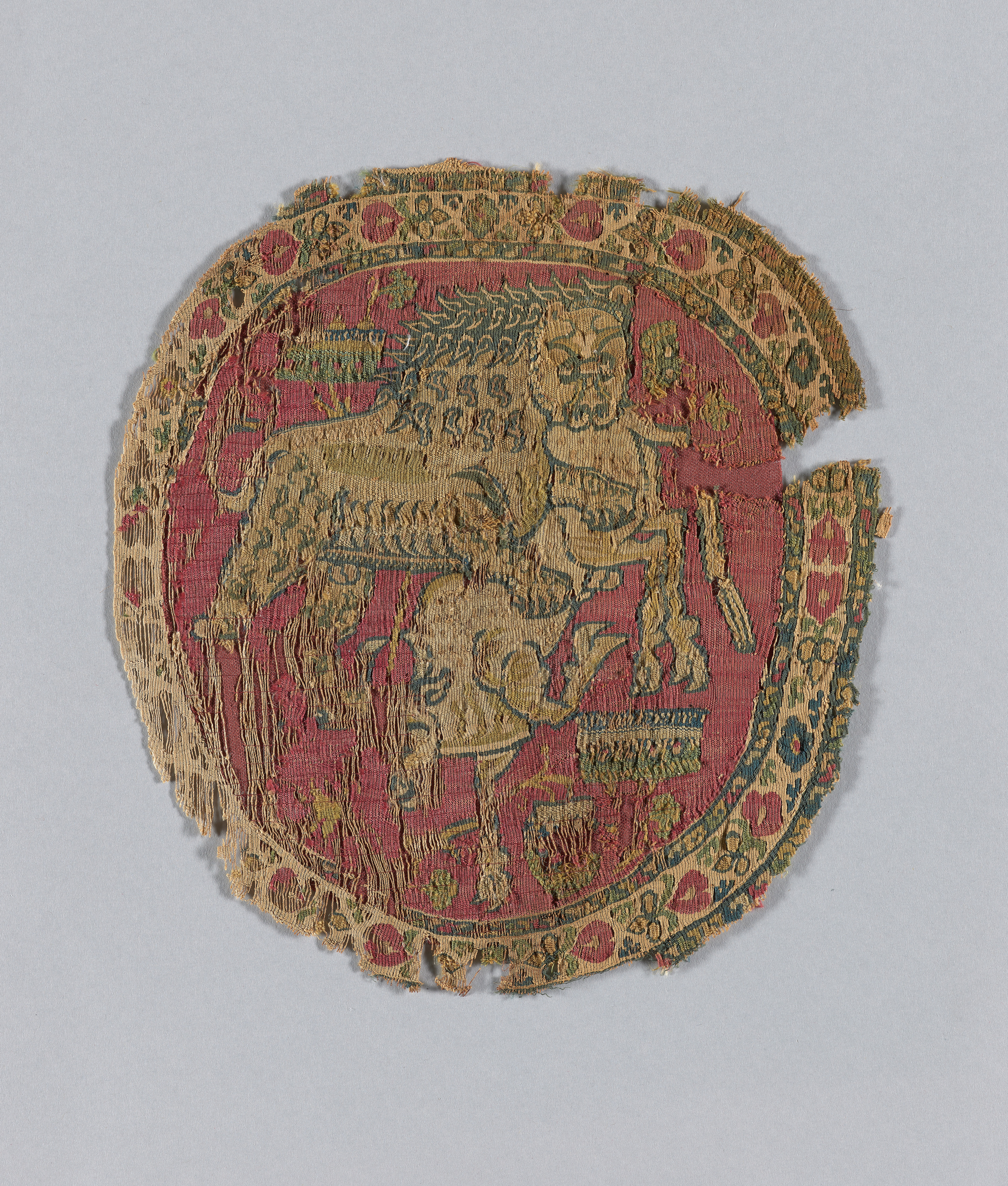
Deconstructing the Segmentum: An Avant-Garde Reading of Abbasid Tapestry
At Zoey Fashion Lab, our core methodology is Archival Resonance—a process of extracting latent, often overlooked, design intelligence from historical artifacts. The subject of today’s analysis is a Segmentum, a decorative band from a tunic, originating in Egypt during the Abbasid period (c. 8th–10th century CE). Constructed using the meticulous technique of tapestry weave in linen and wool, this fragment is not merely a relic of textile history; it is a blueprint for a radical, avant-garde design language. We will deconstruct its technical, cultural, and aesthetic DNA to reveal how its inherent tensions—between structure and fluidity, opulence and restraint, East and West—can inform a contemporary fashion narrative that is both disruptive and deeply rooted.
Technical Foundations: The Tapestry as a System of Restraint and Release
The tapestry weave is a fundamentally different logic from that of a loom’s warp-faced or weft-faced cloth. In tapestry, the weft threads do not travel from selvage to selvage. Instead, they are packed tightly, creating color blocks and patterns that are interlocked or slit-woven. This demands a high degree of premeditation and manual control. For the Abbasid weaver, this technique was a tool for precision and narrative. The linen warp provided a stable, unyielding foundation—the skeleton of the garment. The wool weft, often dyed in vibrant hues from kermes, indigo, and madder, was the flesh, the expressive medium that formed the geometric, epigraphic, and floral motifs characteristic of the period.
From an avant-garde perspective, this technical duality is a powerful metaphor. The linen warp represents the rigid, inherited structures of society, tradition, and the body’s own architecture. The wool weft is the disruptive, organic, and sensory element—the impulse to subvert, to ornament, to tell a story. The slit-weave itself, where two color blocks meet and leave a small, intentional gap, is a moment of fracture. In a conventional garment, this would be a weakness. In an avant-garde context, it is a design feature: a deliberate negative space that allows the underlying structure (the skin, the air, the light) to participate in the garment’s narrative. This concept can be directly translated into modern construction: a deconstructed sleeve where the facing is left open, or a seam that is not sewn but rather tensioned by a series of hand-tied knots, echoing the slit-weave’s delicate balance.
Cultural Resonance: The Segmentum as a Node in a Global Network
Your reference, Archive Resonance, speaks to the silent witness of cultural collision. The Abbasid Empire, at its zenith, was a crucible of global trade and intellectual exchange. The Segmentum from an Egyptian tunic is not a purely “Arab” or “Egyptian” artifact. It is a product of the Silk Road and the Indian Ocean trade. The geometric patterns may echo pre-Islamic Sasanian motifs, the colors may come from Central Asian or Indian dyestuffs, and the very concept of a decorative band on a tunic (the clavi and segmenta) was inherited from Roman and Byzantine imperial regalia.
This layered cultural provenance is the ultimate avant-garde statement. The avant-garde is not about novelty for its own sake; it is about recontextualization. The Segmentum, in its original form, was a marker of status and identity. To wear it was to participate in a vast, interconnected world. For Zoey Fashion Lab, we can reimagine this not as a band of fabric, but as a cartographic device. Imagine a garment where the Segmentum is not a static band, but a digitally printed or embroidered map of trade routes, with the warp threads representing the longitudinal lines and the weft threads representing the latitudinal paths of cultural exchange. The wool becomes the raw material of nomadic life, while the linen represents the settled, agrarian civilization. The garment becomes a wearable archive, a body that carries the memory of movement and convergence.
Avant-Garde Translation: From Fragment to System
To translate this fragment into a contemporary design language, we must move beyond reproduction. We are not interested in a “costume” or a “revival.” We are interested in the principles that govern the fragment’s existence. Here are three specific design strategies for Zoey Fashion Lab:
1. The Deconstructed Tunic as a Modular System. The original tunic was a single, woven piece. We will break it down. The Segmentum becomes a detachable panel that can be worn as a collar, a cuff, a belt, or a separate neckpiece. The linen warp becomes a base grid—a sheer, unbleached linen tunic that is intentionally unfinished, with raw edges and loose warp threads. The wool weft elements are then applied as separate, hand-finished patches or woven-in inserts that can be added or removed, allowing the wearer to customize the garment’s narrative. This challenges the fixed, monolithic nature of the original garment, turning it into a dynamic, participatory object.
2. The Slit-Weave as a Structural Device. The intentional gaps in the tapestry weave are not flaws; they are opportunities for transparency and layering. In an avant-garde garment, we can exaggerate this. Imagine a trench coat or a long coat where the body is constructed from a series of vertical, slit-woven panels. The panels are joined only at the shoulders and hem, leaving a series of vertical, open slits that reveal a contrasting lining or the wearer’s skin. This creates a sense of fragmentation and fluidity, a garment that is both protective and permeable, echoing the tension between the rigid warp and the expressive weft.
3. Material Alchemy: Linen and Wool as Oppositional Forces. The original materials—linen (cool, crisp, plant-based) and wool (warm, dense, animal-based)—are in a state of perpetual dialogue. We can push this dialogue to an extreme. Use a heavy, felted wool for the “Segmentum” elements, creating a sculptural, almost architectural volume. Contrast this with a paper-thin, almost translucent linen for the base garment. The wool elements can be hand-stitched with a visible, irregular stitch, referencing the weaver’s hand, while the linen base is cut with laser precision, referencing the warp’s grid-like structure. The result is a garment that is a tactile and visual argument between the organic and the industrial, the ancient and the hyper-modern.
Conclusion: The Segmentum as a Prototype for Future Memory
The Abbasid Segmentum is not a dead object. It is a living algorithm for how to weave together structure and ornament, tradition and disruption, the local and the global. In the hands of Zoey Fashion Lab, this fragment becomes a prototype for a new kind of garment—one that is not merely worn, but inhabited. It is a garment that acknowledges its own construction, its own history, and its own potential for transformation. The slit-weave is a scar that tells a story. The linen warp is a spine that holds the body. The wool weft is the voice that speaks across centuries. By deconstructing this segment, we are not destroying the past; we are activating it, allowing it to resonate with the complexities of the present. This is the essence of Archival Resonance: not to look backward, but to pull the past forward into a future of radical, wearable expression.