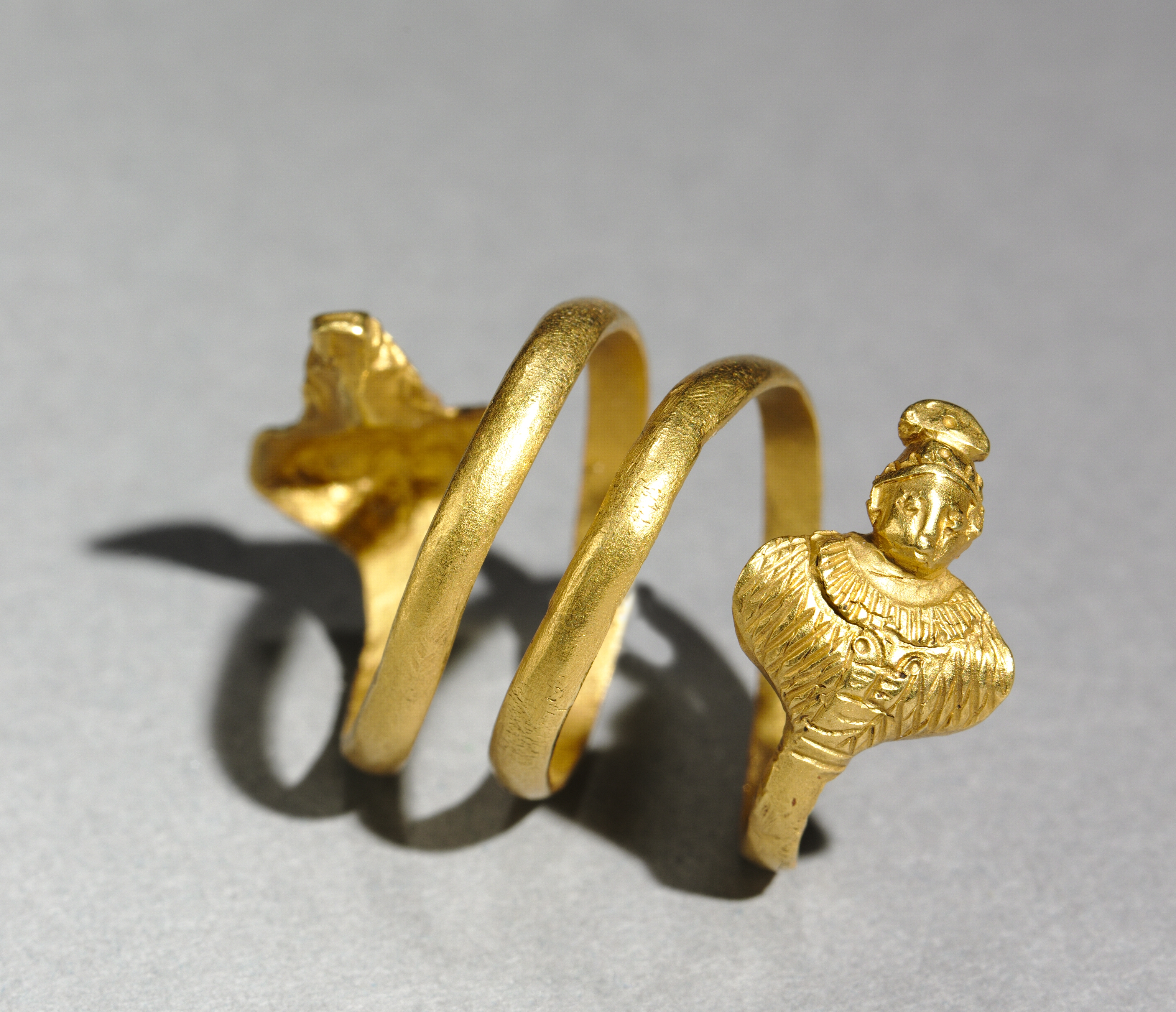
Deconstruction Analysis: The Spiral Ring with Isis and Serapis
Contextual Origin and Material Provenance
The object under examination—a Spiral Ring featuring the syncretic deities Isis and Serapis, likely originating from Hellenistic or Roman Egypt (with possible Greek or Italian workshop attribution)—presents a paradox of temporal and cultural displacement. Its technical composition of pure gold suggests a ritual or high-status funerary context, yet its spiral form and divine iconography resist static classification. The material itself, a noble metal that resists corrosion, embodies the very concept of eternity that the ring’s iconography seeks to anchor. However, as Chief Fabric Deconstructionist for Zoey Fashion Lab, I must interrogate not only its physicality but its resonance within the Archive Resonance framework: the tension between the polished silver mirror’s gold-inlaid acanthus scrolls and the stone sarcophagus’s narrative relief. This ring is neither mirror nor sarcophagus—it is a hybrid object that wears its own contradiction.
Structural Analysis: The Spiral as Temporal Collapse
The spiral form is the ring’s primary architectural gesture. Unlike a closed band, the spiral implies infinite regression—a path that never completes a circuit, yet returns to its origin at a different elevation. This is not a simple loop but a helical narrative that invites the wearer to trace the deity figures’ profiles in a continuous, unending gesture. The gold’s malleability allows for this sinuous line, which in Avant-garde fashion terms becomes a deconstructive silhouette—the ring as a wearable fragment of a larger cosmic diagram. The spiral’s open end suggests incompleteness, a refusal of closure that aligns with the fashion deconstructionist ethos of exposing structural seams. Here, the seam is the gap between the Isis and Serapis figures, who are depicted in profile, facing one another yet never touching. This spatial tension mirrors the archive resonance of the mirror’s reflective surface versus the sarcophagus’s opaque narrative.
Iconographic Deconstruction: Isis and Serapis as Avant-Garde Archetypes
Isis, the Egyptian mother goddess, and Serapis, the Hellenistic composite deity of Osiris and Apis, represent a syncretic collision that prefigures modern fashion’s penchant for hybrid identities. In this ring, they are not merely decorative but structural anchors—their profiles define the spiral’s curvature. Isis’s throne-like headdress and Serapis’s modius (a grain measure crown) become architectural motifs that echo the acanthus leaves of the mirror and the narrative relief of the sarcophagus. The goldsmith’s technique—likely repoussé or granulation—creates a texture that oscillates between smooth reflection and rough narrative. This duality is central to the Avant-garde fashion statement: the ring is both a jewel and a text, a wearable codex that speaks of death and rebirth, mirror and tomb. The spiral’s open form allows these deities to be perpetually in dialogue, never fixed, always in the process of becoming.
Technical Craft as Deconstructive Language
The gold’s surface treatment is critical. A high-polish finish on the spiral’s outer edge creates a mirror-like effect, reflecting the viewer’s gaze and the surrounding environment—a nod to the silver mirror with gold acanthus from the archive. Conversely, the inner surface where the deities are rendered employs a matte or textured finish, reminiscent of the stone sarcophagus’s relief. This juxtaposition of finishes is a deconstructive technique that collapses the binary between surface and depth, reflection and narrative. The ring becomes a micro-architecture where the wearer’s finger is the axis mundi, the central pillar around which the spiral turns. In Avant-garde fashion, this translates to a wearable deconstruction of scale—the ring is not an adornment but a miniature world that the body carries.
Archive Resonance: Mirror and Sarcophagus as Conceptual Framework
The Archive Resonance reference—the mirror with gold-inlaid acanthus on one side and the sarcophagus’s narrative relief on the other—provides the interpretive key. The spiral ring is the third term that mediates between these two poles. The mirror represents surface, reflection, and the present moment; the sarcophagus represents depth, narrative, and the eternal past. The ring, with its spiral form, is a Möbius-like continuum where these opposites coexist. The acanthus leaves, a Hellenistic motif of regeneration, appear in the ring’s decorative filigree around the deities’ heads, linking the object to the mirror’s vegetal abundance. The narrative relief of the sarcophagus—likely depicting the deceased’s journey—is compressed into the ring’s iconography of Isis and Serapis, who preside over death and resurrection. Thus, the ring is a portable archive that collapses the mirror’s immediacy and the sarcophagus’s eternity into a single, wearable spiral.
Avant-Garde Fashion Implications: The Ring as Deconstructive Garment
In the context of Zoey Fashion Lab’s deconstructivist approach, this ring is not merely an accessory but a prototype for a garment. Its spiral form suggests a draping technique that wraps the body in a continuous line, much like a bias-cut dress that follows the body’s contours. The gold’s weight and flexibility evoke chainmail or metallic mesh, materials that the Lab might reinterpret in fabric form. The deity profiles become prints or embroideries that disrupt the fabric’s surface, creating a tension between the garment’s structure and its narrative. The ring’s open spiral—a line that never closes—suggests a seamless garment that is perpetually in construction, a deconstructive statement against the finished, static garment. The wearer becomes a co-creator, completing the spiral through their own movement.
Conclusion: The Spiral as Eternal Return
The Spiral Ring with Isis and Serapis is a deconstructive artifact that resists categorization. Its gold materiality, spiral form, and syncretic iconography create a wearable contradiction that aligns with Zoey Fashion Lab’s Avant-garde ethos. By framing it through the Archive Resonance of mirror and sarcophagus, we see it as a third space—neither reflection nor narrative, but the spiral that connects them. In fashion terms, it is a pattern piece for a garment that never fully assembles, a drape that never falls, a seam that never closes. The ring invites the wearer to inhabit this liminal zone, where the past and present, surface and depth, mirror and stone, are woven into a single, golden, infinite line. This is the deconstructive promise of the Avant-garde: to make the invisible structure visible, and to wear the archive on one’s finger.