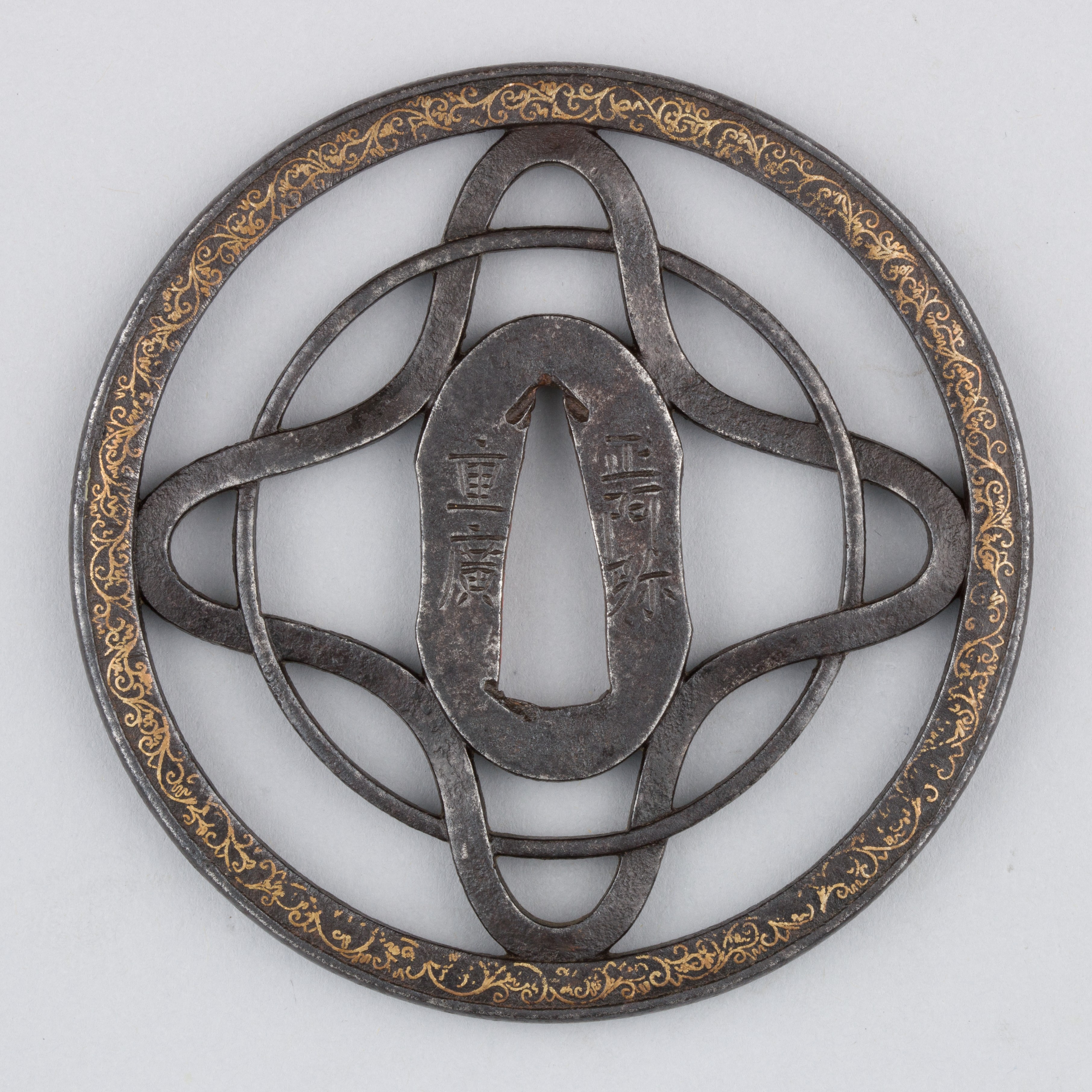
The Tsuba Reforged: Deconstructive Armature for SS26
The katana’s tsuba—a seemingly modest disc of iron, gold, and copper—has long been dismissed by Western fashion as a mere decorative motif. Yet within its circular form lies a radical blueprint for structural innovation. For Zoey Fashion Laboratory’s SS26 collection, we interrogate this Japanese sword guard not as a symbol of feudal Japan, but as a proto-cybernetic chassis: a load-bearing interface between blade and hand, strength and ornament. This analysis deconstructs the tsuba’s material logic, reconfiguring its silhouette into a futuristic armor of tensile freedom.
I. The Circular Frame: Beyond the Disc
The traditional tsuba is a flattened ellipse or circle, pierced with cutouts (hi-atsu) for the blade and handle. Its primary function is to prevent the hand from sliding onto the blade, yet its secondary function is pure sculptural tension. In SS26, we invert this geometry: the circle becomes a negative space, a void that frames the body rather than containing it. Imagine a jacket’s shoulder structure where the tsuba’s iron ring is extruded into a rigid, openwork exoskeleton. The gold and copper inlays—traditionally chiseled into dragons or chrysanthemums—are reimagined as laser-sintered titanium filigree, floating above the fabric like digital ghosts. This is not decoration; it is load-bearing architecture that redefines the silhouette as a series of interlocking orbits.
The material palette is critical. Iron, in its raw, oxidized state, offers a brutalist counterpoint to the polished gold. For SS26, we propose a ferrous weave: a textile woven from carbon-fiber-reinforced iron filaments, mimicking the tsuba’s patinaed surface. Copper is reduced to conductive threads, embedded within the fabric to create a subtle, interactive topography—a garment that responds to touch or temperature, its surface shifting from matte to reflective. The gold is not applied but grown, using electrochemical deposition to create crystalline lattices that catch light like a katana’s edge.
II. The Cutout as Structural Innovation
The tsuba’s hi-atsu are not mere voids; they are strategic cuts that reduce weight while maintaining integrity. In couture, these cutouts become portals for kinetic movement. Consider a floor-length coat where the back is a single, continuous tsuba-inspired panel: a negative space carved from the shoulder blade to the lumbar, exposing a second layer of iridescent copper mesh. The garment breathes, not through fabric, but through structural absence. This is a deconstruction of armor into air, where the body becomes the blade that passes through the guard.
For SS26, we propose a tsuba corset—a rigid, openwork cage that mimics the guard’s central aperture. The corset is constructed from layered iron plates, each one laser-cut with asymmetrical hi-atsu that align with the wearer’s spine. Gold rivets, inspired by the tsuba’s mimi (rim), secure the plates to a flexible copper chainmail base. The silhouette is simultaneously restrictive and liberating: the torso is armored, yet the cutouts reveal the skin as a living, moving core. This is not a garment of protection, but of exposure—a paradox that defines avant-garde couture.
III. Futuristic Silhouettes: The Blade and the Hand
The tsuba’s relationship to the katana’s blade offers a profound lesson in asymmetry. The blade is linear, aggressive, while the guard is circular, defensive. For SS26, we translate this into a silhouette where one shoulder is sharpened into a blade-like extension (a tsuba shoulder) while the opposite hip is rounded into a guard-like disc. The garment becomes a dynamic field of tension: the left side is all edge, the right side all orbit. This is achieved through a combination of molded leather (for the blade) and articulated metal segments (for the guard), connected by a spine of gold-plated steel cables that echo the katana’s tsuka-ito (handle wrapping).
The hand itself is reimagined. Gloves are not gloves but hand guards: rigid, open-fingered structures that extend from the wrist to the knuckles, mimicking the tsuba’s shape. They are crafted from iron mesh, with gold accents that trace the lines of the palm. When the wearer gestures, the guards create a halo of metal around the hand—a ghostly second skin that amplifies every movement. This is functional armor for the digital age, where the hand is both tool and weapon.
IV. Material Alchemy: Iron, Gold, Copper in Motion
The traditional tsuba’s materials are static, but in SS26, they are activated. Iron is not heavy; it is lightweight through honeycombing. Gold is not ostentatious; it is micro-encapsulated in resin, creating a shimmering, fluid surface that shifts with the wearer’s breath. Copper is not metallic; it is woven into a conductive textile that can heat or cool the body on command. This is not costume; it is wearable infrastructure.
Consider a dress where the skirt is a cascade of copper disks, each one laser-etched with the tsuba’s traditional sukashi (openwork patterns). As the wearer moves, the disks rotate, revealing and concealing an underlayer of gold leaf. The sound is a soft chime—a sonic signature of the garment’s construction. The top, meanwhile, is a single iron plate that curves over the bust, its surface oxidized to a deep rust that contrasts with the bright gold of the disks. This is alchemy: the transformation of ancient materials into a futuristic dialogue between decay and brilliance.
V. The Collection’s Philosophical Core: Armor as Interface
Ultimately, the tsuba is an interface—a point of connection between two opposing forces: the blade and the hand. In SS26, this interface is expanded to the entire body. The garment is no longer a covering but a structural membrane that mediates between the self and the world. The iron provides strength, the gold provides vision, the copper provides connectivity. Together, they form a new kind of armor: not for war, but for the battlefield of contemporary existence—where the body must be both protected and expressive, rigid and fluid, ancient and futuristic.
Zoey Fashion Laboratory does not reference the past; it reconfigures it. The tsuba is not a motif; it is a machine for generating new silhouettes. As you prepare for SS26, remember: the guard is not a barrier. It is a threshold. Let the blade pass through.