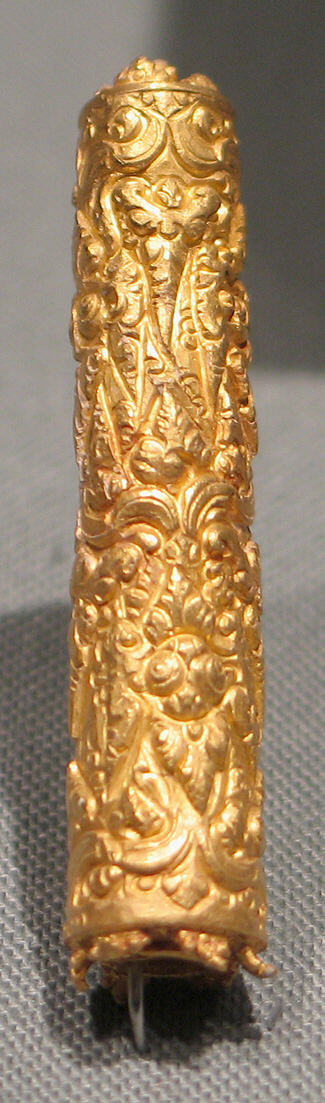
Deconstructing the Sacred: From Javanese Hairpin to SS26 Structural Lexicon
The avant-garde pursuit is not one of mere novelty, but of profound re-contextualization. For Zoey Fashion Laboratory's SS26 collection, the directive is not to replicate, but to transubstantiate. Our origin point is deceptively minute: the apex of a traditional Javanese gold hairpin. This object, a locus of cultural memory, ritual adornment, and refined craftsmanship, becomes the seminal seed for a collection exploring architectural tension, corporeal cartography, and the duality of surface versus narrative. Its correlation with the archival node—the mirror with split-leaf palm design—provides the conceptual framework: one side a polished, reflective plane of ordered beauty; the other, a textured, narrative-driven relief speaking of mortality and legacy. This is the dialectic we weaponize for the future.
Structural Innovation: The Pin as Exoskeletal Armature
The hairpin’s primary function is one of securement and elevation. SS26 transposes this principle from the coiffure to the entire somatic silhouette. We move beyond fabric draped on a body to the construction of a wearable armature, an exoskeleton that defines form from the outside in. Imagine sharp, gilded wires—inspired by the pin’s slender body—emerging from seams and hemlines, not as embellishment but as structural necessity. These linear elements create cantilevers that extend the shoulder line into razor-sharp horizontals, or lift a hemline into a suspended parabola, defying gravity’s pull much as the hairpin holds an elaborate hairstyle aloft.
This approach manifests in what we term "Dermal Scaffolding." Dresses are built upon a foundation of these fine, gold-anodized aluminum or recycled polymer rods, embedded within double-layered organza or fused to technical neoprene. The silhouette is no longer soft but drawn, a series of intentional, precise lines that map a new relationship between body and space. A gown’s back may feature a radiating series of these rods, mimicking the fanning pattern of a *jamang* (Javanese crown) or the split-leaf palm motif, creating a halo of spatial occupation around the wearer. The body becomes the anchor point, the scalp to this sartorial hairpin, with the architecture extending its presence into the environment.
Futuristic Silhouettes: The Dichotomy of Plane and Relief
Here, the archival mirror’s duality becomes our central silhouette generator. We engineer a series of looks that embody this schism between reflective plane and narrative depth.
The "Mirror Plane" Silhouette: This is expressed through sleek, almost liquid, monolithic forms. Think columnar dresses in mirrored chrome laminate or laser-cut vinyl that reflect and distort the surroundings—a literalization of the "光洁银镜" (polished silver mirror). Seams are eliminated or rendered invisible through ultrasonic welding, creating a seamless, impenetrable surface. The silhouette is severe, minimalist, and futuristically austere. It represents the public facade, the polished exterior, the digitized self.
The "Sarcophagus Relief" Silhouette: In stark contrast, this silhouette is entirely about texture, narrative, and dimensional explosion. Inspired by the "冰冷石棺板" (cold stone coffin panel), we employ intricate laser-sintering and 3D-printing to build up surfaces. Gilded palm fronds, inspired by the Javanese *sulur* (floral vine motif), are not printed onto fabric but grown from it as three-dimensional, topographic maps. Silhouettes here are asymmetrical, bulky with meaning, and layered. A coat may appear structured from one angle, but from the side, it erupts in a bas-relief of organic, metallic forms, telling a "生命叙事" (life narrative) through shape and shadow. The body beneath is both obscured and revealed by this tectonic plating.
Material Alchemy: Gilded Fractures and Woven Light
The materiality of gold is not treated as mere ornament but as a functional, conceptual element. We reject plating in favor of fragmentation and integration. Gold is pulverized and fused into transparent resins, creating shattered-glass effects across bodices. It is woven with recycled optical fibers into jacquard patterns that emit a low glow, mimicking the way light catches the high points of a carved relief. Most critically, we develop a "Gilded Fracture" technique: garments are constructed, then strategically deconstructed with precise laser cuts, and the resulting "wounds" are inlaid with strips of recycled gold leather or foil-backed mesh. This makes the process of construction—and deconstruction—visibly sacred, echoing the meticulous craftsmanship of the original artifact while asserting a fractured, nonlinear future.
Conclusion: The Corporeal Node
SS26 for Zoey Fashion Laboratory is an exercise in sartorial archaeology and future-casting. The Javanese hairpin and its correlative mirror are not inspirations but conceptual nodes in an ongoing dialogue between permanence and ephemerality, surface and story, anchor and extension. The resulting collection proposes a future where clothing is not worn but inhabited—a responsive, architectural environment that challenges the very contours of the human form. It is a collection that, like the hairpin securing an elaborate *sanggul*, aims to pin down a moment in fashion’s evolution: a moment of disciplined, radical, and deeply considered structural poetry. The wearer becomes both the polished mirror and the carved narrative, a walking dichotomy forged in gold and shadow.