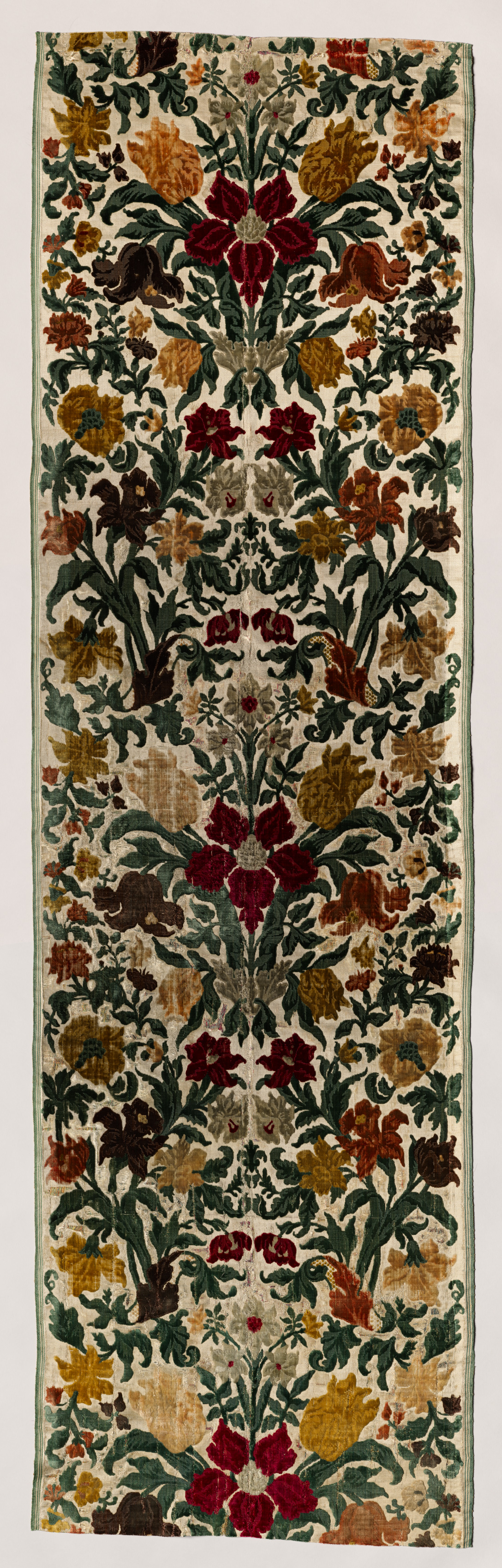
Deconstructing the Genetic Code of Floral Velvet: An Avant-Garde Analysis
As the Chief Fabric Deconstructionist at Zoey Fashion Lab, my role is to dissect the very essence of textiles—not merely their physical composition, but their potential to challenge, redefine, and ultimately rewrite the language of fashion. The subject of this analysis is a singular material: a length of floral velvet, originating from the historic looms of Genoa, Italy. This is not a mere fabric; it is a text, a historical document, and a genetic sequence waiting to be mutated. Our reference point, the "New DNA Strand," serves as a conceptual framework for reinterpreting this classical material through an avant-garde lens. We will explore its technical anatomy—cut, uncut, and voided velvet—and its biological origin in silk, to propose a radical deconstruction and reconstruction for the Zoey Fashion Lab collection.
I. The Genoese Genesis: A Historical and Material Context
The provenance of this floral velvet is critical. Genoa, or Genova, was a powerhouse of velvet production from the 14th century onward, rivaling Venice and Florence. Its looms produced some of the most sumptuous velvets in Europe, often commissioned for ecclesiastical vestments and aristocratic court dress. The floral motif—a recurring pattern of stylized pomegranates, carnations, or acanthus leaves—was not merely decorative; it was a symbol of fertility, prosperity, and the intricate relationship between nature and human artifice. For our lab, this historical weight is both a foundation and a constraint. The New DNA Strand approach demands that we view this fabric not as a finished artifact, but as a parent strand of genetic information. The floral pattern is a sequence of base pairs—A, T, C, G—that can be edited, spliced, and recombined. The challenge is to extract its original code (the luxurious, symmetrical, and hierarchical beauty of the Renaissance) and introduce mutations that yield a new, unsettling, and avant-garde expression.
II. Technical Anatomy: Cut, Uncut, and Voided Velvet
To deconstruct this velvet, we must first understand its three distinct technical registers. Each offers a different texture, light reflectivity, and structural behavior.
Cut Velvet (Velluto Cesellato): This is the dominant texture in our sample. The pile is created by cutting loops of silk thread, resulting in a dense, upright, and lustrous surface. The floral motifs are typically rendered in cut velvet, creating a sharp contrast of high and low. In an avant-garde context, this technique offers a tactile hierarchy. The cut pile can be shaved, burned, or chemically dissolved to create uneven, eroded surfaces. We can treat the floral pattern as a topographical map—the cut areas become peaks, which we can then physically abrade to simulate decay, or laser-etch to introduce new, digital patterns that interrupt the original floral symmetry. The high luster of the silk cut velvet can be selectively dulled or accentuated, creating a visual dissonance that mirrors the fragmentation of a genetic code.
Uncut Velvet (Velluto Riccio): This technique leaves the loops intact, producing a matte, softer, and more absorbent surface. In our floral velvet, uncut areas form the background or secondary motifs. The uncut pile is less reflective, creating a subtle, almost velvety shadow. For deconstruction, the uncut loops can be pulled, snagged, or unraveled to create linear, thread-like trails that resemble the unraveling of a DNA helix. We can intentionally distort the loops by applying heat or pressure, creating permanent creases and folds that mimic the folding of a protein. This introduces a sense of entropy—the fabric is no longer a pristine surface but a dynamic, unstable system. The uncut velvet becomes the mutable ground upon which the cut velvet's "genes" are expressed and transformed.
Voided Velvet (Velluto Vuoto): This is the most radical technique in our sample. It involves selectively weaving areas without pile, creating deliberate "gaps" or voids in the velvet surface. In historical Genoese velvets, these voids often form the background, allowing the underlying silk satin or taffeta to show through. For our avant-garde analysis, the void is the site of mutation. The absence of pile is not a negative space but a positive absence—a place where the fabric's genetic code is missing, awaiting insertion. We can fill these voids with non-traditional materials: metallic threads, phosphorescent yarns, or even biodegradable polymers. The void can be expanded by laser-cutting away the pile around it, creating organic, irregular shapes that resemble chromosomal breaks. The interplay between the dense, floral cut velvet and the empty, luminous voids becomes a dialogue between presence and absence, history and future.
III. The Silk Substrate: Biological and Material Impermanence
The velvet is woven from silk—a protein fiber produced by the silkworm (Bombyx mori). This biological origin is the primary genetic material of our fabric. Silk is strong, lustrous, and historically associated with luxury. But it is also biodegradable, hygroscopic (absorbs moisture), and susceptible to degradation from light, heat, and chemicals. For the New DNA Strand concept, we treat the silk as a living substrate. We can introduce enzymatic treatments that selectively dissolve parts of the silk, creating a "digested" or "eroded" effect that mimics natural decay. Alternatively, we can dye the silk with pH-sensitive or temperature-sensitive pigments, so the floral pattern changes color in response to the wearer's body heat or the environment. This introduces a performative, temporal dimension to the fabric—it is no longer static but responsive, like a living organism. The silk's natural luster can be enhanced or muted by applying metallic leaf or micro-encapsulated scents, adding layers of sensory experience. The ultimate avant-garde move is to grow new fibers—using bacterial cellulose or fungal mycelium—directly onto the voided areas, creating a hybrid textile that is part historical silk, part bio-fabricated future.
IV. Synthesis: The Avant-Garde Mutation
Our deconstruction of this Genoese floral velvet yields a new design vocabulary for Zoey Fashion Lab. The New DNA Strand is not a literal replication of a double helix, but a conceptual framework for mutation, recombination, and expression. We propose the following interventions for the final garment or installation:
1. Asymmetrical Shearing: Use robotic shearing to remove cut pile from specific floral petals, creating a fragmented, half-erased pattern. This mimics a genetic deletion—a missing base pair that alters the entire sequence.
2. Laser-Etched Fractures: Apply a laser to the uncut velvet background, creating fine, branching lines that resemble cracked glass or lightning bolts. These fractures disrupt the floral symmetry, suggesting a genetic breakage that cannot be repaired.
3. Voided Insertions: In the voided areas, insert thermochromic silk ribbons that change from black to white when touched. This creates a responsive, interactive surface—the wearer becomes a catalyst for genetic expression.
4. Biological Erasure: Apply a cellulase enzyme to the cut velvet, selectively digesting the silk fibers to create a moth-eaten, decayed texture. This references the natural lifecycle of silk and introduces a memento mori into the avant-garde aesthetic.
5. Structural Re-weaving: Using a hand-operated loom, re-weave the voided areas with conductive threads and fiber optics. When the garment is worn, the voids will emit a soft, pulsing light, mimicking the bioluminescence of deep-sea organisms. This re-animates the dead, historical fabric with a new, technological life.
In conclusion, this length of Genoese floral velvet is not a relic to be preserved, but a genetic library to be hacked. By deconstructing its cut, uncut, and voided structures, and by manipulating its silk substrate, we can generate a new textile language that is both a homage to its origins and a radical departure. The New DNA Strand is our blueprint for an avant-garde future where fabric is not just worn, but evolved. At Zoey Fashion Lab, we do not merely design clothes; we rewrite the code of fashion itself.