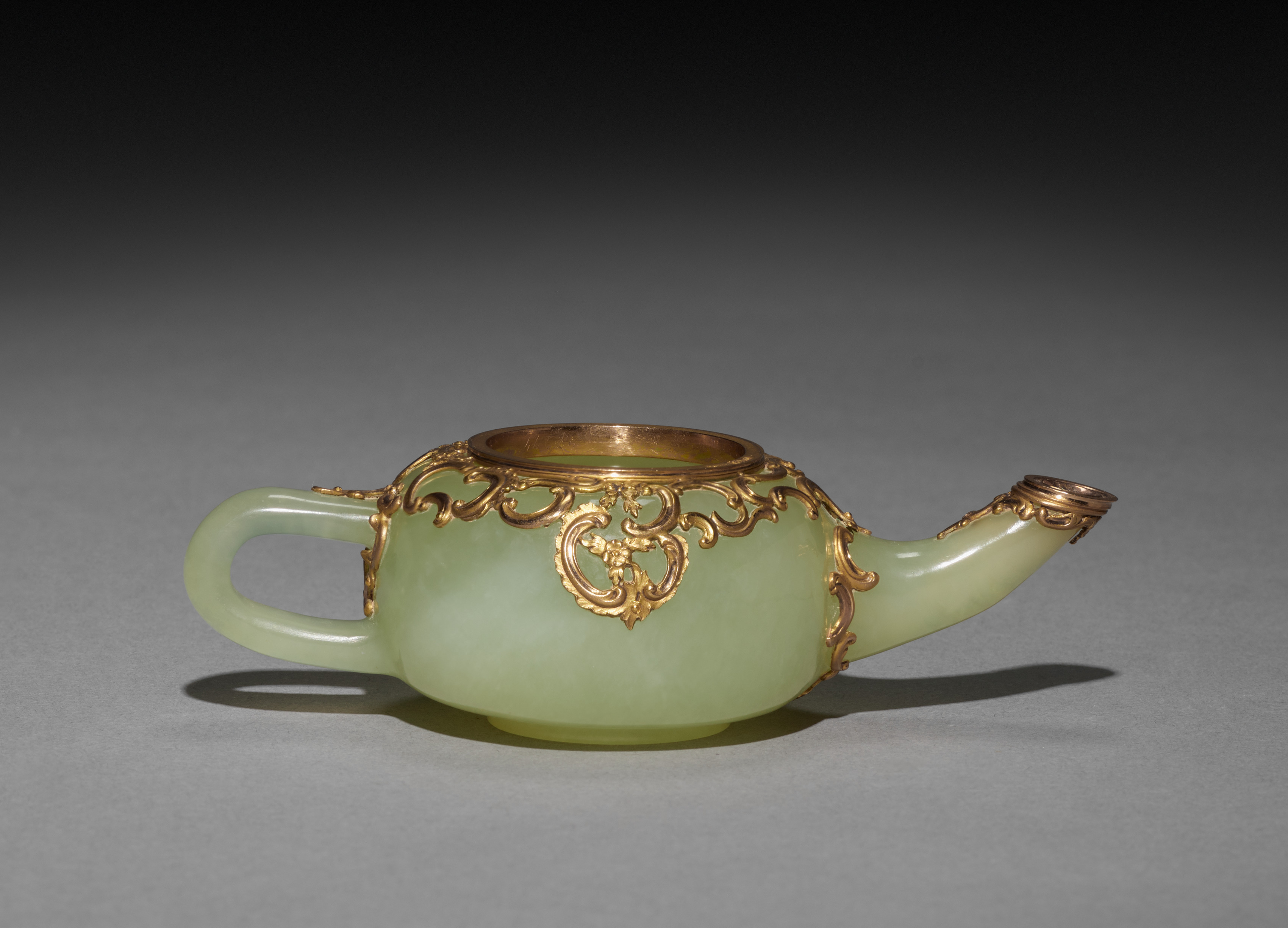
Deconstructing the Miniature Teapot: A Study in Contradiction and Avant-Garde Materiality
At Zoey Fashion Lab, the act of deconstruction is not merely a technical process of disassembly; it is a philosophical inquiry into the origins of form, the narratives embedded within materials, and the potential for transformation. The subject of our current analysis—a miniature teapot from St. Petersburg, Russia—presents a uniquely challenging paradox. Crafted from gold and bowenite, this object is ostensibly a domestic artifact, yet its scale and materiality elevate it into the realm of the avant-garde. Our task is to unravel its structure, not to reduce it, but to reveal the tensions between opulence and austerity, between the intimate and the monumental, that define its core identity.
Material Duality: The Clash of Gold and Bowenite
The fundamental contradiction of this teapot lies in its material composition. Gold, a metal synonymous with wealth, permanence, and reflective brilliance, is paired with bowenite, a serpentine mineral often associated with the earth, the cold, and the opaque. This is not a harmonious marriage; it is a deliberate collision. The gold, likely applied as a gilding or as a structural component, introduces a sense of fluidity and light. Its surface is meant to catch the eye, to shimmer, and to assert a presence of luxury. In contrast, the bowenite—a dense, greenish stone—offers a grounding, almost funereal weight. It is cool to the touch, resistant to polish, and visually absorbs light rather than reflecting it.
From a deconstructionist perspective, this pairing is a statement of avant-garde rebellion against the traditional hierarchy of materials. The gold is not used to elevate the bowenite; rather, the bowenite’s raw, mineral quality subverts the gold’s expected dominance. The teapot’s body, if predominantly bowenite, becomes a vessel of earth, while the gold—perhaps forming the handle, spout, or lid—acts as an alien, metallic intrusion. This tension creates a visual and tactile dialogue: the warmth of gold versus the chill of stone, the polished versus the matte, the ephemeral versus the eternal. In the context of the Archive Resonance reference—which speaks of a “mirror with split-leaves” on one side and a “cold sarcophagus” on the other—the gold mirrors the reflective, ornate surface of the mirror, while the bowenite embodies the stone coffin, a repository of life’s narrative.
Scale as a Form of Subversion
The miniature scale of this teapot is not an accident; it is a deliberate strategy of defamiliarization. A full-sized teapot is a familiar object, associated with ritual, comfort, and domesticity. By shrinking it to a miniature, the object is removed from its functional context and transformed into a totem or a relic. The viewer is forced to confront it not as a tool, but as a sculpture, a symbol, or a fragment of a larger, unknown story. This reduction in scale amplifies the material contrasts—the gold’s details become more precious, the bowenite’s weight more oppressive.
In avant-garde fashion, scale manipulation is a tool to challenge perception. Consider how a garment might be exaggerated or minimized to disrupt the silhouette. Here, the miniature teapot becomes a wearable or displayable object that exists outside of time. It is not meant to hold tea; it is meant to hold meaning. The St. Petersburg origin adds a layer of historical weight—this city, built on swamps and ambition, is itself a monument to artifice and endurance. The teapot, in miniature, echoes that same tension: a tiny, fragile object crafted from enduring materials, a microcosm of imperial grandeur and existential cold.
Archive Resonance: The Mirror-Sarcophagus Dichotomy
The provided Archive Resonance—“一面是光洁银镜上以黄金镶嵌的纷繁棕叶纹,另一面是冰冷石棺板上以浮雕诉说的生命叙事”—serves as a critical lens for our analysis. This phrase describes a dual-faced object: one side a polished silver mirror with intricate gold-inlaid palm leaf patterns, the other a cold stone sarcophagus with a relief depicting a life story. Our miniature teapot embodies this very dichotomy. The gold elements represent the “mirror” side: reflective, ornate, and superficial in the sense of being a surface. The bowenite represents the “sarcophagus” side: dense, narrative, and internal.
The teapot’s form itself becomes a stage for this duality. The lid, perhaps gold, might be a mirror that invites self-reflection, while the body, of bowenite, is the sarcophagus that contains the “life narrative” of the object—its making, its journey from St. Petersburg, its purpose. The spout and handle, if gold, are extensions of the mirror’s ornate leaves, while the stone body is the cold, unyielding record. This is not a simple binary; it is a recursive relationship. The mirror reflects the sarcophagus, and the sarcophagus contains the mirror’s story. The teapot, in its miniature form, becomes a portable archive of this resonance, a physical manifestation of the tension between appearance and essence.
Avant-Garde Application in Fashion and Design
For Zoey Fashion Lab, this analysis is not an end in itself but a foundation for creation. How can the principles of this teapot—material duality, scale subversion, and narrative tension—be translated into fashion? Consider a garment constructed from two opposing fabrics: one side a reflective, gold-embroidered silk that catches light and mimics the mirror’s palm leaves; the other side a heavy, matte jacquard or stone-washed linen that evokes the bowenite’s weight. The cut could be asymmetrical, with one sleeve exaggerated and the other minimal, echoing the teapot’s skewed scale. A structural element, like a collar or a shoulder piece, could be a miniature teapot form itself, rendered in metal and stone, serving as a wearable relic.
Alternatively, the teapot’s narrative could inspire a collection centered on the concept of “domestic archaeology.” Garments would be designed as fragments of a forgotten ritual: a coat with a pocket shaped like a teapot, a skirt with a hem that mimics the bowenite’s geological strata, or a headpiece that combines gold filigree with raw stone. The avant-garde spirit lies in the refusal to settle for mere decoration; every element must carry the weight of the original contradiction.
Conclusion: The Teapot as a Catalyst for Deconstruction
In conclusion, the miniature teapot from St. Petersburg is far more than a decorative object. It is a compressed universe of oppositions: gold versus bowenite, reflection versus absorption, the ornate versus the austere, the miniature versus the monumental. Through the lens of the Archive Resonance, we see it as a mirror-sarcophagus hybrid, a vessel that holds both light and darkness. For Zoey Fashion Lab, this object serves as a powerful catalyst for deconstructing traditional notions of material, scale, and narrative. By embracing its contradictions, we can generate designs that are not merely avant-garde in style but profound in their engagement with the history and philosophy of form. The teapot’s true value lies not in its function but in its capacity to challenge us to see the extraordinary within the miniature, the narrative within the stone, and the reflective within the gold.