The Sleeve Band: A Structuralist Manifesto for SS26
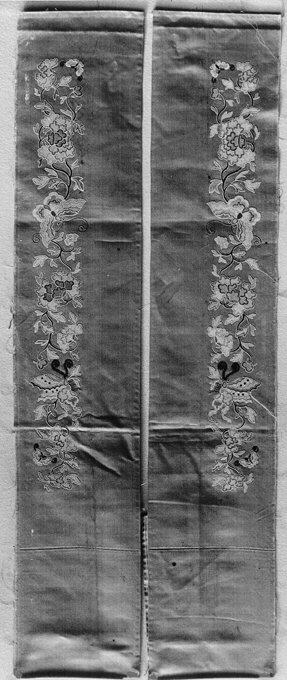
In the relentless pursuit of architectural purity within the avant-garde, the sleeve band has long been relegated to a functional afterthought—a mere boundary between the garment’s torso and the limb. For Zoey Fashion Laboratory’s SS26 collection, we dismantle this paradigm, reimagining the sleeve band as a standalone kinetic sculpture that redefines futuristic silhouettes. Originating from China’s deep textile heritage, this analysis dissects a singular artifact: a sleeve band constructed from silk and metallic thread, embroidered onto a silk base. It is not an accessory; it is a structural fulcrum upon which the entire garment’s volume and motion pivot.
Deconstructing the Boundary: From Constraint to Catalyst
Traditional sleeve bands serve as elastic or sewn-in anchors, stabilizing the sleeve’s hem against the wrist or upper arm. In our SS26 iteration, we invert this logic. The band is liberated from its subservient role and elevated to a primary architectural element. The silk base, in its natural fluidity, offers a counterpoint to the metallic thread’s tensile rigidity. This tension—between soft draping and hard, linear embroidery—becomes the generative force for silhouette innovation. The band no longer merely encircles; it articulates. It creates a cantilevered structure that extends beyond the arm, forming a wing-like projection when the wearer moves, or collapsing into a voluminous, pleated fan when at rest.
The metallic thread, woven in a parametric grid pattern, acts as a memory alloy. It is not merely decorative; it is a self-supporting framework that holds the silk in a state of permanent tension. This allows the sleeve band to assume a geometric, almost robotic silhouette—sharp angles and negative spaces that evoke a cybernetic exoskeleton. The band’s width is exaggerated to 15 centimeters, creating a dramatic visual break between the upper arm and the flowing sleeve. This is not a hem; it is a structural joint that redefines the limb’s relationship to the garment.
Futuristic Silhouettes: The Asymmetric Helix
In SS26, the sleeve band becomes the architectural node for a new silhouette language: the asymmetric helix. The band is not worn uniformly; it is angled, offset from the natural wrist line, and terminated at the elbow in a spiraling overlap. This creates a continuous visual line that wraps around the arm, transforming the sleeve into a mobius-like volume. The silk, anchored by the metallic-thread band, cascades in a single, unbroken plane that twists around the forearm, then flares into a geometric bell shape at the hand. The result is a silhouette that reads as frozen motion—a snapshot of a liquid, digital form rendered in textile.
The band’s modular potential is equally radical. Multiple bands can be stacked vertically along the arm, each with its own metallic-thread tension, creating a layered exoskeleton. When the wearer flexes, these bands shift independently, producing a chimeric, almost insectoid silhouette—a fusion of organic movement and mechanical precision. This is not merely a garment; it is a wearable kinetic system that responds to the body’s biomechanics.
Material Alchemy: Silk and Metallic Thread as Structural Elements
The choice of materials is not aesthetic but functional and symbolic. Silk, with its natural luster and drape, represents the organic, fluid body—the baseline of human form. The metallic thread, typically used in Chinese embroidery for decorative symbolism (e.g., dragons or clouds), is here recontextualized as a load-bearing element. It is woven in a tensile grid that mimics the structural logic of architectural trusses. The thread’s metallic sheen catches light, but its true purpose is compression resistance. When the band is bent, the metallic threads lock into place, holding the silk in a precise, sculptural fold.
This material alchemy is achieved through a digital embroidery process that maps the band’s stress points. The silk base is pre-stretched over a custom form, and the metallic thread is applied in a variable-density pattern: denser at the band’s edges for rigidity, looser at the center for flexibility. The result is a gradient of structural integrity—a single continuum from rigid exoskeleton to soft, breathable fabric. This is a radical departure from traditional Chinese embroidery, which prioritizes flat, decorative surfaces. Here, the embroidery becomes three-dimensional architecture.
Structural Innovation: The Cantilevered Cuff and the Floating Sleeve
The most daring innovation is the cantilevered cuff. The sleeve band is extended beyond the hand, forming a floating extension that hovers 10 centimeters past the fingertips. This extension is supported solely by the metallic-thread grid, with no underlying fabric. The silk sleeve terminates at the band, leaving the extension as a transparent, skeletal wing. When the arm is raised, this wing catches air, creating a dramatic, aerodynamic silhouette that defies the garment’s weight. The band’s structural integrity allows the wearer to control the wing’s angle through subtle wrist movements—a biomechanical interface between human and garment.
Furthermore, the band incorporates magnetic closures embedded within the metallic thread’s weave. This allows the band to be reconfigured in real-time: it can be detached and reattached at different points on the arm, or even transferred to the waist or neck, transforming the sleeve into a modular appendage. This is a futuristic silhouette that anticipates the wearer’s need for adaptability—a garment that is not static but evolving.
Cultural and Conceptual Resonance: The Sleeve Band as Digital Totem
This sleeve band is not merely a technical exercise; it is a cultural statement. In Chinese history, sleeve bands were often used to denote status, with intricate embroidery signaling wealth. In our SS26 iteration, we deconstruct this symbolism by stripping away overt ornamentation and replacing it with pure structural logic. The metallic thread’s grid evokes the digital realm—a binary code of warp and weft—while the silk rootes the piece in ancient craftsmanship. This creates a dialectic between tradition and futurism, where the sleeve band becomes a totem of post-human identity.
For Zoey Fashion Laboratory, this sleeve band is a manifesto for SS26. It declares that the future of couture lies not in fabric as a passive covering, but in textile as an active, structural medium. The sleeve band is no longer a boundary; it is a generator of new forms—a bridge between the body and the machine, the past and the future. In its tension between silk and metal, between organic drape and geometric rigidity, we find the essence of avant-garde innovation: the courage to dismantle the familiar and rebuild it as something alien, beautiful, and utterly unprecedented.