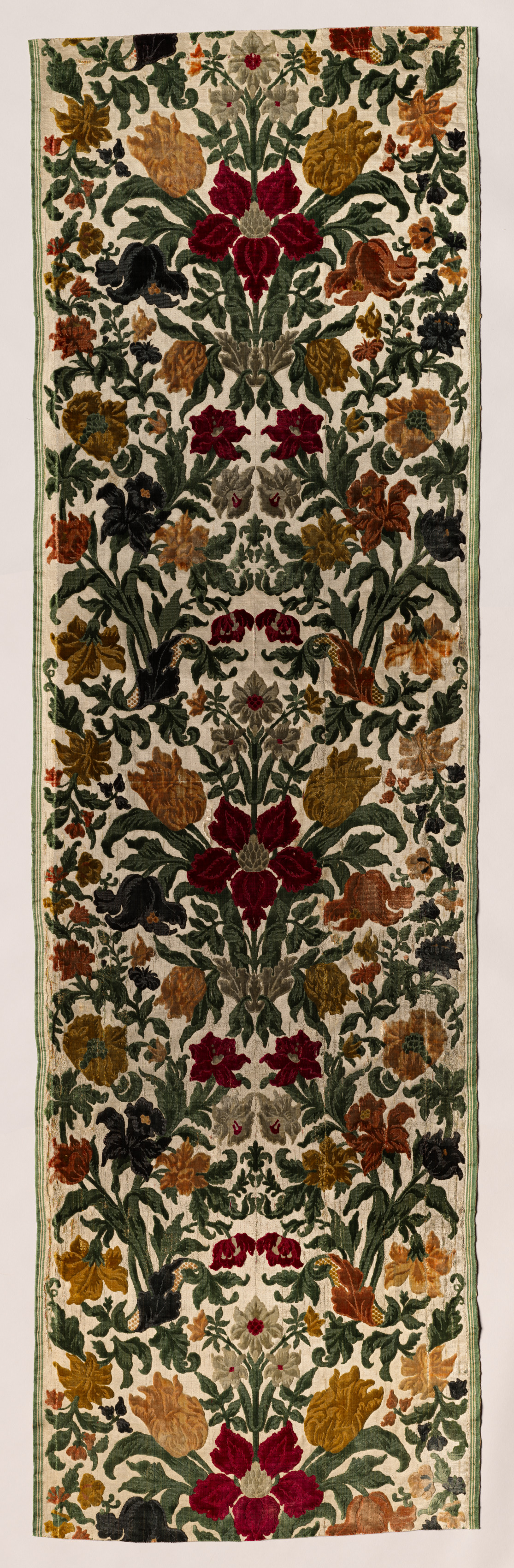
Deconstructing the Floral Velvet: A Technical and Avant-Garde Analysis for Zoey Fashion Lab
At Zoey Fashion Lab, we do not merely observe textiles; we interrogate them. We dissect their molecular structure, their historical weight, and their potential for radical reinvention. The subject of this analysis—a length of floral velvet originating from Genoa, Italy—presents a particularly rich case study. This is not a relic to be preserved, but a genetic code to be recombined. Our reference point, the New DNA Strand, is not a metaphor; it is a design directive. We will deconstruct this velvet’s technical architecture to understand how its cut, uncut, and voided elements can be spliced, mutated, and expressed in an avant-garde context that defies traditional luxury.
I. The Genoese Genetic Code: Historical Context and Material Provenance
Genoa, during the Renaissance and Baroque periods, was a powerhouse of velvet production, particularly the prized velluto a cesellato (chiseled velvet) and velluto allucciolato (voided velvet with metallic threads). This fabric carries the DNA of that legacy. The floral motif, likely a stylized pomegranate or carnation, is not merely decorative; it is a structural element. In historical Genoese weaving, the pattern was created by the interplay of pile heights and ground weaves. The silk base—a warp-faced satin or twill—provides the luminous ground, while the pile, formed by additional warp threads, creates the velvet surface. The Genoese weavers mastered the art of voiding, where sections of the pile are deliberately omitted to reveal the shimmering silk ground, creating a chiaroscuro effect that is both tactile and optical.
For Zoey Fashion Lab, this historical context is not a constraint but a catalyst. The New DNA Strand approach requires us to view this fabric as a living organism. The floral motif is not a fixed image; it is a sequence of pile loops and cut pile interactions. The uncut pile (loops) offers a matte, textured surface, while the cut pile (velvet) yields a plush, light-absorbing depth. The voided areas are the negative space—the silence between notes. This is the raw genetic material we will manipulate.
II. Technical Deconstruction: Cut, Uncut, and Voided as Design Variables
To engineer an avant-garde expression, we must treat each technical component as an independent variable:
1. Cut Velvet (Pile Coupé): This is the dominant tactile element. In the Genoese original, the cut pile forms the petals and leaves of the floral pattern. The height of the pile—typically 1-2 mm—creates a dense, sumptuous surface. For the New DNA Strand, we propose a radical manipulation: asymmetric pile height. By using a dual-warp system, we can create sections where the cut pile is 3 mm on one petal and 0.5 mm on an adjacent leaf, generating a topographic relief that mimics cellular growth. This is not a flat pattern; it is a landscape.
2. Uncut Velvet (Pile Bouclé or Loop): The loops, when left uncut, produce a more irregular, granular texture. Historically, this was used for backgrounds or secondary motifs. In our avant-garde reconfiguration, we will selectively heat-set the loops to create permanent crimps and distortions. This introduces a memory effect—the fabric will retain a three-dimensional wave, even when draped. The loops become a structural exoskeleton, not a mere surface finish.
3. Voided Velvet (Velluto Vuoto): This is the most critical variable for the New DNA Strand. In traditional voided velvet, the pile is absent in specific areas, revealing the silk ground. We propose a laser-guided voiding technique that removes pile in irregular, fractal patterns—not geometric, but biological. Imagine the negative space of a leaf skeleton or the branching of a neural network. The voided areas will not follow the floral motif; they will interrupt it, creating a tension between the organic floral shape and the inorganic voided network. The silk ground, in its raw, unadorned state, becomes a conductive surface for further manipulation.
III. The New DNA Strand: Splicing Silk with Avant-Garde Techniques
The silk base itself is not passive. We will treat it as a substrate for bio-mimetic coating. Using a micro-encapsulation process, we can infuse the voided areas with thermochromic pigments that change color with body heat. The floral velvet remains static, but the voided ground becomes a dynamic, responsive layer. This creates a dialogue between the historical permanence of the Genoese weave and the ephemeral, interactive quality of the New DNA Strand.
Further, we propose a deconstructive cutting of the fabric itself. Instead of using the full width of the velvet, we will isolate individual floral clusters—each cluster a genetic unit—and re-weave them into a new matrix using a laser-welded seam technique. The seams will be visible, not hidden; they become the suture lines of a new organism. The voided areas will be cut away entirely, leaving only the pile clusters floating on a transparent, silk organza ground. The result is a fabric that is simultaneously dense and ethereal, heavy and weightless.
IV. Avant-Garde Expression: From Textile to Wearable Biology
For Zoey Fashion Lab, the final garment is not a dress; it is a wearable biological system. The floral velvet, deconstructed and recombined, becomes a second skin that registers and responds to the environment. The cut pile provides insulation and structure; the uncut loops offer ventilation and flexibility; the voided areas act as thermal windows. The thermochromic silk ground will shift from deep burgundy (the historical Genoese color) to electric blue when the wearer’s body temperature rises, creating a visual pulse.
The silhouette will be asymmetrical and fragmented, reflecting the genetic splicing. One sleeve may be fully covered in high-pile cut velvet, while the other is a lattice of voided silk and floating floral clusters. The hemline will be laser-cut into irregular, organic edges that mimic the frayed ends of a DNA strand. This is not about comfort; it is about provocation and transformation.
V. Conclusion: The Future of Velvet as a Living Archive
This length of Genoese floral velvet is not a dead artifact. It is a dormant genetic sequence waiting to be activated. By treating its cut, uncut, and voided elements as discrete variables in a design equation, we have redefined it as a New DNA Strand. The result is an avant-garde textile that honors its historical craftsmanship while violently rejecting its static nature. For Zoey Fashion Lab, this is not the end of the analysis; it is the beginning of the mutation. The fabric will never be the same again—and that is precisely the point.