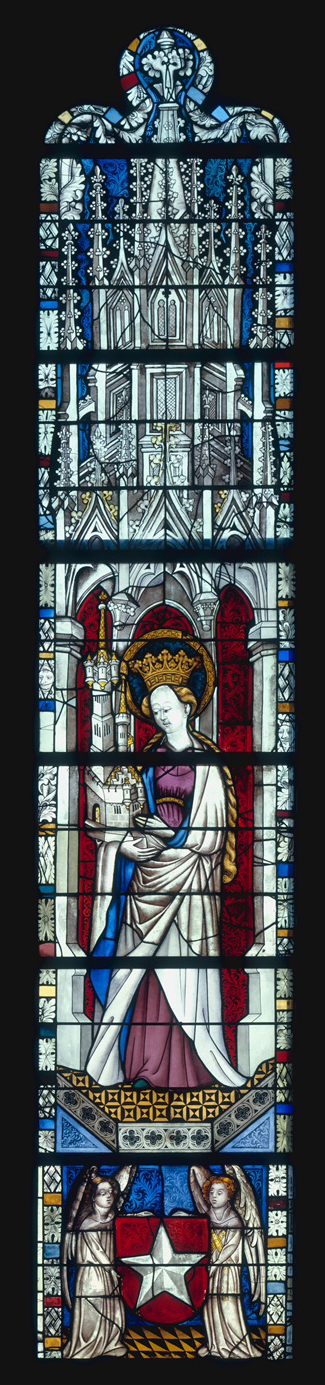
Deconstructing the Divine: Saint Barbara’s Tower as a Blueprint for SS26 Structural Innovation
In the hallowed silence of a medieval German workshop, a fragment of eternity was captured in pot-metal glass, white glass, vitreous paint, and silver stain. The depiction of Saint Barbara Holding a Tower, from the series with The Virgin Mary and Five Standing Saints, is not merely a relic of Gothic piety; it is a radical manifesto for the future of fashion. For Zoey Fashion Laboratory’s SS26 avant-garde study, this stained-glass saint offers a profound lexicon of futuristic silhouettes and structural innovation. The tower she holds—a symbol of her imprisonment and subsequent martyrdom—becomes an architectural metaphor for the body as a site of both constraint and liberation. Here, the holy becomes the hyper-modern, the sacred geometry of the past is recast as the blueprint for a new, armored femininity.
The Tower as Exoskeleton: Reimagining Silhouette as Architecture
The central motif of Saint Barbara’s tower is not a static object but a dynamic, load-bearing structure. In our SS26 interpretation, this tower is deconstructed and re-engineered as a wearable exoskeleton. Imagine a silhouette that is both rigid and fluid: a high-collared, cantilevered jacket that juts forward like a parapet, its shoulders squared into buttresses of sculpted, pot-metal glass-infused resin. The glass itself—translucent, fractured, and layered—becomes the primary textile. We propose a technique of laminated vitreous panels, heat-molded to the body’s contours, creating a second skin that is both protective and transparent. The saint’s tower is no longer a distant symbol; it is a futuristic carapace, a fortress worn on the body, its crenellations translated into sharp, asymmetrical hemlines and angular, origami-like folds that defy the natural drape of fabric.
This is not a garment that follows the body; it is a garment that redefines the body’s architecture. The silhouette becomes a series of intersecting planes—a geometric abstraction of the tower’s stonework. The waist is cinched not by a belt, but by a rigid, circular hoop reminiscent of a rose window, while the skirt flares into a bell-like volume, its surface a mosaic of silver-stained glass shards. The overall effect is one of monumental fragility, a paradox that speaks to the saint’s own narrative of vulnerability and strength. Each piece is a standalone study in how sacred, medieval structural principles can be updated for a world where the body is both a fortress and a site of radical expression.
Material Alchemy: Pot-Metal Glass and the Optics of the Future
The materiality of the original artifact—pot-metal glass, white glass, vitreous paint, and silver stain—is not a limitation but a generative force. For SS26, we propose a material alchemy that transforms these historical substrates into avant-garde textiles. Pot-metal glass, with its deep, saturated hues, is reimagined as amorphous, hand-cast polymer panels that capture light like stained glass but move with the wearer. White glass, the translucent base, becomes a biodegradable, milk-white membrane that can be laser-cut into intricate, lace-like patterns, evoking the delicate tracery of Gothic windows. Vitreous paint, originally used for facial details and shadows, is translated into digital-printed, UV-reactive pigments that shift color under different light conditions, creating a dynamic, living surface on the garment.
The silver stain, a hallmark of medieval glasswork, is perhaps the most revolutionary element. In our SS26 collection, silver stain is not a surface treatment but a conductive, metallic thread woven into the fabric. This thread can be used to create illuminated embroidery that traces the saint’s halo or the tower’s battlements, powered by miniature, flexible batteries. The garment becomes a luminous, interactive artifact, its light output changing in response to the wearer’s movements or the ambient environment. This is not mere decoration; it is a structural innovation that blurs the line between garment and architecture, between the sacred and the technological. The silver stain, once a mark of devotion, now becomes a conduit for futuristic expression.
Deconstructive Aesthetics: The Fractured Saint and the Unfinished Tower
The avant-garde imperative is to deconstruct, to reveal the hidden scaffolding. Saint Barbara’s tower, in its original stained-glass form, is a complete, idealized structure. In our SS26 study, we fracture this completeness. The tower is disassembled into its constituent parts: the windows become cut-outs in a leather bodice, the battlements become jagged, removable epaulets, and the foundation stones are transformed into a series of modular, interlocking panels that can be reconfigured by the wearer. This is a deconstructive aesthetic that celebrates the unfinished, the raw, and the exposed. The seams are left visible, the glass panels are held in place by exposed metal rivets, and the silver-stain embroidery is deliberately erratic, as if the saint herself is in the process of being built or unbuilt.
This approach challenges the conventional notion of a finished garment. Instead, each piece is a system of possibilities. A jacket might be worn with its sleeves detached, revealing the armature of the shoulder. A skirt might be a cascade of glass shards that can be added or removed, altering the silhouette from a narrow column to a voluminous bell. The structural innovation lies in the creation of a garment that is not static but evolving, a reflection of the saint’s own journey from captive to transcendent. The fragmented tower becomes a metaphor for the modern self—a being in constant construction, defined by its fractures and its potential for reassembly.
Futuristic Silhouettes: The Armored Feminine and the Sacred Geometry of Power
The final synthesis of this avant-garde study is the creation of a futuristic silhouette that is both armored and ethereal. Saint Barbara, as a martyr, is a figure of immense inner strength; her tower is a symbol of her defiance. In our SS26 collection, the silhouette is designed to empower the wearer through its very structure. The shoulders are broad, not through padding but through cantilevered glass wings that echo the tower’s buttresses. The waist is defined by a geometric corset made of interlocking, laser-cut glass tiles, each one a miniature version of the tower’s windows. The hemline is asymmetrical, one side trailing into a train of silver-stained fabric, the other cut sharply at the knee, creating a dynamic, forward-moving line.
The sacred geometry of the original—the pointed arches, the rose windows, the vertical lines—is translated into 3D-printed, lattice-like structures that form the sleeves and collars. These structures are not decorative; they are functional, providing support and structure to the garment while allowing for unprecedented freedom of movement. The overall effect is one of monumental grace, a silhouette that is both a fortress and a flight. The wearer becomes a modern saint, not of religion, but of self-determination, her body a testament to the power of architectural thinking in fashion. This is the definitive avant-garde couture of SS26: a dialogue between the medieval and the futuristic, the sacred and the structural, the glass and the body.