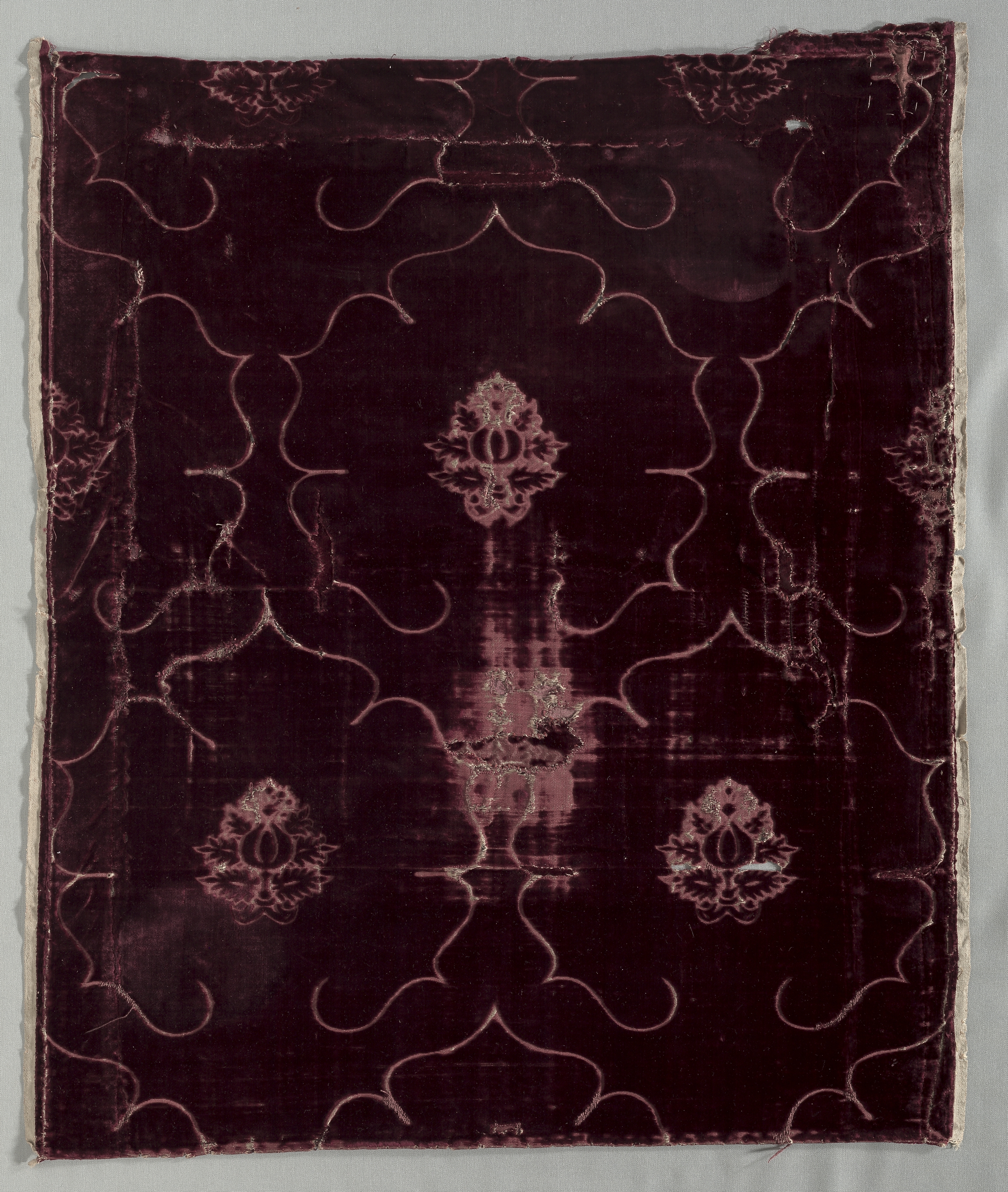
Technical Analysis: Velvet Fragment (Italy, 15th Century)
The provided fragment represents a pinnacle of late medieval textile technology and artistry. Its designation as cut and voided velvet is critical. This technique involves weaving two sets of warp threads (the lengthwise threads on the loom): a ground warp and a supplementary pile warp. The pile warp forms loops over rods inserted during weaving. For cut velvet, these loops are later cut, creating the fabric's signature plush, luminous surface. The voided aspect is more complex and prestigious; here, the pile warp is selectively woven to create a raised pattern, while the background areas are left as plain, flat silk ground. This creates a dramatic play of texture and light—a sculptural effect in cloth. The base material, silk, confirms its luxury status, accessible only to the ecclesiastical, royal, or supremely wealthy elite. The "New DNA Strand" reference is apt: this textile technology was the cutting-edge genomic code of its day, a tightly guarded secret of Italian city-states like Florence, Venice, and Genoa, which dominated the European luxury trade.
Deconstruction: From Historical Artifact to Avant-Garde Codex
Our role is not to restore, but to dissect and re-engineer. This fragment is not merely a sample; it is a multidimensional blueprint. We deconstruct it across four vectors:
1. Material Memory: The silk carries the memory of the worm, the dyer's vat (likely using precious pigments like kermes for crimson), and the loom. The velvet pile holds the shadow of the cutter's blade. We interrogate these memories. Can we replicate the tactile dichotomy of voided velvet using modern sustainable polymers or bio-fabricated silk? Can the "cut" be achieved through laser etching or ultrasonic bonding, creating new forms of textural relief?
2. Structural Paradox: Velvet is a study in contradiction—simultaneously robust and delicate, absorbing and reflecting light. The voided technique introduces a binary system: presence (pile) and absence (ground). In avant-garde terms, this is not just pattern; it is data visualization. The raised motifs (likely pomegranates, acanthus, or heraldic symbols) are units of information against a silent field. Our design process transposes this binary into modern contexts: hard vs. soft tech, opaque vs. transparent materials, protective shell vs. vulnerable core.
3. The "DNA Strand" Helix: The reference is a direct prompt. The double helix structure of DNA is a twisted ladder, a code built on pairs. This mirrors the very structure of velvet: the ground warp and pile warp, intertwined to create a third, luxurious substance. Our avant-garde interpretation literalizes this. Imagine garments constructed from intertwined strands of contrasting materials—a rubberized cord woven with silk chenille, or optical fiber paired with reclaimed wool—where the "pile" is not cut loops but emergent properties like light emission or dynamic texture change.
Avant-Garde Synthesis: The Zoey Fashion Lab Proposition
Informed by this deconstruction, we move from analysis to proposition. The avant-garde style demands a forward-looking dialogue with the past, not pastiche.
Collection Concept: "Voided Genome"
This collection positions the 15th-century velvet fragment as the ancestral source code. Each piece will manifest a decoded and recompiled aspect of its DNA.
Silhouette & Architecture: Moving beyond flat cloth, we treat the voided technique as a spatial mapping principle. Where the historical fragment has raised motifs on a flat ground, our garments will feature sculptural, 3D-printed or thermo-molded "pile" elements emerging from a sheer or matte "ground" base. A coat, for instance, might have a smooth, liquid silk shell suddenly erupt with organic, velvet-like protrusions along one shoulder and sleeve, creating a living, topographic map on the body.
Material Innovation: We re-sequence the material "genome." The silk remains an inspiration for its sensual hand, but we hybridize it. Develop a techno-velvet: a base of recycled nylon mesh (the voided ground) fused with a pile of shredded, re-woven silk scraps from production waste, creating a new textile with a profound narrative of circularity and contrast. Alternatively, use a base of silicone-coated technical fabric, with a "pile" made of laser-cut, recycled leather strips or biodegradable acrylic rods, playing the historical luxury against industrial modernity.
Pattern & Surface Narrative: The original fragment's pattern held symbolic meaning. Our new "patterns" will be derived from contemporary data sets—sonic waveforms, digital traffic flows, or biometric readings. These will be translated into voided velvet jacquards, where the "pile" forms the data peaks. A dress could feature a pattern derived from the wearer's own heartbeat rhythm, making the garment a deeply personal, tactile visualization.
Philosophical Core: The true avant-garde leap is conceptual. The 15th-century velvet signified power, wealth, and divine connection through its material splendor. "Voided Genome" will signify conscious integrity, coded identity, and sustainable luxury. The "void" is not empty space; it is the essential ground that gives the figure meaning, the silence between notes, the sustainable choice within a system of excess. The wearer engages in a dialogue of presence and absence, history and future.
Conclusion: The Fragment as Catalyst
This Italian velvet fragment is far more than a historical artifact. It is a catalyst for a material philosophy. By deconstructing its technical prowess—the cut and voided silk—through the lens of avant-garde design and the metaphor of a genetic strand, Zoey Fashion Lab can engineer a new lineage for luxury. We honor the past not by replicating its forms, but by embracing its innovative spirit to code a future where texture is intelligent, surface is narrative, and beauty is a complex equation of memory and innovation. The result will be a collection that, like the fragment itself, feels both timeless and radically new.