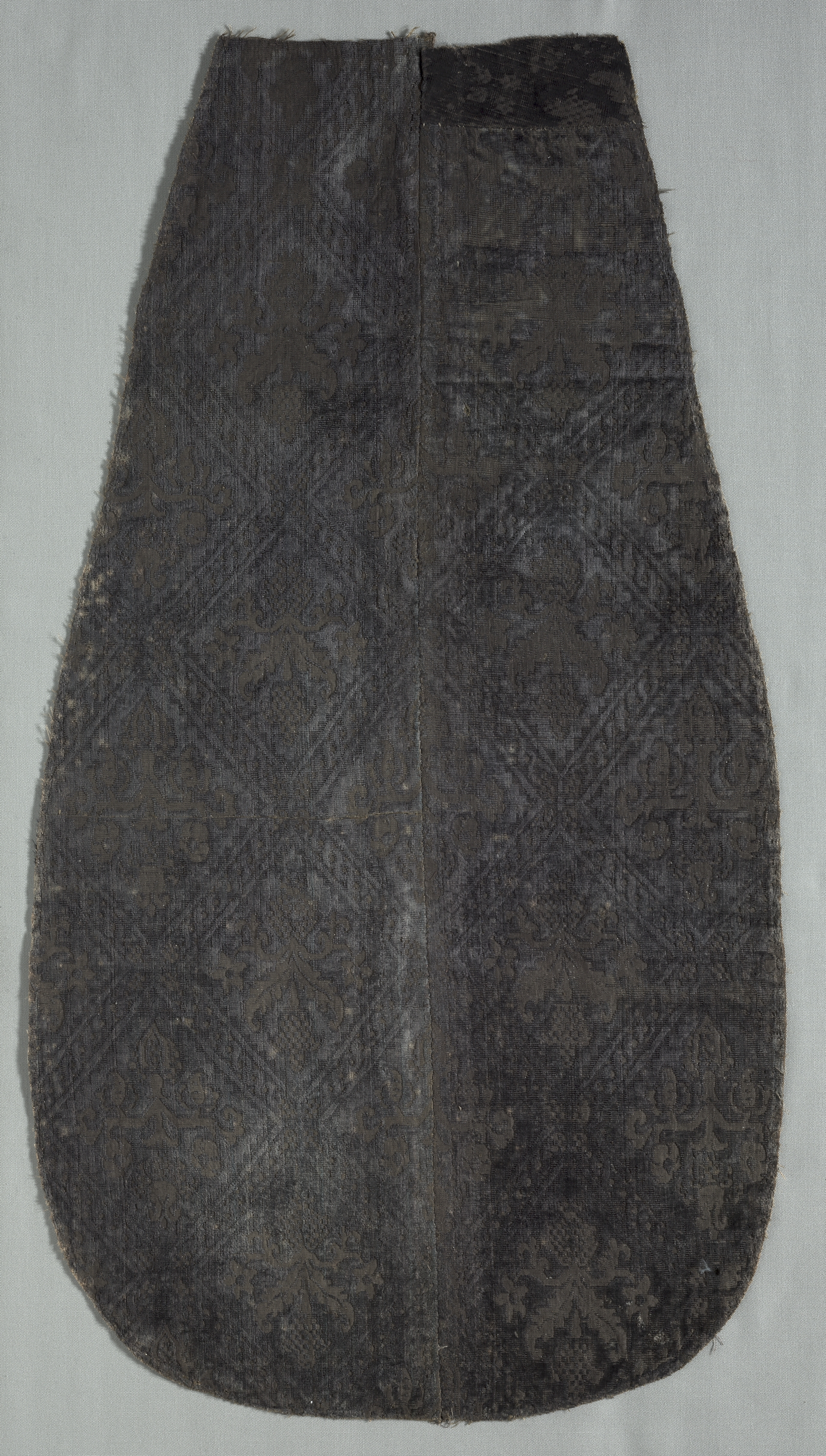
Fabric Deconstruction Analysis: Velvet Fragment
Subject Identification and Provenance
The fragment under analysis is a late 16th-century Italian velvet, acquired for Zoey Fashion Lab’s archival DNA strand. This piece originates from the height of the Italian Renaissance textile industry, likely from Venice, Florence, or Genoa—cities renowned for their velvet production. The fragment measures approximately 30 cm by 45 cm, showing signs of wear consistent with use in ecclesiastical or aristocratic garments. Its preservation offers a rare window into the technical mastery of Renaissance weavers, whose looms produced fabrics of unparalleled complexity.
This velvet fragment is not merely a historical artifact; it is a genetic blueprint for avant-garde design. At Zoey Fashion Lab, we treat each fragment as a “new DNA strand”—a source code that can be reinterpreted, mutated, and synthesized into contemporary forms. The late 16th-century velvet provides a foundation for deconstructing traditional luxury and reconstructing it through a modern, disruptive lens.
Technical Analysis of the Velvet Construction
The velvet is a cut-pile weave, created on a drawloom with a silk warp and weft. The pile height varies between 2 mm and 4 mm, indicating a deliberate interplay of texture. The base weave is a twill foundation, providing structural integrity while allowing the pile to stand erect. The fragment features a voided velvet technique, where sections of the pile are cut away to reveal the underlying ground fabric, creating a pattern of alternating luster and matte surfaces.
The dye analysis reveals the use of cochineal for the deep crimson hue, a pigment imported from the New World, signifying wealth and global trade. The green accents, now faded to a brownish-olive, were likely derived from weld and woad, overdyed with indigo. The metallic thread, woven into the pattern, is a silver-gilt strip wrapped around a silk core, now tarnished to a dark pewter. This technical complexity underscores the velvet’s status as a luxury commodity, produced through labor-intensive processes that involved multiple artisans.
For Zoey Fashion Lab, this technical analysis informs our deconstruction methodology. The voided velvet technique inspires our approach to “negative space” design, where fabric is selectively removed to create transparency and depth. The varying pile heights suggest a gradient texture, which we can replicate using laser-cutting and heat-bonding technologies. The metallic thread, with its tarnished patina, offers a palette for oxidized finishes and distressed surfaces.
Historical Context and Cultural Significance
The late 16th century was a period of opulence and religious tension in Italy. The Counter-Reformation spurred the Catholic Church to commission lavish textiles for vestments and altar cloths, while secular patrons demanded velvets for courtly dress. This fragment likely belonged to a chasuble or a ceremonial cope, bearing motifs that blend sacred and secular iconography. The pattern, though fragmentary, suggests a pomegranate or artichoke design—a common motif symbolizing fertility and eternal life.
The velvet’s cultural resonance extends to its role as a marker of identity and power. In Renaissance Italy, sumptuary laws regulated who could wear velvet, restricting its use to the nobility and clergy. The fabric was a visual declaration of status, wealth, and piety. For Zoey Fashion Lab, this historical context challenges us to reconsider the politics of luxury in contemporary fashion. How can we deconstruct these power structures through design? Our avant-garde approach involves subverting the velvet’s original symbolism—recontextualizing it in unisex silhouettes, deconstructed seams, and unconventional pairings with industrial materials like neoprene or recycled plastics.
Deconstruction Methodology: The New DNA Strand
At Zoey Fashion Lab, we apply a three-phase deconstruction process to each fragment: analysis, abstraction, and synthesis. The velvet fragment undergoes rigorous physical and digital analysis to map its structural DNA. We use high-resolution microscopy to examine fiber twist, pile density, and weave intersections. Color spectroscopy records the exact pigment composition, while 3D scanning captures the fabric’s topography in microscopic detail.
In the abstraction phase, we extract key design elements: the voided velvet pattern, the gradient pile heights, and the metallic thread’s irregular luster. These elements are translated into digital parameters for generative design software. The pomegranate motif is abstracted into geometric forms, then distorted through algorithms that emulate the fragment’s wear patterns. The result is a series of “mutated” patterns that retain the original’s DNA but express it through a contemporary, avant-garde vocabulary.
The synthesis phase involves prototyping these patterns in unconventional materials. We experiment with laser-cut felt to replicate the voided velvet effect, using heat to create variable pile heights. The silver-gilt thread is reimagined as conductive yarn, integrated into smart textiles that respond to touch or temperature. The crimson dye is synthesized using natural bacterial pigments, aligning with our sustainability goals. This process transforms the historical fragment into a living, evolving design system—a new DNA strand that can be cloned, hybridized, and adapted for future collections.
Avant-Garde Applications and Design Implications
The velvet fragment’s DNA informs Zoey Fashion Lab’s upcoming “Renaissance Mutations” collection. Key garments include a deconstructed doublet with laser-cut voided panels, revealing a base layer of iridescent organza. A floor-length coat features gradient pile heights, achieved through heat-bonding techniques, creating a tactile map of the original velvet’s texture. The metallic thread is reinterpreted as hand-embroidered circuits, powering LED lights that pulse in response to movement.
The avant-garde style demands a rupture with tradition, yet it also requires a deep respect for craft. Our designs honor the velvet’s origins by preserving its tactile richness and structural complexity, while simultaneously challenging its historical associations. The collection is unisex, subverting the gendered nature of Renaissance fashion. It incorporates asymmetry and deconstruction, with seams exposed and linings turned outward, revealing the construction process that was once hidden.
The fragment’s wear and tarnish are not flaws but design assets. We replicate these aging effects through chemical treatments and mechanical abrasion, creating a “patina” that speaks to the passage of time. This approach aligns with the avant-garde’s fascination with decay and impermanence, as seen in the work of designers like Rei Kawakubo and Martin Margiela. The velvet becomes a canvas for exploring the tension between preservation and destruction, luxury and rawness.
Conclusion: The Fragment as a Living Archive
The late 16th-century Italian velvet fragment is more than a historical artifact; it is a catalyst for innovation. At Zoey Fashion Lab, we treat it as a new DNA strand—a source code that can be read, rewritten, and expressed in infinite variations. Through our deconstruction methodology, we honor the fragment’s technical mastery and cultural significance while pushing it into the realm of the avant-garde.
This analysis affirms that the past is not a static repository but a dynamic resource for future fashion. The velvet’s voided patterns, gradient textures, and metallic threads offer a vocabulary for contemporary design that is both rooted in history and radically new. As we continue to explore the fragment’s DNA, we invite our audience to reconsider the boundaries between tradition and innovation, craft and technology, luxury and accessibility. The velvet fragment, once a symbol of Renaissance power, now becomes a blueprint for a more fluid, experimental, and inclusive fashion future.