Deconstructing the Dragon's Chase: A Technical and Symbolic Analysis of "Dragons Chasing Flaming Pearls"
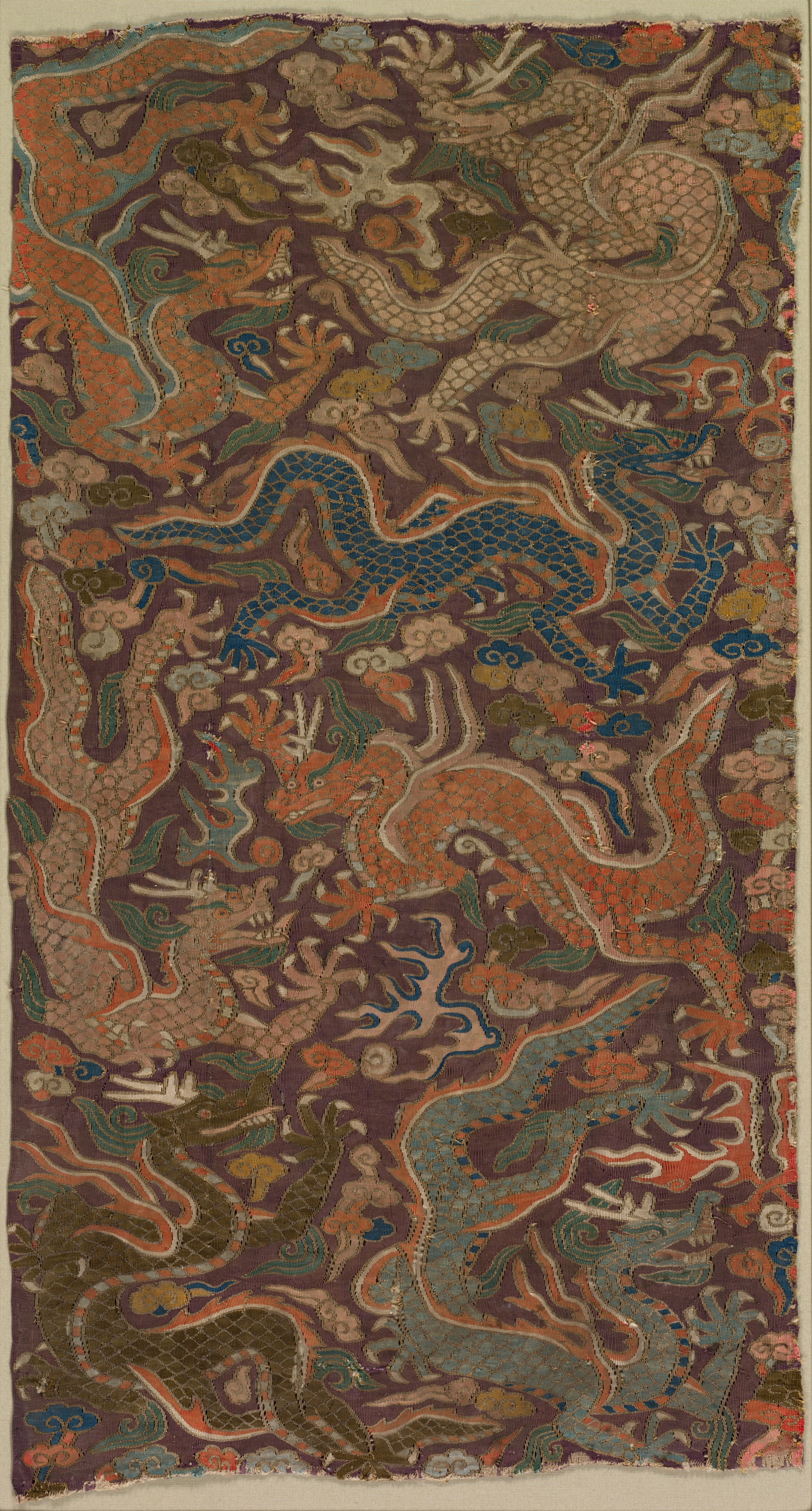
As Chief Fabric Deconstructionist for Zoey Fashion Lab, it is my privilege to present a comprehensive analysis of the textile artifact titled "Dragons Chasing Flaming Pearls". This piece, originating from Central China and executed in silk and gold thread tapestry, represents a profound intersection of ancient symbolism and avant-garde fashion theory. The reference to a "New DNA Strand" is not merely a poetic flourish but a critical lens through which we must examine the fabric's structural, chromatic, and narrative DNA. This analysis will dissect the tapestry's materiality, its symbolic choreography, and its radical reinterpretation through the avant-garde lens, ultimately positioning it as a living, mutating organism within the Zoey Fashion Lab ecosystem.
Material DNA: Silk, Gold, and the Tapestry as Genetic Code
The choice of silk and gold thread as the primary materials is not arbitrary; it is a deliberate invocation of China's imperial and spiritual heritage. Silk, a protein fiber derived from the silkworm, possesses a natural luster and tensile strength that mimics the fluidity of dragon scales and the ethereal quality of celestial pearls. Gold thread, often spun around a silk core, introduces a metallic rigidity that disrupts the silk's softness, creating a tension between organic flow and structural permanence. This duality mirrors the "New DNA Strand" reference: the silk represents the mutable, living code, while the gold acts as the inert, stabilizing marker—a metallic nucleotide that locks the pattern into place.
From a technical standpoint, the tapestry weave itself is a form of genetic expression. Each pass of the weft thread over the warp is a transcription of information, a binary of over-under that builds the image. In "Dragons Chasing Flaming Pearls," the density of the weave is variable; the gold thread is often floated across the surface in long, unbroken strands to create the pearls' fiery halos, while the silk is tightly packed to render the dragons' sinuous bodies. This variation creates a textural genome where smooth and rough, matte and reflective, coexist. The avant-garde interpretation demands we see this not as a finished image but as a sequence of code—a fabric that can be "read" for its historical and futuristic instructions.
Choreography of the Chase: Symbolic Deconstruction
The central motif—dragons chasing flaming pearls—is a classic trope in Chinese mythology, representing the pursuit of wisdom, immortality, or cosmic balance. However, Zoey Fashion Lab's avant-garde approach requires a deconstruction of this narrative. The dragon is not merely a benevolent guardian but a manifestation of primal energy, a force of chaos and order intertwined. The pearl, often depicted as a flaming orb, is not a static object but a nucleus of transformation—a source of light that both attracts and repels.
In this tapestry, the chase is cyclical, not linear. The dragons' bodies form a continuous loop, their tails merging with the clouds and their heads forever reaching toward the pearls that never quite align. This creates a visual feedback loop, a closed circuit of desire and unattainability. The avant-garde lens reframes this as a commentary on fashion's own endless pursuit of novelty—the "flaming pearl" of trend, forever chased but never fully captured. The dragons become metaphors for the designer, the consumer, and the garment itself, locked in an eternal dance of creation and obsolescence.
The pearls, rendered in gold thread, are not singular but multiple, scattered across the composition like mutated cells. Some are large and central, others small and peripheral, suggesting a hierarchy of value that is constantly shifting. This fragmentation echoes the "New DNA Strand" concept: the pearls are the genes of desire, replicating and recombining to form new patterns of meaning. In the context of Zoey Fashion Lab, this motif challenges the viewer to see the garment as a living system, where every element is in flux.
Avant-Garde Intervention: The Tapestry as a Living System
The designation of this piece as avant-garde necessitates a radical rethinking of its function. Traditional tapestry is static, meant for display. Zoey Fashion Lab's analysis posits that "Dragons Chasing Flaming Pearls" is instead a prototype for a wearable organism. The silk and gold threads are not merely decorative but conductive—the gold can carry electrical signals, and the silk can be treated to respond to environmental stimuli. Imagine a garment where the dragons' chase becomes a real-time animation, the pearls glowing in response to the wearer's heartbeat or the ambient light. This is the "New DNA Strand" in action: the fabric becomes a biological interface, a second skin that communicates and adapts.
Furthermore, the tapestry's structure allows for deconstruction and reconstruction. The gold threads, being stronger, can be pulled to unravel the silk, creating intentional tears or openings that reveal the underlying warp. This technique, known in avant-garde fashion as "unweaving," transforms the garment from a finished product into a process. The wearer becomes a co-creator, able to alter the narrative of the chase by exposing or hiding certain elements. The dragons' pursuit of the pearls becomes a metaphor for the wearer's own journey of self-construction—a constant negotiation between heritage and innovation.
Conclusion: The Fabric as a New Species
In summary, "Dragons Chasing Flaming Pearls" is not a relic but a living document of Central Chinese artistry, reanimated through the avant-garde methodology of Zoey Fashion Lab. Its silk and gold threads form a genetic code that speaks to both the past and the future. The dragons' eternal chase is a narrative of desire, mutation, and transformation—a story that resonates deeply with fashion's role in identity formation. By viewing this tapestry through the lens of a "New DNA Strand," we recognize it as a blueprint for a new species of garment: one that is interactive, mutable, and perpetually in pursuit of its own evolution. As Chief Fabric Deconstructionist, I recommend that this piece be studied not as a finished work but as a starting point for experimental designs that challenge the boundaries of textile, technology, and tradition.