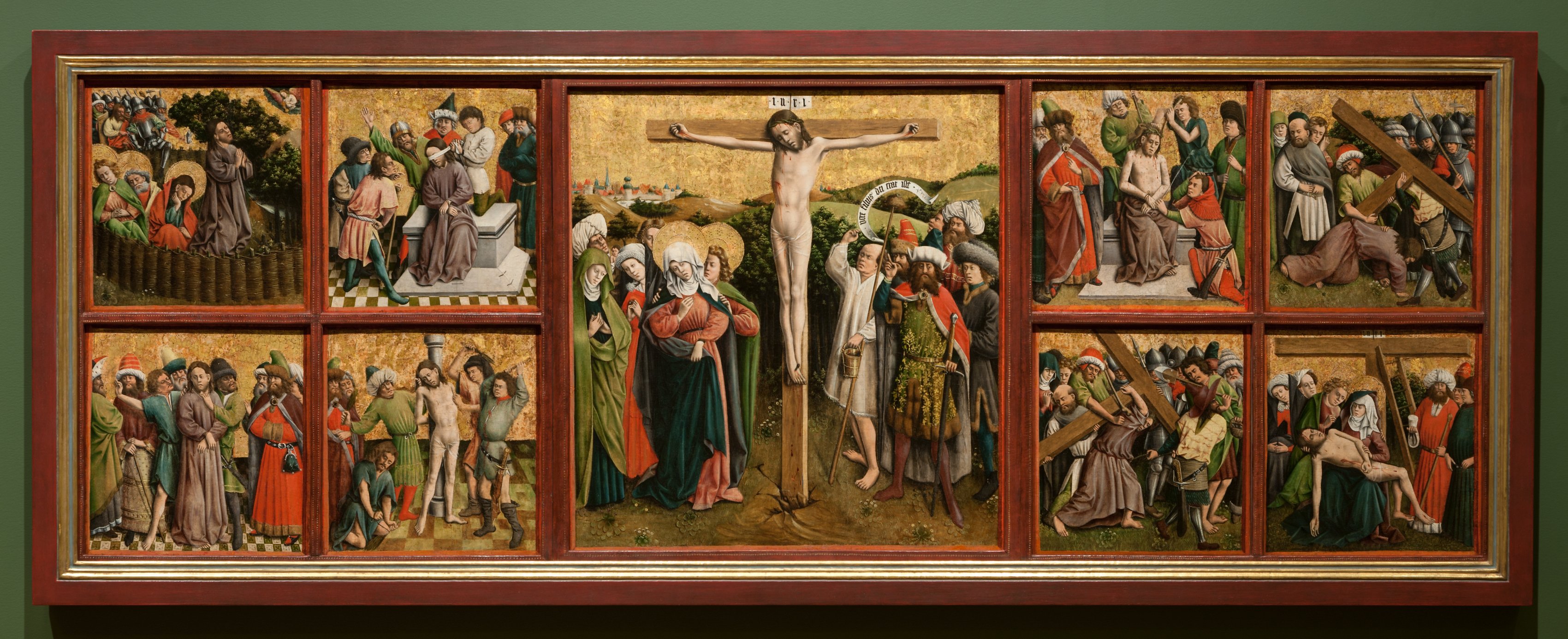
Deconstructing the Sacred: An Avant-Garde Analysis of the German Altarpiece with The Passion of Christ
At Zoey Fashion Lab, our mission is to dismantle historical artifacts to extract their raw, resonant DNA—transforming sacred relics into wearable narratives. The subject of this analysis, an Altarpiece with The Passion of Christ (Germany, oil and gold on wood), presents a profound paradox. It is an object of devotion, yet its materiality and iconography offer a blueprint for avant-garde deconstruction. The Archive Resonance—“一面是光洁银镜上以黄金镶嵌的纷繁棕叶纹,另一面是冰冷石棺板上以浮雕诉说的生命叙事” (one side a smooth silver mirror inlaid with intricate gold palm-leaf patterns, the other a cold stone sarcophagus whose relief tells a life story)—guides our interpretation. We will extract three core avant-garde design principles from this altarpiece: Sacred Opulence, Narrative Armor, and Binary Materiality.
1. Sacred Opulence: The Gold Leaf as a Subversive Surface
The altarpiece’s use of gold leaf is not merely decorative; it is a theological statement. In medieval and Renaissance Germany, gold represented the divine light, the uncreated energy of God. To the avant-garde designer, this is a challenge: how do we use opulence not to signal wealth, but to disrupt? The “纷繁棕叶纹” (intricate palm-leaf patterns) inlaid into the silver mirror suggest a layered, almost fractal opulence. This is not flat gilding; it is textured, reflective, and dynamic.
For Zoey Fashion Lab, we translate this into Sacred Opulence—a design language that weaponizes luxury against itself. Imagine a garment where panels of liquid gold leaf are applied to a base of oxidized silver mesh. The gold catches light, but the silver beneath tarnishes and shifts, creating a living surface that mirrors the altarpiece’s dual nature: sacred and decaying. The palm-leaf motif, a symbol of martyrdom and victory, becomes a repeating pattern laser-cut into leather or embossed onto bio-plastic. This is not reverence; it is reappropriation. The sacred becomes a tool for questioning the very idea of value in contemporary fashion. The avant-garde designer must ask: can gold be radical? Yes, when it is used to highlight the wounds—the Passion—rather than the glory.
2. Narrative Armor: The Passion as a Wearable Story
The central narrative of the altarpiece is The Passion of Christ: the betrayal, trial, crucifixion, and resurrection. In traditional iconography, this is a linear, didactic story. But the Archive Resonance introduces a critical twist: “冰冷石棺板上以浮雕诉说的生命叙事” (a cold stone sarcophagus whose relief tells a life story). This suggests a compression of narrative into sculptural form. The altarpiece is not a book; it is a relief, a surface that demands touch and time.
In an avant-garde context, we interpret this as Narrative Armor. The Passion becomes a series of modular, wearable reliefs. Imagine a corset constructed from segmented panels of resin or cast bronze, each panel depicting a station of the cross—not as realistic scenes, but as abstracted, fragmented forms. The “cold stone” quality translates to a material palette of matte black polymer, frosted glass, and hammered steel. The narrative is not read; it is felt. The wearer becomes a living altarpiece, a walking archive of suffering and transcendence. The design must incorporate negative space—gaps between the panels—to suggest the missing parts of the story, the silence between the screams. This is fashion as history, but history that is broken, reassembled, and worn as armor against forgetting.
3. Binary Materiality: The Mirror and the Sarcophagus
The most provocative element of the Archive Resonance is the binary: “一面是光洁银镜...另一面是冰冷石棺” (one side a smooth silver mirror...the other a cold stone sarcophagus). This is a literal, physical duality. The mirror reflects the present, the viewer, the ephemeral. The sarcophagus contains the past, the relic, the eternal. The altarpiece, in its original form, likely had a hinged structure—a triptych or a polyptych that could be opened and closed. The avant-garde designer must exploit this hinge.
We propose Binary Materiality as a design principle: garments that are reversible, transformable, or layered in a way that forces the wearer and viewer to choose a side. One layer is a high-polish silver lamé, embedded with gold-thread palmettes that catch the light. The other layer is a heavy, textured fabric—perhaps a wool or felt impregnated with stone dust—that feels cold and heavy, like a sarcophagus. The garment can be worn inside-out, or it can be a cape that flips to reveal its opposite. The “split-leaf” (Split-Lea...) motif from the reference suggests a bifurcation, a tearing. This could manifest as asymmetrical hems, zippers that bisect the garment, or seams that are left raw and exposed. The binary is not a contradiction; it is a dialogue. The mirror reflects the stone, and the stone grounds the mirror. In a collection, this creates tension: a dress that is both a weapon and a wound, a shield and a shroud.
Avant-Garde Synthesis: From Altarpiece to Runway
To synthesize these principles, Zoey Fashion Lab proposes a capsule collection titled “Passion Binary.” The silhouette is architectural, inspired by the altarpiece’s verticality and hinged structure. Shoulders are exaggerated, like the wings of a triptych. Hemlines are sharp and asymmetrical, suggesting the broken edges of a wooden panel. The color palette is severe: silver, gold, black, and a deep, blood-rust red (the only nod to the Passion’s violence).
Key pieces include:
- The Mirror Corset: A structured bodice of polished silver mesh, with gold palm-leaf appliqués that extend like ribs. The back is open, revealing a black sarcophagus-like panel of cast resin.
- The Passion Coat: A reversible coat. One side is a high-gloss silver satin with gold embroidered stations of the cross in abstract geometric forms. The other side is a heavy, matte black wool with a relief pattern of a fragmented stone cross, created by laser-cut felt layers.
- The Split-Leaf Skirt: A skirt that is literally split—one half is a smooth, reflective silver lamé, the other half is a textured, stone-gray neoprene. The gold palm-leaf motif is printed in a gradient, fading from the silver side to the stone side, suggesting the transition from mirror to sarcophagus.
Accessories are equally binary: a silver mirror cuff that can be worn over a black stone bracelet; a gold palm-leaf choker that is sharp-edged, almost painful to touch. The collection is not meant to be comfortable. It is meant to be confrontational. It asks the wearer: are you the mirror, reflecting the world, or the sarcophagus, containing history?
Conclusion: The Altarpiece as a Blueprint for Deconstruction
The German Altarpiece with The Passion of Christ is not a relic of the past; it is a blueprint for the future of avant-garde fashion. Its gold leaf teaches us Sacred Opulence—the use of luxury to disrupt. Its narrative reliefs teach us Narrative Armor—the compression of story into sculptural form. Its binary mirror-sarcophagus structure teaches us Binary Materiality—the power of duality and transformation. At Zoey Fashion Lab, we do not copy history; we cannibalize it. We extract its bones, its gold, its wounds, and we stitch them into garments that are both armor and archive. The result is fashion that does not just cover the body—it reveals the soul, in all its fractured, sacred, and profane glory.