The Hip-Joint Armchair as Silhouette Engine: A Deconstructive Blueprint for SS26
Introduction: The Throne as a Prosthetic of Power
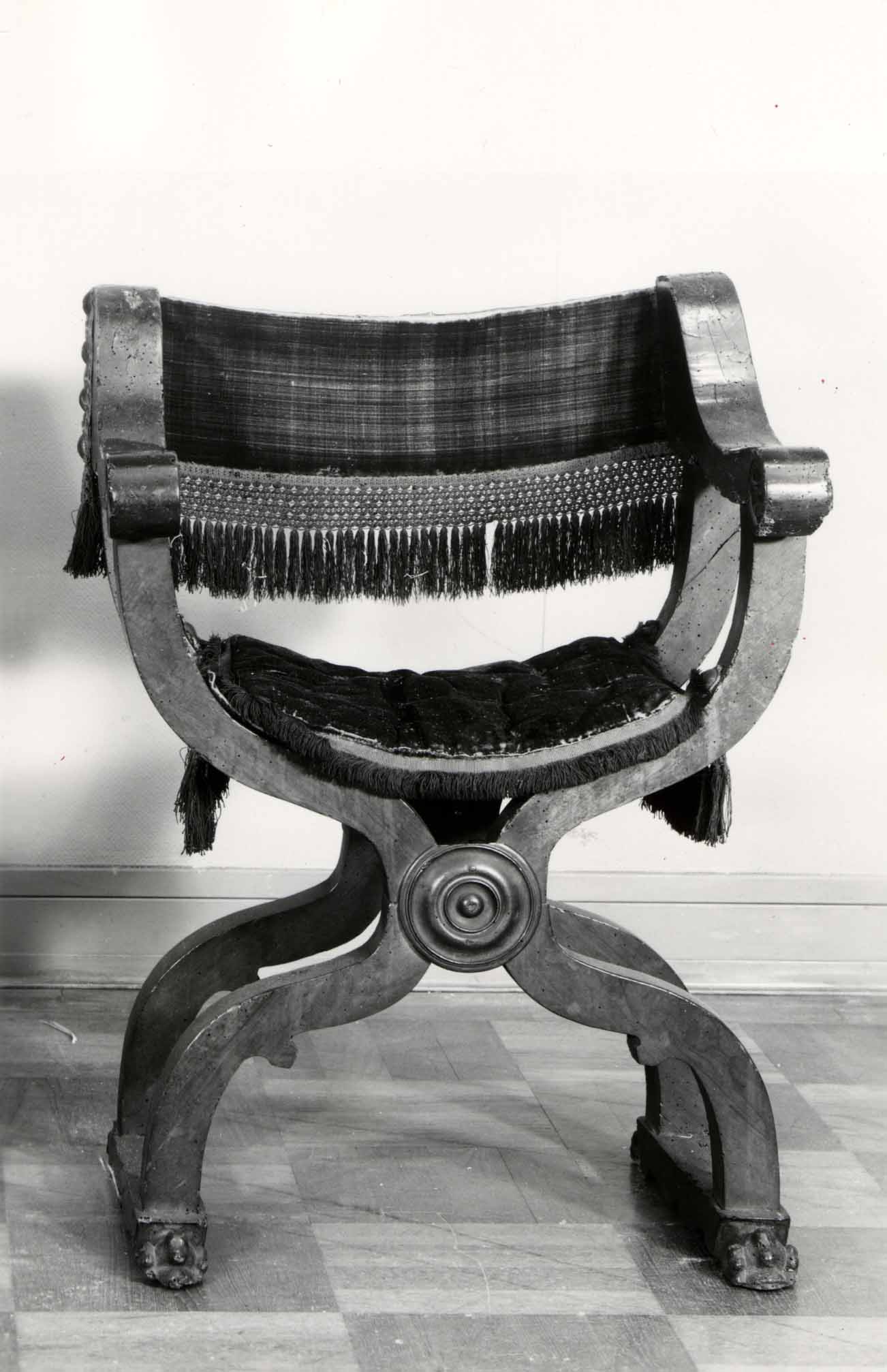
The Dantesca-type hip-joint armchair, with its origins in the Italian Renaissance, is traditionally a monument to hierarchical stability—a carved walnut throne that cradles the sitter in a rigid, symmetrical embrace. Yet, for the avant-garde curator, this object is not a relic but a silhouette laboratory. Its defining feature—the exposed, carved arm supports that mimic the human hip joint—offers a radical departure from garment-as-skin. For Zoey Fashion Laboratory’s SS26 collection, we propose a deconstructive transposition: the armchair’s structural logic becomes the foundation for futuristic silhouettes that challenge the very notion of wearability. This is not fashion; it is wearable architecture that interrogates the body’s relationship with furniture, gravity, and power.
Material Alchemy: Walnut, Velvet, and the New Textile Syntax
The armchair’s dual materials—carved walnut and red silk cut velvet—provide a dialectic of rigidity and fluidity. The walnut, with its organic grain and weight, suggests a static skeleton, while the velvet, with its piled nap and chromatic intensity, evokes voluptuous movement. In SS26, this binary is exploded. The walnut is not discarded but abstracted into a biomorphic exoskeleton. Imagine laser-cut walnut veneers bonded to recycled carbon fiber, forming articulated panels that hinge at the wearer’s hip joint. These panels are not decorative; they are kinetic structural elements that lock into place when the wearer sits, creating a chair-like silhouette from the body itself. The red velvet, meanwhile, is reimagined as laser-fused micro-pleats that cascade from these panels, mimicking the cut velvet’s depth while offering thermal-reactive color shifts—from arterial crimson to shadowed burgundy—as the body moves. This is a textile that remembers its furniture origins but refuses stasis.
Structural Innovation: The Hip Joint as Articulation Point
The armchair’s namesake, the hip joint, is the pivot between the seat and the armrest. In traditional furniture, this joint is static; in our SS26 proposition, it becomes a dynamic articulation point for the garment. We introduce the “Dantesca Hinge”: a 3D-printed titanium alloy joint that connects a sculpted shoulder yoke to a floating hip cradle. This joint allows for 120 degrees of rotation, enabling the wearer to transition from a standing, linear silhouette to a seated, cubic form in seconds. The garment’s upper body—a carved walnut veneer corset—lifts away from the torso when seated, creating a negative space that references the armchair’s backrest. The lower body, a velvet sheath with embedded shape-memory alloys, expands into a bell-like silhouette that mimics the chair’s seat cushion. This is not a costume; it is a functional transformation that redefines the body as a piece of living furniture. The wearer becomes both subject and object, sitter and throne.
Futuristic Silhouettes: The Anthropomorphic Cube and the Void
SS26’s silhouette vocabulary is built on geometric abstraction. The Dantesca armchair’s cubic proportions—a wide seat, tall back, and projecting armrests—are translated into two primary forms: the Anthropomorphic Cube and the Void Silhouette. The Anthropomorphic Cube is a garment that maintains a rectangular volume from shoulder to hip, with the hip joint as the fulcrum. This is achieved through internal lattice structures of walnut veneer that expand outward when the wearer is seated, creating a perfect 90-degree angle at the hip. The red velvet drapes over this lattice in asymmetrical swaths, revealing the internal architecture. The Void Silhouette, conversely, is a negative-space garment that removes material from the hip area entirely, leaving a gap framed by carved walnut arm supports that hover beside the body. This silhouette is inspired by the armchair’s armrests, which create a void between the sitter’s torso and the chair’s sides. The garment is a living sculpture of absence, challenging the viewer to perceive the body not as a solid but as a space-defining element.
Deconstructive Aesthetics: The Ruin as Innovation
Deconstruction in avant-garde fashion is often about exposing seams and fraying edges. Here, we take a more archaeological approach. The Dantesca armchair, as a historical object, carries the weight of its own decay—the walnut may chip, the velvet may fade. For SS26, we celebrate this ruin aesthetic through deliberate fragmentation. The walnut veneers are not polished but left with charred, burned edges, referencing the fires of Renaissance workshops. The red velvet is cut into jagged, unfinished panels that are stitched together with exposed, oxidized copper wire. The hip joint itself is deliberately oversized, with visible screws and gears, evoking a machine that is both ancient and futuristic. This is not a nostalgic nod but a critical commentary on the transience of power—the throne that becomes a ruin, the garment that decays in real-time. The wearer is a time-traveling archivist, embodying the past’s collapse into the future’s form.
Contextual Performance: The Garment as Interactive Furniture
The final layer of this analysis is the garment’s performance context. Unlike traditional couture, which exists on a static runway, these pieces are designed for interactive installations. Imagine a gallery space where models, wearing the Dantesca-inspired garments, sit on identical walnut armchairs. As they rise, the garments reconfigure themselves, the hip joints locking into standing positions, the velvet pleats snapping back into linear folds. The audience is invited to touch the walnut panels, feeling the grain and the heat from the wearer’s body. This blurs the line between spectator and participant, garment and furniture. The collection becomes a living exhibition of structural innovation, where each garment is a prototype for a new kind of wearable architecture. The hip joint, once a symbol of static support, is now a metaphor for transformation—the point where the body meets the object, where history meets the future, where fashion becomes furniture.
Conclusion: The Throne Reimagined
The Dantesca hip-joint armchair, in its original form, is a testament to Italian craftsmanship and hierarchical design. In Zoey Fashion Laboratory’s hands, it becomes a blueprint for SS26’s most radical propositions. By deconstructing its materials, articulating its joints, and abstracting its silhouette, we offer a collection that is both a tribute and a critique. This is not fashion for the passive wearer; it is fashion for the active architect of space. The walnut and velvet are no longer furniture; they are second skins that challenge the body to become a throne, a ruin, a machine. For the avant-garde curator, this is the ultimate study: a garment that is never just worn, but inhabited—a living, breathing, transforming piece of history.