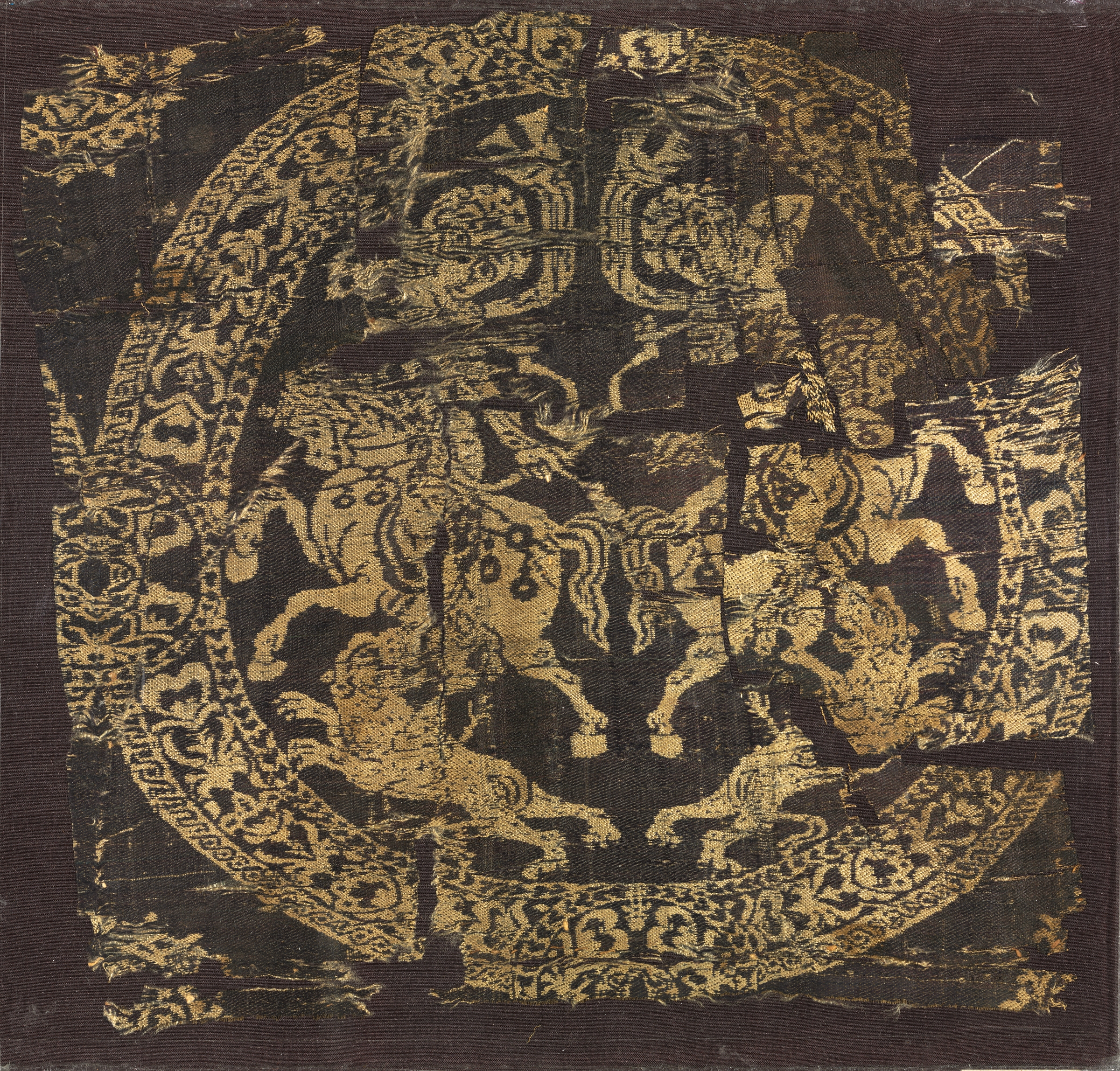
Fabric Deconstruction Report: The "New DNA Strand" Samite Roundel
At Zoey Fashion Lab, we approach historical textiles not as relics to be preserved in sterile cases, but as living, breathing sources of genetic code for future fashion. The subject of this analysis—a Roundel with Amazons, originating from Egypt or Syria, executed in samite silk—presents a profound paradox. It is at once a testament to ancient craftsmanship and a blueprint for avant-garde deconstruction. We have designated this artifact the "New DNA Strand," as it holds the key to splicing historical narrative with radical form.
Technical Genesis: The Samite Silk Structure
Samite, a heavy, compound weave often in silk, was a hallmark of Late Antique and early medieval luxury. Its structure is inherently complex: multiple warp and weft systems interlace to create a dense, patterned fabric. The Roundel with Amazons is not merely a decorative patch; it is a self-contained universe of thread. The silk fibers, likely from wild silkmoths, possess a natural, irregular luster that modern synthetics struggle to replicate. The weave itself is a twill-based compound structure, where the ground weave and pattern wefts are manipulated to create a raised, almost sculptural effect.
For the Zoey Fashion Lab deconstructionist, this technical density is a playground. The samite's rigidity—a product of its tight weave and multiple layers—is not a limitation but a material property to be exploited. We identify the primary structural weaknesses: the points where pattern wefts cross ground warps, creating natural stress lines. These are the "fault lines" where a garment would historically wear thin. In our avant-garde analysis, these are the intended rupture points for a new garment architecture.
Iconographic Analysis: The Amazon as Avant-Garde Archetype
The roundel's central motif—Amazons—is not a passive decoration. These warrior women, engaged in battle or hunt, are symbols of disruption, autonomy, and physical prowess. In the context of a tunic, they were likely worn by a person of high status, perhaps a military commander or a woman asserting her own power. The iconography is rendered in a stylized, almost abstracted manner: figures are compressed into the circular frame, their limbs and weapons forming a dynamic, radial pattern.
From an avant-garde perspective, the Amazon motif is a narrative weapon. We do not merely reproduce these figures; we fragment, distort, and recontextualize them. The circular format of the roundel becomes a lens or a portal. By isolating individual gestures—a raised spear, a horse’s rearing head, a flowing cape—we extract these kinetic elements and translate them into structural seams, darts, and asymmetrical draping. The Amazon’s combat stance becomes the asymmetric shoulder line of a modern jacket. The horse’s gallop is captured in a cascading, bias-cut skirt panel.
The "New DNA Strand" Methodology: Deconstruction as Genetic Extraction
Our lab’s designation of this roundel as a "New DNA Strand" is deliberate. We treat the textile as a genetic sequence that can be isolated, mutated, and recombined. The process involves four stages:
- Strand Isolation: We physically extract a single warp or weft thread from the roundel’s edge. This thread is not a souvenir; it is a material gene. Its twist, tension, and dye composition are analyzed. In our avant-garde practice, this thread becomes a design constraint—a line that must appear in the final garment, either as a visible stitch, a drawstring, or a structural element.
- Pattern Sequencing: The roundel’s weave pattern is mapped as a binary code of warp and weft intersections. We identify repeating units—the "codons" of the fabric. These are then re-sequenced using algorithmic design software. A traditional repeating pattern of Amazons and horses is mutated into a glitch-like, irregular grid where figures appear and disappear, creating optical illusions.
- Structural Mutation: The roundel’s original function—a decorative appliqué on a tunic—is subverted. We cut the roundel into multiple fragments, reassembling them not as a flat circle but as a three-dimensional, sculptural collar or epaulette. The original circular seam allowance becomes a raw, exposed edge, finished with a contrasting silk thread that mimics the original samite’s color.
- Wearable Expression: The final garment is not a costume. It is a functional, avant-garde piece that references the original while rejecting its historical context. The Amazon’s aggression is channeled into sharp, angular lapels. The roundel’s radial symmetry is echoed in a circular zipper pull or a spiral seam that wraps around the body.
Material and Color Palette: From Antique to Avant-Garde
The original samite roundel likely featured a deep indigo or madder red ground with pattern threads of undyed silk, gold, or other bright hues. The New DNA Strand interpretation does not replicate these colors but samples their emotional resonance. The indigo becomes a neon, almost ultraviolet blue in a double-faced satin. The madder red is transformed into a translucent, blood-red organza that overlays a matte black base. The gold threads are replaced with metallic Lurex that is intentionally distressed, creating a frayed, oxidized effect that echoes the original’s age.
Constructing the Avant-Garde Tunic: A Prototype Concept
We propose a prototype garment: a deconstructed tunic that is both a tribute and a rebellion. The body is composed of multiple layers of silk charmeuse and organza, each cut to mimic the shape of the original roundel but at different scales. The Amazon motifs are printed using a digital jacquard process that replicates the samite’s texture but with a 3D, lenticular effect: as the wearer moves, the figures appear to shift and fight.
The structural seams are left raw, with the cut edges curling inward like frayed ancient threads. A single, continuous line of gold silk thread—the extracted "DNA strand"—runs from the left shoulder to the right hip, mimicking the Amazon’s spear. This thread is not sewn down but floats freely, catching light and movement. The neckline is asymmetrical, cut on the bias to create a draped cowl that references the tunic’s original drape. The sleeves are detached, held in place only by the gold thread, creating a deliberate instability that challenges the wearer’s posture.
Conclusion: The Living Fabric
The Roundel with Amazons is not a dead object. For Zoey Fashion Lab, it is a dynamic, mutable source code. By deconstructing its technical weave, extracting its iconographic DNA, and re-sequencing its structure, we create garments that are not merely inspired by history but genetically linked to it. The avant-garde tunic born from this analysis is a new organism—one that wears its origins on its raw, exposed seams while charging forward into an unpredictable future. The Amazon warrior, once confined to a silk circle, now fights on the body of the modern wearer, her spear transformed into a thread that connects the ancient world to the next frontier of fashion.