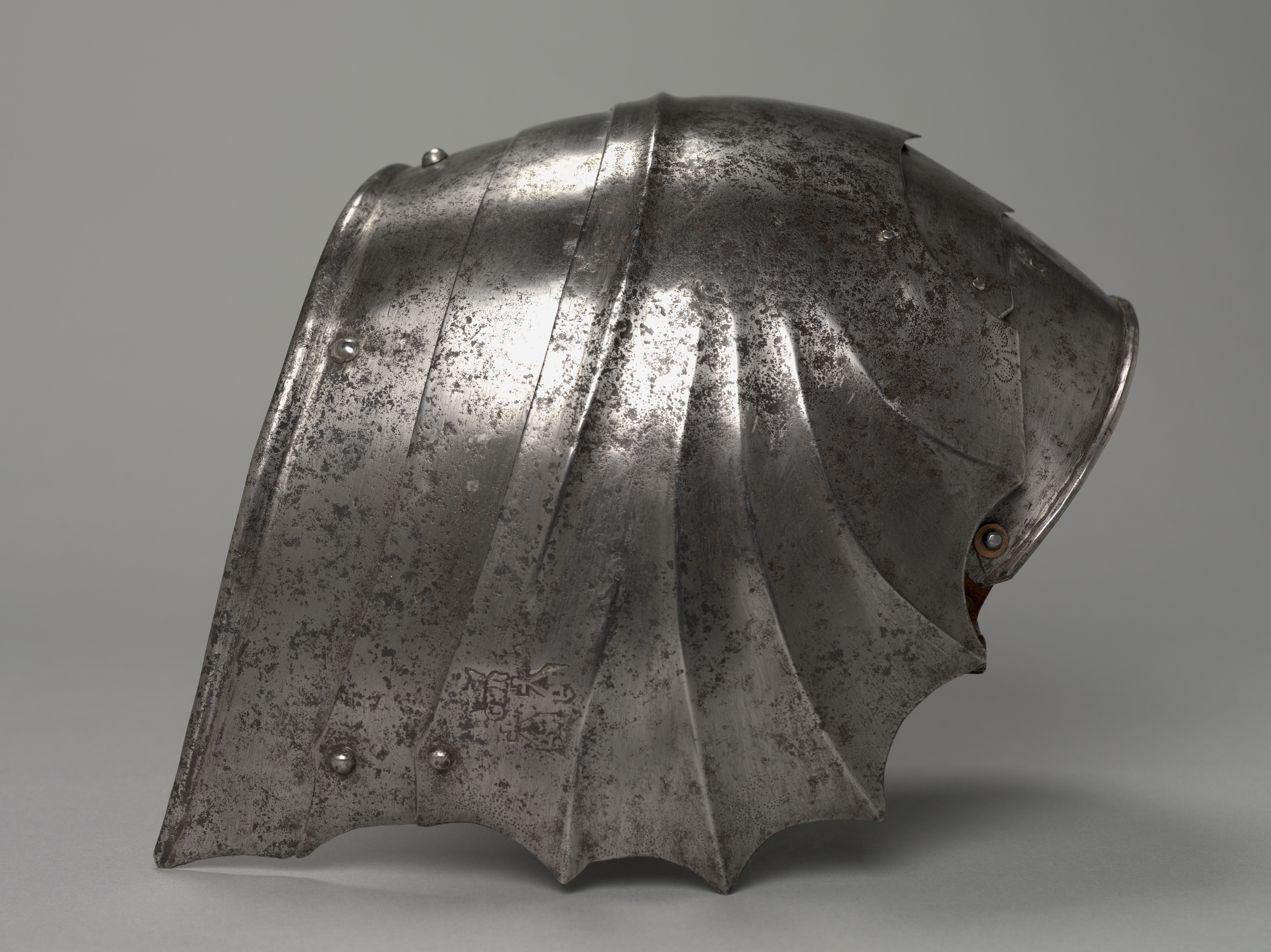
Deconstructing the Gothic Fan-Shaped Pauldron: A New Avant-Garde DNA Strand
At Zoey Fashion Lab, our mission is to dissect historical artifacts not merely as relics, but as living, breathing components of a new sartorial genome. The subject of this analysis—the right-side Gothic Fan-Shaped Pauldron, crafted in Milanese steel—represents a critical mutation in what we term the "New DNA Strand" of avant-garde fashion. This piece, originating from the 15th-century Italian school of armor, is far more than a piece of protective equipment; it is a sculptural manifesto, a study in negative space, and a progenitor of modern structural silhouettes.
Technical Provenance and Material Integrity
The pauldron’s origin in Milan is paramount. During the Renaissance, Milan was the undisputed capital of armor production, renowned for its high-carbon steel and sophisticated heat treatment processes. This pauldron exhibits the hallmark of Milanese mastery: a finely tapered, overlapping lamellar construction that allows for both articulation and formidable rigidity. The steel, cold-forged and then polished to a mirror-like finish, demonstrates a deep understanding of material stress. For the Zoey Fashion Lab, this technical DNA is non-negotiable. The avant-garde designer must treat steel not as a rigid cage, but as a dynamic, malleable skin. The fan shape—a series of graduated, overlapping plates radiating from the shoulder point—is a feat of engineering. Each plate is individually riveted, creating a system of tension and release. This is the blueprint for modern, articulated shoulder structures in haute couture, from leather to resin.
Deconstructing the Fan Shape: A Study in Avant-Garde Geometry
The defining feature of this pauldron is its fan-like expansion. Unlike the symmetrical, rounded pauldrons of later periods, the Gothic fan shape is aggressively asymmetrical. The right-side piece, specifically, extends outward and downward in a sweeping arc, creating a dramatic, almost architectural overhang. This is not a passive form; it is a statement of aggressive elegance. In our lab, we identify this as a "negative-space generator." The pauldron does not simply cover the shoulder; it defines the space around it. The gap between the arm and the fan creates a void, a tension between protection and vulnerability. This is the core of the avant-garde: the deliberate manipulation of absence. The fan shape also introduces a dynamic vector. It draws the eye upward and outward, elongating the torso and creating a silhouette that is simultaneously powerful and fragile. This is the antithesis of the natural human form, a deliberate distortion for the sake of visual impact.
The New DNA Strand: Deconstruction as Reconstruction
We classify this pauldron as a "New DNA Strand" because it challenges the binary of armor and fashion. In traditional analysis, armor is functional; fashion is ornamental. This piece collapses that distinction. The steel is not merely a shell; it is a scaffold for a new identity. For the avant-garde designer, the pauldron becomes a template for a new kind of garment: one that is simultaneously protective and provocative. The DNA strand metaphor is literal here: the overlapping plates are like nucleotides, each one a unit of information. The rivets are the hydrogen bonds, connecting the structure. To deconstruct this piece is to understand how to build a new kind of garment from the ground up. The process involves isolating each plate, mapping its curve, and then re-contextualizing it. For example, a single plate, when detached, can become a collar, a cuff, or a hip piece. The fan shape itself can be translated into a rigid, pleated skirt or a dramatic, cantilevered sleeve.
Avant-Garde Application: From Armor to Architecture
How does this translate to the Zoey Fashion Lab runway? The Gothic Fan-Shaped Pauldron is the ancestor of the modern, oversized shoulder. However, where 1980s power dressing used padding to create bulk, the Milanese armor uses structural cantilevering. The avant-garde interpretation would be a garment that appears to defy gravity. Imagine a jacket where the shoulder is not sewn but riveted, using lightweight carbon fiber or laser-cut aluminum. The fan shape could be re-imagined as a series of overlapping, translucent polymer scales, each one hinged to allow for movement while maintaining a rigid silhouette. The asymmetry is crucial. The right-side pauldron, being the dominant piece, suggests a warrior’s stance. In a contemporary context, this could be a single, oversized shoulder piece worn over a sheer, deconstructed bodice. The contrast between the cold, hard steel and the soft, ephemeral fabric is the essence of avant-garde tension. The pauldron also suggests a new form of wearable sculpture. It is not meant to be hidden; it is meant to be the focal point. The mirror-polished steel reflects the environment, making the wearer both a part of and separate from the space. This is the ultimate avant-garde goal: to create a garment that is an event, not just an object.
Conclusion: The Pauldron as a Blueprint for Future Silhouettes
The Gothic Fan-Shaped Pauldron from Milan is not a historical curiosity; it is a blueprint for the future of structural fashion. At Zoey Fashion Lab, we see it as a strand of DNA that, when spliced with modern materials and deconstructive techniques, can produce entirely new forms of expression. Its geometry teaches us about balance, tension, and the power of negative space. Its materiality teaches us about the relationship between protection and vulnerability. Its asymmetry teaches us that the body is not a symmetrical canvas, but a dynamic, ever-changing form. The avant-garde designer who understands this pauldron does not simply copy it; they re-code it. They take its rivets, its fan, its steel, and they translate it into a language of contemporary rebellion. This piece is a testament to the enduring power of the human form to be both armored and exposed, both protected and provocative. It is, in the truest sense, a new beginning for the art of dressing.