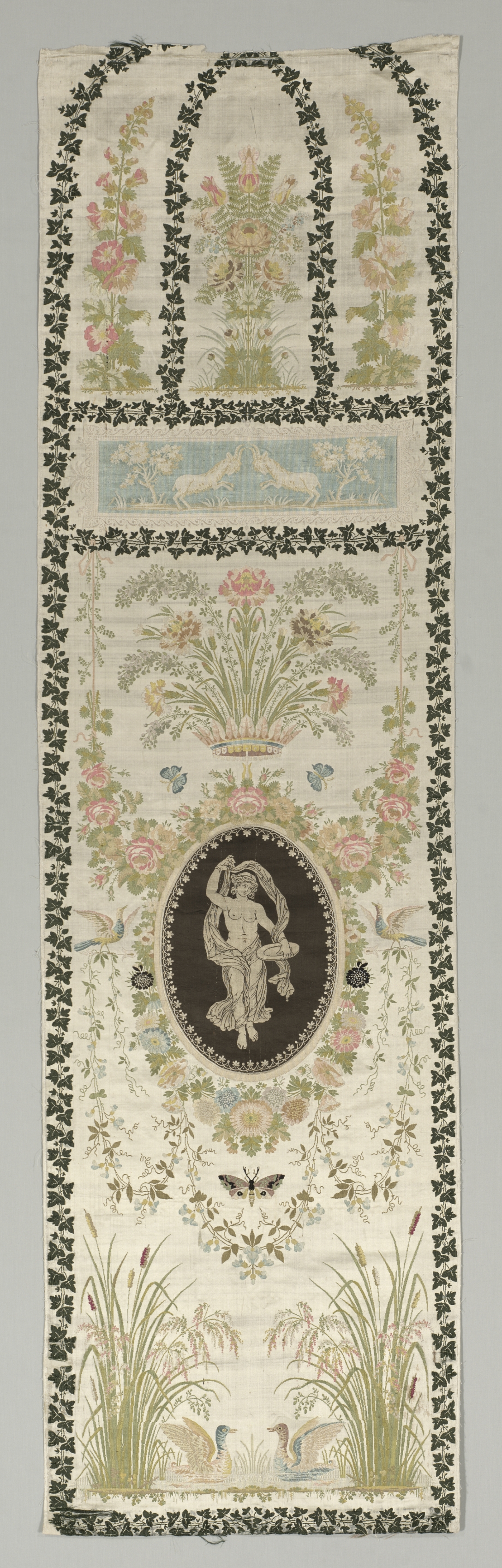
Deconstructing the Archive: A Silk Lamella of Neoclassical Grandeur
At Zoey Fashion Lab, the act of deconstruction is not one of destruction, but of archaeological revelation. We excavate the material past to unearth the structural and conceptual DNA that can be reborn in the avant-garde. The subject of this analysis—a French wall covering from the late 18th to early 19th century, depicting a classical figure—is a particularly potent artifact. Executed in silk lampas with brocading, appliqué, and embroidery, this piece is not merely a decorative surface; it is a stratified document of political ideology, textile technology, and aesthetic ambition. Our task is to dismantle its technical and symbolic architecture to propose a radical reinterpretation for the contemporary body.
Technical Stratigraphy: The Language of the Loom
The primary weave structure is lampas, a compound weave that allows for a complex interplay of pattern and ground. Here, a satin weave (likely for the lustrous figure) alternates with a plain weave variant (for the matte background). This is not a simple binary. The satin weave, with its long floats, captures light to give the classical figure a sculptural, almost three-dimensional presence. The plain weave ground, by contrast, is a field of quiet, absorbent texture. This creates a fundamental tension: the figure is a luminous apparition against a tactile, grounded surface.
The brocading technique introduces supplementary weft threads that are not woven across the entire width of the fabric. These threads are introduced only where needed, creating localized, raised patterns of flowers, laurel wreaths, or architectural motifs. In the context of the classical figure, brocading was used to articulate details like drapery folds, a gilded staff, or a sacrificial altar. This is a technique of selective emphasis, a form of material highlighting that draws the eye to narrative elements.
Further complicating the surface is the application of appliqué and embroidery. Appliqué involves cutting shapes from a separate fabric—perhaps a finer, more lustrous silk or even a metallic lamé—and stitching them onto the lampas ground. This is a collage-like intervention, a deliberate break from the woven continuity. Embroidery, with its needle-driven threads, adds a final layer of mark-making, often outlining the appliquéd forms or adding intricate details like facial features, jewelry, or the veins of a leaf. This combination of woven, applied, and stitched elements creates a dense, multi-sensorial surface that invites both visual and tactile exploration.
Symbolic Resonance: The Classical Figure as Political and Aesthetic Device
The choice of a classical figure is far from neutral. In late 18th-century France, the Neoclassical revival was a direct response to the decadence of the Rococo and a visual articulation of Enlightenment ideals. Figures from Greek and Roman mythology—Minerva, Apollo, or allegorical representations of Liberty, Reason, and Victory—were not mere decoration. They were embodiments of civic virtue, rational order, and republican strength. This wall covering, therefore, was not simply a beautiful object; it was a political manifesto woven in silk.
The classical figure here is likely an allegory of triumph or abundance, perhaps a goddess offering a cornucopia or a hero receiving a laurel crown. The brocaded and embroidered details would have reinforced this narrative: a brocaded sword signifying military might, an embroidered olive branch symbolizing peace, an appliquéd crescent moon referencing the goddess Diana. The entire composition is a system of visual signs designed to communicate a specific ideology of power, virtue, and cultural inheritance.
Avant-Garde Reconfiguration: From Wall to Body, From Archive to Action
For Zoey Fashion Lab, this artifact is not a relic to be copied. It is a generative matrix. To translate this wall covering into an avant-garde garment, we must deconstruct its fundamental principles and re-assemble them in a new, disruptive context.
1. Inversion of Structure: The lampas weave’s hierarchy—figure against ground—can be inverted. The classical figure, instead of being a centralized motif, could become a fragmented, de-centered ghost image woven into a primary structure of plain weave. The satin floats, once reserved for the figure, could be used to create abstract, tectonic lines that fracture the body’s silhouette. The garment becomes a deconstructed architectural plan, where the classical figure is only visible in the negative space.
2. Material Collision: The technique of appliqué, which introduces a foreign element onto a woven ground, can be radicalized. Instead of silk-on-silk, we might appliqué laser-cut recycled industrial felt or bio-engineered mycelium leather onto a base of hand-woven, undyed linen. The embroidery, once a delicate delineation, could be executed in conductive thread or recycled copper wire, creating a circuit that lights up when the wearer moves. This is a collision of the 18th-century handcraft with 21st-century technology, a material dialogue between the archive and the future.
3. Narrative Disruption: The classical figure’s allegorical meaning—virtue, order, power—can be subverted. The goddess’s face could be replaced with a digitally printed, distorted selfie of the wearer. The cornucopia could be embroidered as a data stream of social media metrics. The laurel wreath, once a symbol of victory, could be appliquéd as a tangled, barbed-wire crown. The garment becomes a critical commentary on contemporary notions of fame, surveillance, and identity, using the very techniques of the past to critique the present.
4. The Body as Archive: The wall covering was static, a backdrop to human activity. The garment, by contrast, is kinetic and performative. The brocaded details, once fixed, can be made detachable—snap-on panels of hand-embroidered silk that can be removed and rearranged. The appliqué elements can be weighted with tiny brass beads, so they swing and shift with the wearer’s movement, creating a constant state of visual flux. The body becomes the primary surface for this ever-changing archive, a living, breathing museum of deconstructed history.
Conclusion: The Fabric of a New Narrative
This French wall covering, with its classical figure and complex technical execution, is a masterful artifact of its time. But its true value for the avant-garde lies not in its perfection, but in its internal contradictions: the tension between the luminous figure and the matte ground, the static narrative and the dynamic potential of its techniques. At Zoey Fashion Lab, we do not preserve the past; we activate it. By deconstructing the lampas weave, subverting the allegorical figure, and colliding 18th-century handcraft with 21st-century materials, we can forge a garment that is not a costume of history, but a critical instrument for the present. The classical figure, once a symbol of static order, becomes a deconstructed, dynamic entity—a testament to the fact that the most revolutionary fashion is born from the most radical reading of the archive.