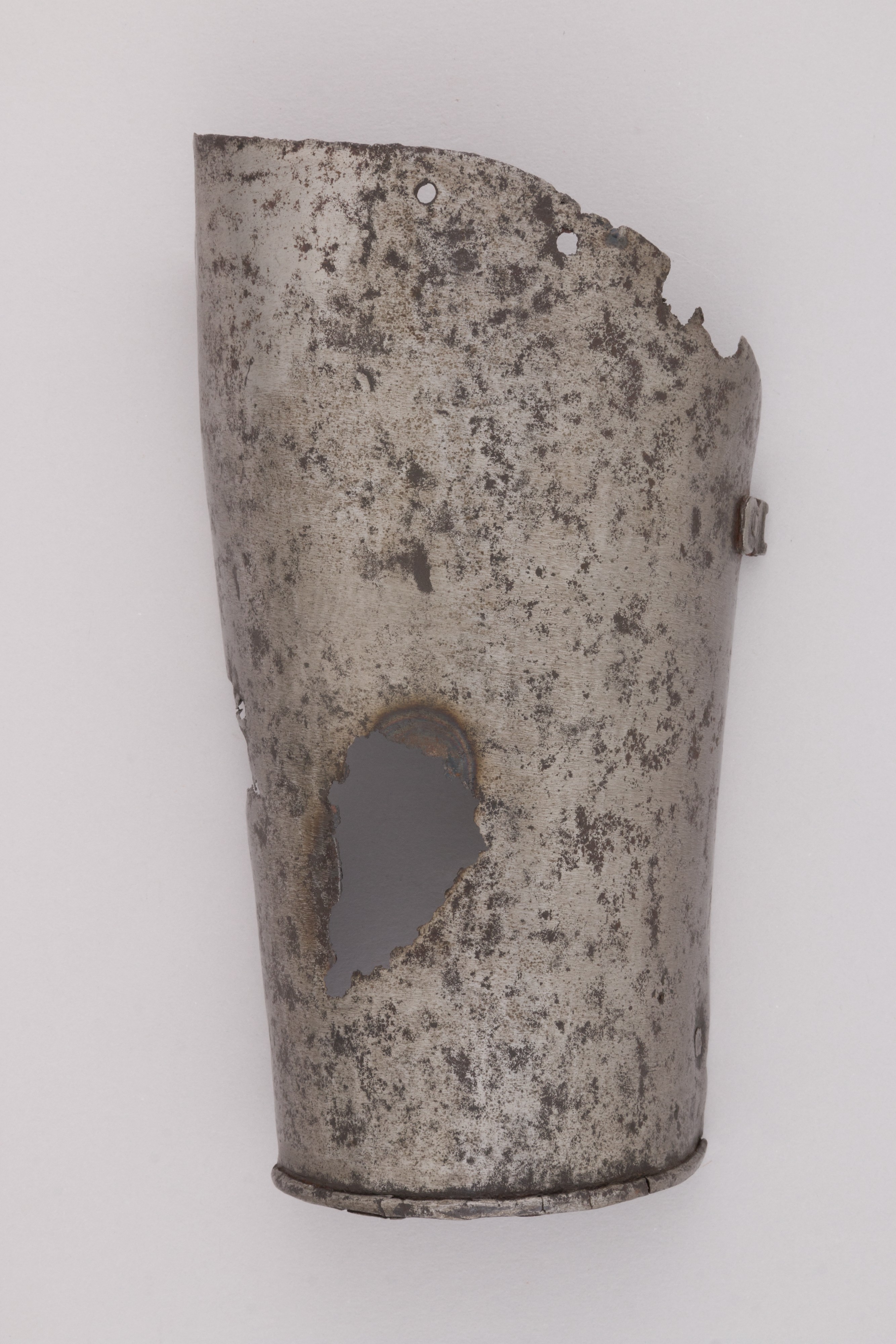
Deconstructive Metallurgy: The Vambrace as a Futuristic Silhouette Prototype
Historical Precedent Meets Algorithmic Form
The vambrace, historically a rigid forearm defense forged for medieval combat, undergoes a radical transmutation within Zoey Fashion Laboratory’s SS26 avant-garde study. This Italian steel artifact—stripped of its original martial context—emerges as a standalone architectural fragment, a prototype for reimagining the human arm as a site of structural innovation. The piece challenges conventional garment hierarchy by isolating the forearm as a discrete, load-bearing zone, a move that echoes the deconstructive ethos of Rei Kawakubo while pushing toward a biomechanical future. The steel’s cold, polished surface becomes a canvas for algorithmic pattern-making, where the interplay of shadow and reflection generates a dynamic, ever-shifting silhouette.
The vambrace’s lineage—from 15th-century Italian armorers to contemporary speculative design—is recontextualized here as a meditation on protective elegance. The steel is not merely a material but a structural narrative, its curves and edges calibrated to suggest both vulnerability and defiance. In the SS26 context, this piece functions as a sartorial exoskeleton, a fragment that redefines the proportions of the upper body. The forearm, often neglected in fashion’s focus on shoulders and hips, becomes a focal point of tension and release. The vambrace’s articulated joints—if present—hint at a kinetic future, where garments respond to movement with mechanical precision.
Futuristic Silhouette Architecture
The vambrace’s silhouette is a study in asymmetrical balance. Its steel plates, whether forged as a single, unbroken curve or segmented into overlapping lamellae, create a stark contrast with the organic softness of the human arm. This juxtaposition is central to the avant-garde aesthetic: the body is not draped but encased, transformed into a living sculpture. The piece’s profile—tapered at the wrist, flaring toward the elbow—echoes the aerodynamic forms of automotive design or the skeletal structures of modern architecture. The steel’s reflective quality amplifies this effect, capturing and distorting surrounding light to produce a shimmering, almost holographic presence.
For SS26, the vambrace’s silhouette must be considered in dialogue with negative space. The arm’s natural curve is interrupted by the rigid steel, creating voids that invite the eye to trace the boundary between protection and exposure. This spatial tension is a hallmark of deconstructive fashion: the garment becomes a frame for the body, not a covering. The vambrace’s edges—whether raw, polished, or laser-cut—define a new topography. The piece may be worn in isolation, allowing the bare arm above and below to emphasize its sculptural weight, or integrated into a larger system of modular armor, where it serves as a counterpoint to softer textiles like organza or bio-fabricated mesh.
Materiality and Structural Innovation
Italian steel, renowned for its historical artistry (e.g., the Milanese armor of the 16th century), is here subjected to contemporary fabrication techniques. The metal’s weight—approximately 1.5 to 2.5 kilograms for a full vambrace—is offset by its ergonomic articulation. The piece may feature hidden hinges, rivet-free joints, or memory-alloy inserts that allow it to conform to the wearer’s anatomy without sacrificing rigidity. This marriage of old-world craftsmanship and futuristic engineering positions the vambrace as a hybrid object: part relic, part prototype. The steel’s patina—whether left to oxidize naturally or treated with a matte, gunmetal finish—adds a temporal dimension, suggesting a garment that ages and evolves with use.
The structural innovation lies in the vambrace’s modularity. Unlike traditional armor, which is fixed in form, this piece can be disassembled into component parts—a wrist cuff, an elbow guard, a mid-forearm plate—each capable of independent wear. This deconstruction aligns with the laboratory’s ethos of fragmentation: the vambrace is not a complete defense but a fragment of a larger system, inviting the wearer to compose their own silhouette. The steel’s surface may be etched with digital patterns—algorithmic grids, fractal geometries—that reference the intersection of craft and code. These markings are not decorative but functional, guiding the eye along the piece’s structural lines.
Contextualizing the Vambrace in SS26
Within Zoey Fashion Laboratory’s SS26 collection, the vambrace serves as a critical anchor for a broader narrative of exoskeletal couture. The season’s theme—tentatively titled “Post-Human Armor”—explores the body as a site of augmented vulnerability. The vambrace, in its isolation, becomes a symbol of selective protection: the forearm, a limb often exposed in contemporary dress, is suddenly fortified, while the rest of the body remains unguarded. This asymmetry creates a visual and conceptual tension, questioning the boundaries between fashion, armor, and prosthesis.
The piece’s Italian origins are not incidental but strategically invoked. Italy’s heritage of Renaissance armor-making—where form and function were inseparable—is reimagined through a cybernetic lens. The vambrace’s steel may be sourced from the same regions (e.g., Lombardy) that produced the finest medieval plate, but its design is informed by parametric modeling and 3D scanning of the human arm. The result is a garment that feels both ancient and alien, a relic from a future where history is recycled into new forms of expression.
Conclusion: The Vambrace as a Manifesto
This Italian steel vambrace, in its standalone analysis, is more than a garment—it is a manifesto for avant-garde couture. It rejects the notion that fashion must be soft, draped, or ephemeral, embracing instead the rigor of engineering and the poetry of metal. Its silhouette, defined by sharp angles and reflective surfaces, challenges the wearer to move differently, to occupy space with intention. For Zoey Fashion Laboratory, the vambrace represents a prototype for SS26: a fragment that contains the whole, a defense that is also an invitation. In a season of excess and ornament, this piece stands as a testament to the power of structural minimalism—a single, unyielding form that redefines the body’s potential.