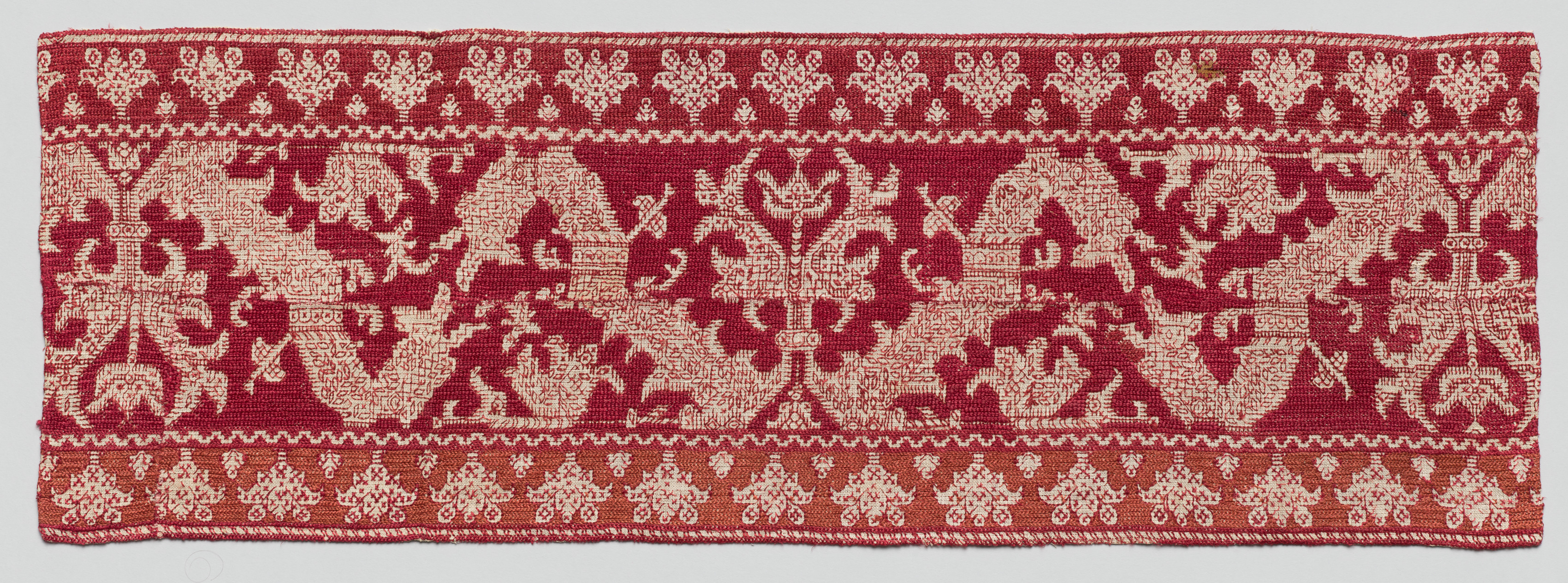
Fragment of a Furnishing Textile: A Deconstruction of North African Avant-Garde
As the Chief Fabric Deconstructionist for Zoey Fashion Lab, I am tasked with excavating the latent narratives embedded within historical textiles. The subject of this analysis is a fragment of a furnishing textile, originating from Azemmour, Morocco, and crafted by a Moroccan embroiderer during the 16th to 17th centuries. The material composition—linen, silk, and dye—serves as a primary lexicon. However, the true resonance of this artifact lies not in its surface beauty but in its role as a silent witness to cultural collision and aesthetic synthesis. This fragment, referenced under Archive Resonance, embodies a moment when North African craftsmanship intersected with European trade routes, creating a hybrid visual language that predates modern avant-garde sensibilities by centuries. For Zoey Fashion Lab, this fragment is not a relic; it is a blueprint for radical deconstruction and recontextualization.
Technical Analysis: The Material Dialogue
The textile’s technical construction reveals a sophisticated understanding of material properties. The base is a plain-weave linen, a fiber prized in the Mediterranean for its strength and breathability. Linen, derived from the flax plant, was a staple in North African household textiles, often used for furnishings, bedding, and ceremonial cloths. The embroiderer’s choice of linen as a foundation speaks to a utilitarian tradition, yet the introduction of silk thread elevates the piece from the functional to the opulent. Silk, a luxury import from the East, was a marker of status and cross-continental trade. The dye, likely derived from cochineal or madder for reds, and indigo for blues, demonstrates a mastery of natural pigments that were both locally sourced and globally traded.
The embroidery technique is where the avant-garde potential emerges. The fragment exhibits a dense, almost obsessive layering of silk threads in geometric and floral motifs. The stitches—likely a combination of double running stitch and cross-stitch—create a raised, tactile surface that disrupts the flatness of the linen ground. This is not a passive decoration; it is a deliberate subversion of the textile’s structural integrity. The threads pull and distort the weave, creating a topography that challenges the viewer’s expectation of a furnishing cloth as a mere backdrop. For Zoey Fashion Lab, this technique is a precursor to textile sculpture—a three-dimensional intervention that transforms a two-dimensional surface into a dynamic, interactive object.
Cultural Collision: The Azemmour Aesthetic
Azemmour, a coastal city in Morocco, was a nexus of cultural exchange during the 16th and 17th centuries. The Portuguese occupation from 1513 to 1541 left an indelible mark on local artistry, introducing European motifs such as heraldic symbols and botanical scrollwork. Yet, the Moroccan embroiderer did not simply replicate these forms; they absorbed and reimagined them through an indigenous lens. The fragment’s design features interlacing arabesques—a hallmark of Islamic geometric art—interwoven with stylized floral elements that echo Portuguese Manueline ornamentation. This is not a passive assimilation but an active reappropriation, a form of cultural resistance that asserts local identity while engaging with global influences.
The color palette further underscores this hybridity. The deep indigo blue, a color associated with protection and spirituality in Berber culture, is juxtaposed with a crimson red derived from Mediterranean kermes. This chromatic tension mirrors the geopolitical friction of the era—a visual negotiation between the sacred and the secular, the local and the foreign. For the avant-garde designer, this fragment is a case study in decolonial aesthetics. It demonstrates that cultural authenticity is not a fixed state but a fluid, contested process. The embroiderer’s work is a form of visual code-switching, a sophisticated navigation of multiple visual languages that predates postmodern pastiche by four centuries.
Archive Resonance: The Silent Witness
The Archive Resonance of this fragment lies in its ability to speak across time. The original context—a furnishing textile for a wealthy home—suggests a functional object that was also a status symbol. Yet, the fragment’s survival is itself a narrative. The frayed edges, the faded dye, the missing sections: these are not flaws but evidence of use, of life. The textile has been touched, folded, exposed to light, and perhaps repurposed. It bears the scars of history—colonial incursions, economic shifts, and the passage of time. For Zoey Fashion Lab, this fragment is a palimpsest, a surface layered with erased and rewritten stories. The deconstructionist’s task is to make these erased stories visible again, not through restoration but through creative disruption.
The concept of Archive Resonance also speaks to the fragment’s role in contemporary fashion discourse. In an era of fast fashion and digital reproduction, this handcrafted object demands a slowing down of the gaze. It insists on the value of time—the hours of embroidery, the sourcing of materials, the embodied knowledge of the maker. This is a direct challenge to the avant-garde’s obsession with speed and novelty. The fragment suggests that true innovation emerges from deep engagement with material history, not from surface-level trend appropriation. For Zoey Fashion Lab, this means rethinking the design process as a form of archaeological excavation, where each stitch is a clue to a larger cultural system.
Avant-Garde Recontextualization: From Fragment to Future
How does this 16th-century Moroccan textile inform an avant-garde fashion practice? The answer lies in its structural deconstruction. The fragment’s embroidery does not merely decorate; it dismantles the linen ground. The thread pulls the weave, creating gaps and tensions. This is a literal deconstruction—a breaking down of the textile’s integrity to reveal its constituent parts. For Zoey Fashion Lab, this technique can be translated into garment construction: seams that are visible and exaggerated, fabric that is deliberately distressed, and patterns that are asymmetrical and unfinished. The fragment teaches us that imperfection is a form of agency.
Furthermore, the fragment’s hybrid motifs offer a model for cultural synthesis in design. The avant-garde has often been criticized for cultural appropriation, but this fragment demonstrates a different approach: transformative borrowing. The Moroccan embroiderer did not copy Portuguese motifs; they reworked them through a local aesthetic, creating something entirely new. For Zoey Fashion Lab, this means approaching global references with critical empathy—acknowledging the power dynamics of cultural exchange while allowing for creative transformation. The fragment is a lesson in responsible innovation.
Finally, the fragment’s materiality—linen, silk, dye—points toward a sustainable avant-garde. These natural fibers and dyes are biodegradable, renewable, and imbued with cultural significance. In a fashion industry grappling with ecological crisis, this fragment offers an alternative model: one that values durability, craftsmanship, and localized production. The avant-garde is often associated with synthetic materials and industrial processes, but this fragment suggests that the future of fashion may lie in a return to artisanal complexity. The deconstructionist’s role is not to destroy but to reassemble—to take the fragment’s lessons and weave them into new forms.
Conclusion: The Fragment as Manifesto
This fragment of a furnishing textile from Azemmour is not a passive historical artifact. It is a manifesto for a new kind of fashion practice—one that embraces cultural hybridity, material deconstruction, and temporal depth. For Zoey Fashion Lab, it serves as a generative object, a catalyst for design thinking that challenges the boundaries between art, craft, and fashion. The Moroccan embroiderer, working in the 16th century, was already an avant-garde practitioner, using thread and cloth to negotiate the complexities of a globalized world. Our task is to continue that conversation, to let the fragment speak through our hands, and to create garments that are not just clothes but resonant archives of cultural memory. This is the future of fashion: a radical re-engagement with the past.