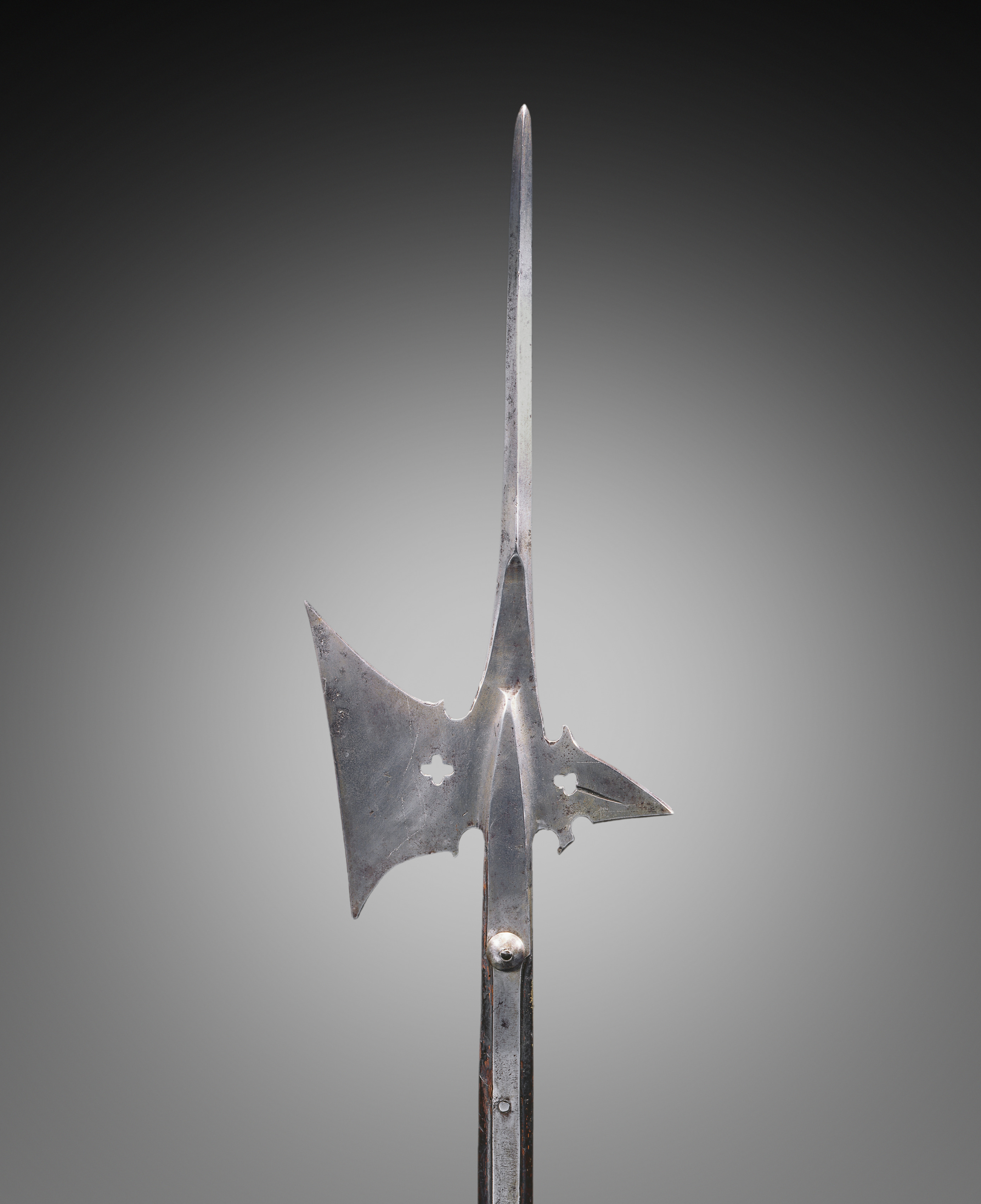
Halberd: Deconstructing the Avant-Garde DNA of a German Steel Relic
At Zoey Fashion Lab, the act of deconstruction is not merely an aesthetic choice; it is a forensic investigation into the material, historical, and symbolic DNA of objects. Our latest subject, the Halberd—a German polearm from the late medieval period—presents a unique challenge. Its technical specifications: a steel head featuring a pierced quatrefoil, mounted on a rectangular wood haft with planed corners. This weapon, a relic of battlefield discipline, becomes, in our hands, a new DNA strand for an avant-garde collection. We are not replicating armor; we are extracting the genetic code of tension, geometry, and ritual to forge a new language for the human silhouette.
The Steel Head: Pierced Quatrefoil as Structural Lace
The halberd’s steel head is a study in brutalist elegance. The pierced quatrefoil—a four-lobed cutout typically associated with Gothic cathedral tracery—is the critical element. In its original context, this piercing served to reduce weight while maintaining structural integrity. In our deconstruction, this becomes a negative-space motif for fabric manipulation. We translate the quatrefoil into a pattern of laser-cut perforations on high-tensile technical fabrics, such as Kevlar blends or structured neoprene. These cuts are not decorative; they are functional, allowing for ventilation, movement, and a visual interplay of skin and textile that echoes the weapon’s lethal airiness.
The steel itself, cold and rigid, inspires a treatment of metallic finishes on fabric. We employ liquid-metal coatings, foil stamping, and chainmail weaves that mimic the weapon’s surface. However, the avant-garde twist lies in the juxtaposition: we fuse this steel-like rigidity with fluid, organic shapes. A jacket’s shoulder might be a sculpted, steel-gray panel with a quatrefoil cutout, while the sleeve dissolves into a cascade of liquid silk. This creates a tension between armor and drape, between protection and vulnerability. The halberd’s head is not worn as a helmet; it is embedded as a structural seam in a coat, a corset, or a skirt’s yoke. The piercing becomes a window, a portal through which the body’s movement is framed.
The Wooden Haft: Rectangular Geometry and Planed Corners
Moving from the steel to the haft, we encounter the rectangular wood haft with planed corners. This is not a rounded, organic staff; it is a disciplined, architectural form. The planed corners suggest a deliberate, almost brutalist geometry—a rejection of natural curves in favor of angular, man-made precision. For Zoey Fashion Lab, this translates directly into the construction of structural silhouettes. We are inspired by the haft’s linearity to create garments that are built, not draped. Think of a coat with sharp, rectangular shoulders, a skirt with a rigid, box-pleated structure, or a bodice with planed, angular seams that mimic the haft’s facets.
The materiality of the wood—its grain, its weight, its tactile warmth—is reinterpreted through textured, ribbed fabrics. We use jacquard weaves that replicate the look of wood grain, or we incorporate actual wood veneers into accessories and structural panels. The planed corners inspire sharp, clean hems and seams. No raw edges, no soft curves. Every line is deliberate, every corner a statement. The haft’s length suggests a vertical, elongating line, which we echo in floor-length coats, high-waisted trousers, and columnar dresses. The wearer becomes a living staff, a moving architecture. The haft’s function as a handle—a point of control—translates into grip-inspired details: leather straps, metal loops, and cinched waists that allow the garment to be adjusted, tightened, or released, giving the wearer agency over their own silhouette.
The New DNA Strand: Avant-Garde Synthesis
The true innovation of the Halberd as a new DNA strand lies in the synthesis of its two opposing elements: the aggressive, ornamented steel head and the disciplined, minimal wooden haft. In traditional weaponry, these are unified by function. In our avant-garde collection, they are unified by conceptual tension. We are not creating a costume; we are creating a wearable dialectic between violence and order, between ornament and austerity, between the historical and the futuristic.
The avant-garde style demands a break from convention. Here, we break the halberd down into its core genetic components: piercing, geometry, tension, and ritual. The piercing (quatrefoil) becomes a motif of strategic exposure—cutouts in unexpected places, like the back of a jacket or the side of a pant leg. The geometry (rectangular haft) becomes a system of panels and seams that structure the garment’s form, creating a second skeleton. The tension is physicalized through asymmetrical closures, offset zippers, and contrasting textures—a matte wool panel next to a glossy, steel-like insert. The ritual is evoked through ceremonial details: high collars, long trains, and fastenings that require deliberate, almost meditative action to engage.
Consider a specific garment: a Halberd Coat. The body is a long, rectangular form in heavy, charcoal wool, with planed, sharp edges at the hem and collar. The sleeves are set with quatrefoil cutouts at the elbows, lined with a metallic, mesh fabric. The front closure is a single, long steel zipper that runs from the collar to the hem, mimicking the haft’s vertical line. At the shoulders, sculpted steel-gray panels echo the weapon’s head, but they are soft to the touch, made from a molded silicone-coated textile. The coat is heavy, architectural, and demands a certain posture from the wearer—a stance of readiness, of poised tension.
Conclusion: From Weapon to Wearable Code
The German Halberd, with its steel pierced quatrefoil and rectangular wood haft, is not a relic to be preserved. It is a code to be decoded and rewritten. At Zoey Fashion Lab, we have extracted its DNA: the piercing as a motif of negative space, the rectangle as a principle of structure, and the tension between steel and wood as a dynamic of contrast. This new strand is woven into garments that are at once historical and futuristic, rigid and fluid, aggressive and refined. The avant-garde is not about shock for its own sake; it is about recontextualizing the familiar to reveal new truths. The halberd, in our hands, is no longer a weapon of war. It is a weapon of style—a tool for deconstructing the body’s relationship with space, power, and material. The wearer becomes a living architecture, a moving monument to the fusion of history and innovation. This is the new DNA of Zoey Fashion Lab: where the past is not a museum, but a laboratory for the future of fashion.