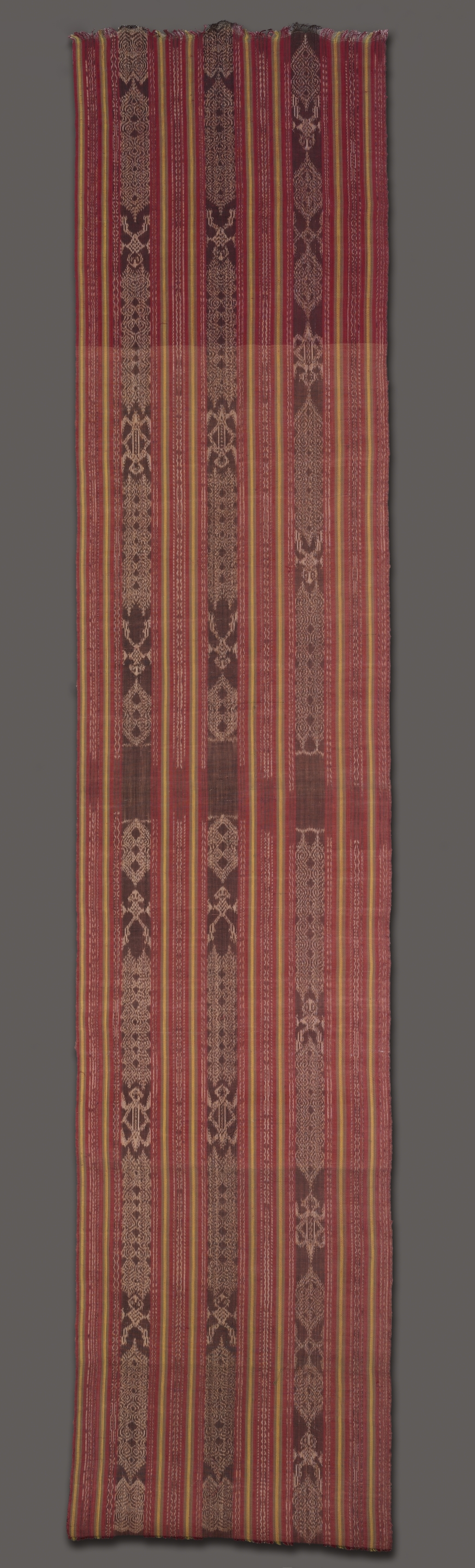
Deconstructing the Dagmay: An Avant-Garde Analysis of Mandaya Textile for Zoey Fashion Lab
As the Chief Fabric Deconstructionist for Zoey Fashion Lab, it is my privilege to present an in-depth analysis of the Mandaya textile, specifically the composite dagmay, sourced from the Philippines, Mindanao. This plain-weave hemp fabric, dyed with indigenous techniques, represents not merely a material artifact but a profound intersection of cultural memory, ecological wisdom, and aesthetic rebellion. In the context of our avant-garde design philosophy, the dagmay is not a relic to be preserved in sterile archives; it is a living, breathing text to be deconstructed, reinterpreted, and reanimated. This analysis will dissect its technical properties, cultural resonance, and potential for radical transformation within the high-fashion landscape, drawing inspiration from the conceptual framework of Archive Resonance—the idea that objects from the 16th to 17th centuries are silent witnesses to cultural collisions and aesthetic fusions, waiting to be decoded.
Technical Anatomy: The Hemp Matrix and the Plain Weave
The foundational structure of the composite dagmay is its plain weave, executed in hemp fiber. Hemp, a bast fiber derived from the Cannabis sativa plant, is renowned for its exceptional tensile strength, durability, and breathability. Unlike cotton, which softens and degrades over time, hemp’s crystalline cellulose structure becomes more supple with wear while retaining its structural integrity. This makes the dagmay a fabric of architectural potential—capable of holding sharp pleats, voluminous drapes, and sculptural forms without the need for synthetic interfacing.
The plain weave itself is a binary grid: warp and weft interlace at right angles, creating a checkerboard of intersection points. In the dagmay, this grid is not uniform. The hand-spun hemp yarns vary in thickness, introducing an organic, irregular tension that results in a fabric with subtle ripples and textural depth. This irregularity is not a flaw but a feature—a deliberate deviation from the sterile precision of machine-made textiles. For Zoey Fashion Lab, this translates into a material that can be manipulated through deconstruction: we can introduce deliberate pulls, gaps, and distortions to the weave, creating a new language of asymmetry and controlled chaos.
The dyeing process further complicates the technical narrative. Traditional Mandaya dyers use natural sources: indigo for deep blues, and various barks, roots, and leaves for earthy browns, blacks, and rusts. The composite dagmay often features ikat-like resist dyeing, where yarns are bound and dyed before weaving, resulting in blurred, organic patterns. These dyes are not colorants in the synthetic sense; they are chemical compounds that bond with the hemp’s cellulose, creating a living patina that evolves with exposure to light, moisture, and friction. This patina of time is a key element in our avant-garde approach: we will accelerate and control this aging process through selective exposure, chemical treatments, and mechanical abrasion, transforming the fabric into a palimpsest of wear.
Cultural Resonance: The Archive as a Catalyst for Disruption
To understand the dagmay is to understand its role as a composite artifact—a textile that synthesizes multiple cultural influences. The Mandaya people, indigenous to the eastern coast of Mindanao, have a weaving tradition that predates Spanish colonization. However, the composite nature of the dagmay suggests a later development, likely from the 16th to 17th centuries, when trade routes brought Chinese silks, Indian cottons, and European wools to the archipelago. The dagmay is not a pure, isolated tradition; it is a hybrid, a testament to the cultural collisions that define the early modern period.
This hybridity is the crux of Archive Resonance. The dagmay is a silent witness to the exchange of techniques, motifs, and materials. The geometric patterns—often diamonds, zigzags, and human figures—are not merely decorative; they are mnemonic devices, encoding stories of ancestry, cosmology, and social status. For the avant-garde designer, these motifs are not to be reproduced faithfully but fragmented, distorted, and recontextualized. We will extract individual motifs from the weave, isolate them as digital prints, and project them onto deconstructed silhouettes, creating a dialogue between the original and the alienated.
The act of wearing a dagmay in its original context was a performance of identity. The textile was a second skin, a marker of belonging. In our avant-garde reinterpretation, we will subvert this function. We will cut, fray, and reassemble the dagmay into garments that are deliberately incomplete—jackets with missing sleeves, skirts with asymmetrical hems, bodices that expose the raw warp threads. This is not an act of destruction but of deconstruction: we are exposing the textile’s internal logic, revealing the labor and skill that went into its creation, and challenging the viewer to see it not as a finished object but as a process.
Avant-Garde Transformation: The Deconstructionist’s Toolkit
At Zoey Fashion Lab, we do not simply use the dagmay as a decorative material. We interrogate it. The following techniques will be employed to translate its archive resonance into a contemporary, avant-garde collection:
1. Structural Unraveling: The plain weave will be selectively unraveled along the warp or weft, creating deliberate holes and fringed edges. These openings will be framed with contrasting materials—sheer organza, metallic mesh, or recycled plastic—to create a dialectic between the organic and the synthetic. The dagmay’s hemp body will serve as the anchor, while the unraveled sections become portals to another dimension.
2. Chemical Patination: Using controlled exposure to mild acids, alkalis, and UV light, we will age the dyes in specific zones. The indigo blues will fade to pale cyans, the rust browns will oxidize to deep ochres. This process will create a geological strata on the fabric’s surface, mimicking the effects of centuries of wear in a matter of hours. The resulting garment will look as if it has been excavated from a forgotten tomb, yet it will be pristine in its construction.
3. Motif Extraction and Digital Projection: The traditional Mandaya motifs—the binagong (diamond), the sinulog (flowing line), and the kata-kata (human figure)—will be digitally scanned and extracted from the fabric’s pattern. These motifs will then be projected onto the deconstructed garments using LED-embedded fibers or reactive dyes. The motifs will not be static; they will shift, morph, and dissolve in response to the wearer’s movement or ambient light, creating a living archive that is constantly in flux.
4. Composite Layering: The dagmay will be layered with other deconstructed textiles—silk organza, wool felt, and even recycled denim—to create a collage of textures. Each layer will be cut to expose the one beneath, creating a visual narrative of depth and time. The hemp’s coarse, earthy texture will contrast with the silk’s fluidity and the wool’s density, creating a symphony of tactile sensations.
Conclusion: The Dagmay as a Radical Proposition
The Mandaya composite dagmay is not a passive material awaiting consumption. It is a radical proposition—a challenge to the fashion industry’s obsession with novelty and disposability. By deconstructing this textile, we are not erasing its history; we are amplifying it. We are saying that the past is not a static archive but a dynamic reservoir of possibilities. The dagmay’s hemp fibers, its irregular weave, its living dyes, and its hybrid motifs all speak to a world where craftsmanship, ecology, and cultural exchange were intertwined.
For Zoey Fashion Lab, this analysis is a call to action. We will not merely use the dagmay as a fabric; we will collaborate with it. We will let its irregularities guide our cuts, its patina inform our finishes, and its motifs inspire our silhouettes. The result will be a collection that is at once ancient and futuristic, grounded and ethereal, respectful and irreverent. The dagmay, in our hands, will become a manifesto—a declaration that fashion can be a site of memory, resistance, and transformation. This is the essence of Archive Resonance: not to preserve the past, but to resurrect it in a form that speaks to the present and the future.