Technical Deconstruction: The Flintlock Pistol as Armored Chassis
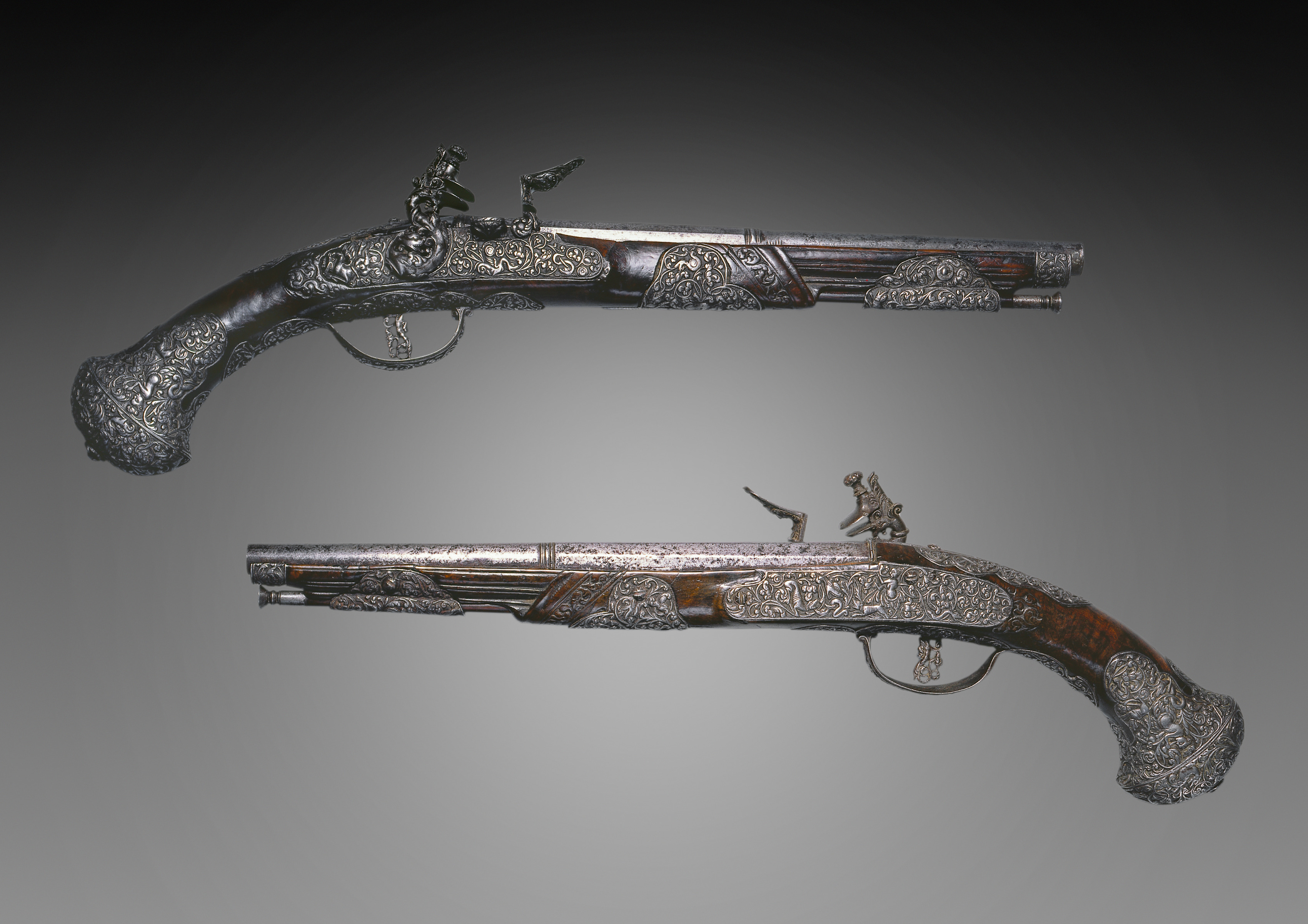
The pair of Brescian flintlock pistols, circa 17th century, presents not as mere historical weaponry but as a fully realized exoskeleton for power. Our analysis begins by stripping the object to its core technical architecture. The steel barrel is the foundational line—a rigid, authoritative spine from which all other elements depend. Its function is singular: to channel and direct explosive force with precision. In a fashion context, this translates to structural integrity and directional silhouette. Imagine this not as a literal barrel, but as the boning in a corset, the rigid seam in a tailored jacket, or the architectural curve of a shoulder exaggeration. It is the uncompromising line that defines the garment's intent.
The chiseled decoration on the steel is not ancillary; it is data etched into the armor. Each foliate pattern, each mythic scene carved into the metal, represents a coded language of status, artistry, and origin. For Zoey Fashion Lab, this technique moves beyond surface appliqué. It suggests a methodology where texture and narrative are embedded directly into the structural material—through laser-cutting, heat-embossing, or 3D printing that alters the fabric's very topography. The decoration is integral, not applied, creating a tactile history on the surface of the garment.
Material Dialectic: Steel vs. Walnut
The material dichotomy is profound. The cold, unforgiving steel of the lock plate and barrel meets the warm, organic walnut of the stock. This is a dialectic of tension and reception. The steel is active, mechanical, and dangerous. The walnut stock, shaped to fit the human hand, is the interface—the element that translates lethal potential into controlled utility. In avant-garde fashion, this invites exploration into radical material juxtapositions. Imagine a garment with a rigid, polished polymer "action" (inspired by the steel lock mechanism) seamlessly flowing into a section of thermo-formed wood veneer or rich, molded leather (the walnut stock) that conforms to the body's contours. The wearer becomes the operative, engaging with the hard, technical elements through soft, organic interfaces.
Conceptual Genesis: The "New DNA Strand" Reference
The reference to a "New DNA Strand" is pivotal. It instructs us to view these pistols not as static artifacts, but as prototypes containing a replicable genetic code. A DNA strand is a double helix—two interconnected, spiraling sequences that mirror and complement each other. This is perfectly manifested in the pair of pistols. They are a matched set, a binary system. This concept of symbiotic pairing is crucial for fashion. It moves beyond the singular garment to consider the ensemble as a dual-system: top and bottom, inner and outer, rigid and fluid, operating in concert like the two pistols in their case.
The "newness" of this DNA lies in its recombinant potential. We are to extract the core sequences—the genes of ignition, precision, duality, and ornamented structure—and splice them with the biological language of the body and contemporary textiles. The result is a hybrid: clothing that carries the latent power and poised tension of the flintlock, expressed through a modern, living medium.
Avant-Garde Translation: From Ignition to Gesture
The avant-garde interpretation must center on the pistol's potent latency. The flintlock's most powerful state is not in firing, but in the moment it is charged and poised—the hammer cocked, the spark imminent. This is a garment of suspended animation and potential energy. Design elements should evoke this state of readiness. This could manifest in closures that resemble lock mechanisms, seams that converge like the sights on a barrel, or silhouettes that appear to have just "discharged" a shape, like a skirt with a petal-like flare suggesting recoil.
The ignition sequence itself—spark, flash, propulsion—offers a kinetic blueprint. Fabrics could transition from a matte, steel-grey "loaded" state to sections with sudden, iridescent "flash" patterns. Silhouettes might incorporate controlled explosive details: sudden bursts of ruffles from a tight cuff, or asymmetric drapery that seems propelled from a single, precise point on the garment's architecture.
Collection Blueprint: The Brescian Protocols
Based on this deconstruction, Zoey Fashion Lab can develop a capsule collection under the working title "The Brescian Protocols." This collection would operationalize the extracted DNA into wearable art.
Line 01: The Action focuses on the steel components. Garments are built on a rigid, linear silhouette. Look for tailored coats with severe, elongated lines, incorporating laser-cut "chiseled" patterns directly into leather or technical fabrics. Fastenings are overt, mechanical, and inspired by the cocking mechanism. Color palette: gunmetal, polished steel, black.
Line 02: The Stock explores the walnut interface. This line is about ergonomic warmth and organic form. It features molded leather bodices, garments with burnished wood-bead embellishments, and shapes that curve to embrace the body. The materials are rich, tactile, and earthy—walnut-dyed silks, molded suede, warm bronzes. It represents the human element in the mechanical system.
Line 03: The Pair embodies the dual-strand DNA. This line consists of symbiotic separates designed to be worn only in concert. A rigid, structured polymer corset (the "steel" pistol) is functionally incomplete without its paired, flowing, organic skirt or drape (the "walnut" pistol). The two pieces connect via unique, proprietary closures, making the ensemble a complete, operational unit.
In conclusion, this Brescian flintlock pair is a masterclass in tense, beautiful functionality. It provides a genetic blueprint for a fashion that is architecturally severe, intimately interfaced, and charged with potential. By splicing its codes of duality, ornamented structure, and latent energy with contemporary form, Zoey Fashion Lab can create a collection that does not merely reference history, but reloads it for a new era.