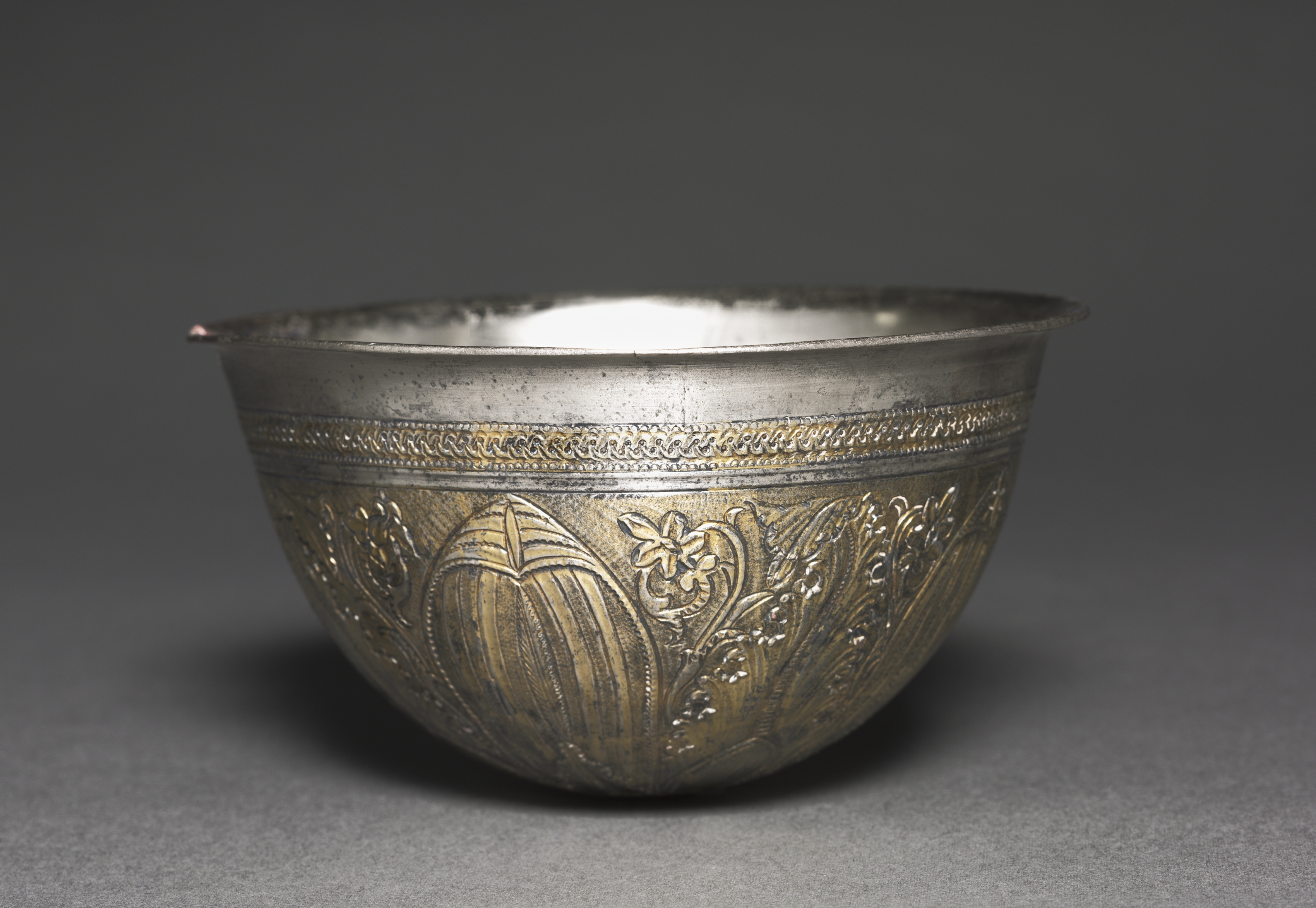
Deconstructing the Hellenistic Bowl: An Avant-Garde Resonance for Zoey Fashion Lab
As Chief Fabric Deconstructionist at Zoey Fashion Lab, my mandate is to dismantle historical artifacts not merely as objects, but as tectonic plates of aesthetic tension. The subject under analysis—a silver gilt bowl from the late Hellenistic period, Greece—is no mere vessel. It is a paradox in metal, a fractured mirror of dualities that directly informs our avant-garde design ethos. The reference, “Mirror with Split-Leaf,” serves as our Rosetta Stone: a document that records the bowl’s core contradiction. One side presents a polished silver surface inlaid with intricate gold palmettes; the other, a cold sarcophagus lid narrating life through relief. This is not decoration. This is deconstruction as narrative.
I. The Silver Gilt Paradox: Surface as Seduction, Depth as Dissection
The bowl’s technical execution—silver gilt—is the first site of our deconstruction. Silver, in its polished state, is a mirror of vanity, reflecting the viewer’s immediate reality. Gold, inlaid as palmettes, is a hallucination of permanence, an attempt to freeze organic life into eternal geometry. Yet the late Hellenistic period was an era of dissolving certainties: the fall of empires, the rise of individualism, the collision of Greek rationalism with Eastern mysticism. The bowl captures this fracture. The polished silver side is a façade of coherence, a surface that promises unity but delivers only fleeting reflection. The gold palmettes, while intricate, are disjointed fragments—split leaves, broken scrolls—that refuse to form a complete picture. This is the avant-garde’s first lesson: beauty is not in harmony, but in the violence of its own assembly.
For Zoey Fashion Lab, this translates into fabric as discordant mirror. We will not use a single textile to tell a story. Instead, we will laminate silvered organza over gold-threaded jacquard, creating a surface that shifts from blinding reflection to opaque ornamentation. The wearer becomes a living artifact, simultaneously seen and hidden. The gold palmettes will be deconstructed into appliqué patches, placed asymmetrically—not to mimic nature, but to expose the mechanics of their own creation. Stitches will be visible, edges raw, as if the bowl’s surface had been shattered and reassembled by a blind archivist.
II. The Sarcophagus Lid: Life Narrated Through Death’s Cold Geometry
Flip the bowl, and the narrative inverts. The reverse side is not a mirror but a stone slab—cold, unyielding, carved with reliefs that tell a story of life. This is the ultimate deconstructive gesture: to make the vessel that holds wine (life’s blood) also bear the weight of a sarcophagus (death’s container). The reliefs are not soft; they are geometric, angular, compressed into the metal’s depth. Figures are squeezed between planes, their gestures frozen mid-motion. This is not a celebration of life; it is life trapped under the pressure of its own ending. The “Mirror with Split-Leaf” reference underscores this: the leaf is split, the mirror is broken, the story is told in fragments.
In our avant-garde interpretation, this side becomes texture as testimony. We will develop a fabric that mimics the cold, compressed relief of stone: a heavy wool-cashmere blend, felted and then laser-cut with angular, interlocking patterns. These patterns will not depict figures but abstracted body parts—a hand, a foot, a jawline—each isolated, as if excavated from a tomb. The fabric will be backed with a thin layer of liquid silicone, giving it a stone-like weight and chill. When the wearer moves, the fabric will resist and pull, creating a tension between the living body and the dead material. This is not comfort; it is confrontation.
III. The Split-Leaf Aesthetic: Avant-Garde as Archaeological Palimpsest
The split-leaf motif is the bowl’s most potent deconstructive element. In Hellenistic art, the palmette was a symbol of renewal and victory. But here, it is split, bifurcated, its symmetry broken. This is not a mistake; it is a deliberate act of aesthetic violence. The artist is saying: I will show you the leaf, but I will also show you the cut that made it. This is the essence of deconstruction: to reveal the process behind the product.
For Zoey Fashion Lab, the split-leaf becomes a silhouette strategy. We will design garments that are bisected, halved, asymmetrical. A coat will have one sleeve of mirror-polished silver leather and the other of matte, stone-grey felt. The collar will be split down the center, one side rising in a sharp, geometric point (the sarcophagus), the other draping in a soft, organic curve (the palmette). The hemline will be a broken line, not a clean cut, as if the garment had been torn from a larger, ancient cloth. Each piece will be a palimpsest, with layers of fabric—silver, gold, stone—visible at the seams, as if the wearer is peeling back time itself.
IV. The Archive Resonance: From Bowl to Body
The “Mirror with Split-Leaf” reference is not just a title; it is a design manifesto. It tells us that the bowl is not a single object but a dialectic between two opposing states: reflection and burial, surface and depth, life and death. Our task is to translate this dialectic into wearable form. The result is not a costume but a conceptual garment that wears the wearer.
Consider the kinetic experience. When the wearer turns, the silver side catches light, flashing like a mirror. When they turn again, the stone side absorbs light, becoming a dark, narrative void. This is not a garment for passive observation; it is a performance of duality. The wearer becomes the archaeologist and the artifact, the living mirror and the dead stone.
In terms of material innovation, we will push the boundaries of composite textiles. The silver gilt effect will be achieved through a vapor-deposited aluminum film on a silk base, hand-embroidered with 24-karat gold thread in deliberately broken palmettes. The stone relief will be 3D-printed in a bio-resin that mimics the tactile density of marble, then hand-applied to a felted wool underlayer. The seams will be exposed and reinforced with silver rivets, echoing the bowl’s metallic construction. This is craft as critique, where every element is visible, traceable, and confrontational.
Conclusion: The Bowl as Blueprint for Avant-Garde Deconstruction
The late Hellenistic silver gilt bowl is not a relic; it is a blueprint for the avant-garde. Its split-leaf mirror and sarcophagus relief are not opposites but co-dependent narratives. One cannot exist without the other. As Chief Fabric Deconstructionist, I see this bowl as a challenge to modern fashion’s obsession with surface. We are not in the business of making clothes that simply look beautiful. We are in the business of making clothes that reveal the fractures—the cuts, the splits, the deaths—that underlie all beauty.
Zoey Fashion Lab’s forthcoming collection, “Split-Leaf Archive,” will be a direct response to this artifact. Each garment will be a dialogue between reflection and burial, between the polished surface of vanity and the cold geometry of mortality. The wearer will not just wear a garment; they will inhabit a paradox. And in that paradox, they will find the true resonance of the avant-garde: not to escape history, but to wear its scars.