Deconstructing the Venetian Loom: An Avant-Garde Analysis of Exotic Gold-Patterned Silk
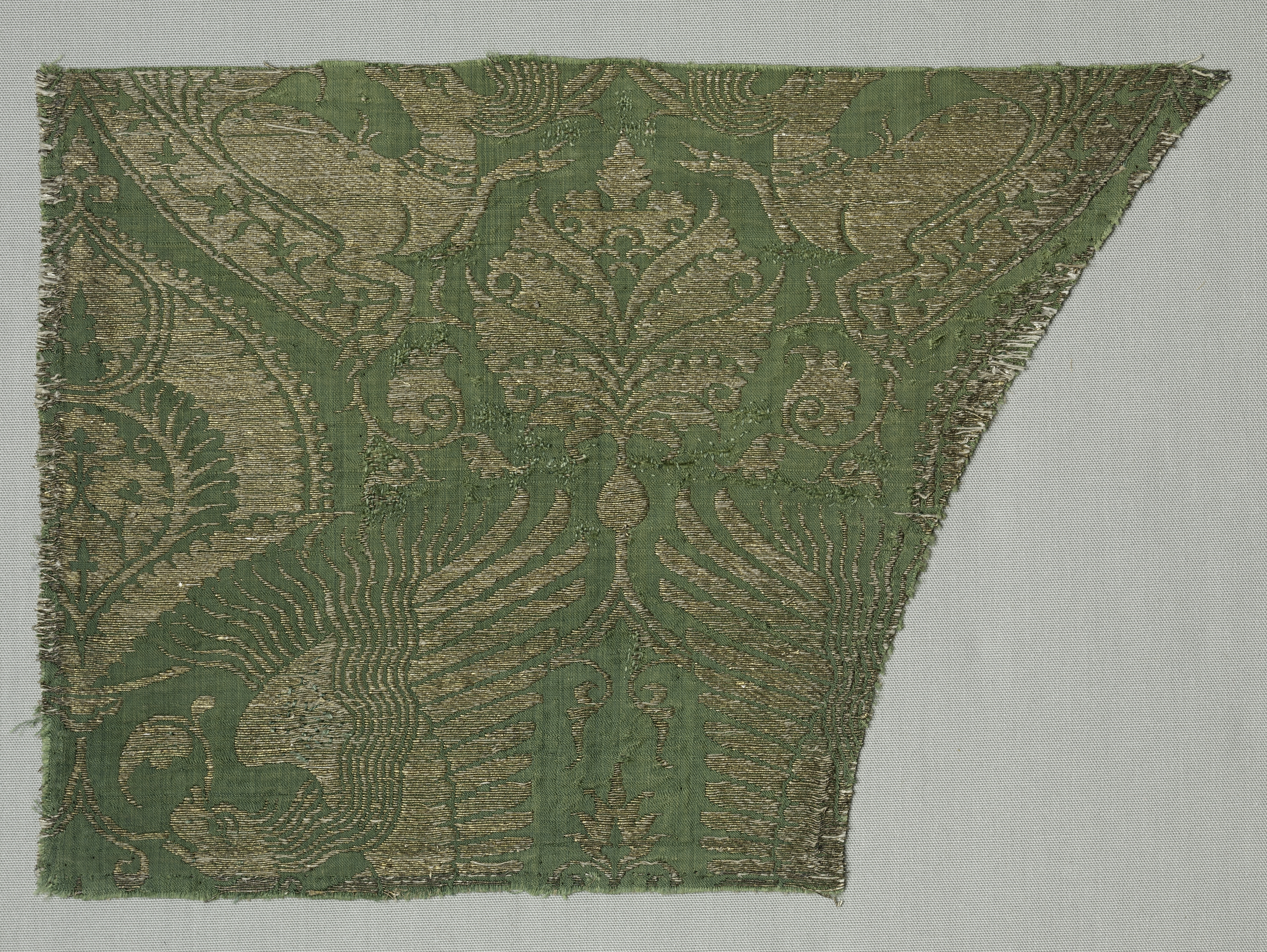
At Zoey Fashion Lab, the act of deconstruction is not an act of destruction, but a forensic excavation of narrative, technique, and potential. We do not merely observe fabric; we interrogate it. Our subject today is a specimen of extraordinary provenance and technical complexity: an Exotic Gold-patterned Silk from Venice, Italy. This is not a simple textile. It is a hybrid beast, a woven paradox born from the marriage of 2/1 twill and 1/3 twill, a structure historically known as lampas. To understand this fabric is to understand the very tension between opulence and structure, between the fluidity of silk and the rigidity of gold thread. Our analysis, guided by the archive resonance of a Mirror with Split-Leaf motif, will strip this material to its structural and philosophical bones, revealing its potential for an avant-garde future.
I. The Geopolitical Thread: Venice as a Loom of Empires
The origin of this fabric is not incidental; it is foundational. Venetian silk weaving, at its zenith, was a state-sanctioned art of industrial espionage and exquisite craft. Venice served as the critical node between the raw silks of the East and the voracious markets of Western Europe. The gold thread—likely oro filato (gilt silver or gilt copper wound around a silk core)—speaks to immense wealth and a mastery of metallurgy applied to textile. This is not a humble cloth. It is a declaration of power, a portable treasury.
For the avant-garde designer, this origin story is a weapon. The fabric carries the ghost of mercantile ambition, of doges and courtiers. To use it today is to invoke a history of luxury that was always also a history of control. The designer must ask: How do we honor the craft while subverting the power structure it once served? The answer lies in the weave itself.
II. The Structural Paradox: Lampas as a Dialogue of Weaves
The technical specification—a combination of 2/1 twill and 1/3 twill—is the key to the fabric’s dual personality. This is the classic lampas structure. In lampas, a ground weave (here, the 2/1 twill) provides the base structure, while a pattern weave (the 1/3 twill) floats on top to create the design. This is not a simple print or embroidery; the pattern is woven into the very skeleton of the cloth.
- The 2/1 Twill (Ground): This structure is a workhorse. It is a warp-faced weave, meaning the warp threads dominate the surface. It offers stability, drape, and a subtle, diagonal ribbing. It is the fabric’s body—the quiet, disciplined foundation.
- The 1/3 Twill (Pattern): This is the voice. A weft-faced weave, the 1/3 twill allows the gold thread (typically carried in the weft) to float across the surface, creating the luminous, raised patterns. The longer floats of the 1/3 structure catch the light, creating a shimmering, almost three-dimensional effect.
The genius of lampas is that these two weaves coexist in the same cloth, on the same loom, at the same time. The ground weave provides the structural integrity; the pattern weave provides the opulent surface. This is not a compromise; it is a dialogue. The 2/1 twill whispers of structure and restraint, while the 1/3 twill shouts of gold and excess. For the avant-garde designer, this dialogue is the design brief. The fabric itself is a completed conversation about the relationship between foundation and ornament, between the hidden and the shown.
III. The Archive Resonance: Mirror and Split-Leaf
The provided reference—“一面是光洁银镜上以黄金镶嵌的纷繁棕叶纹,另一面是冰冷石棺板上以浮雕诉说的生命叙事”——translates to a profound conceptual duality. It speaks of a Mirror with Split-Leaf motif, but more importantly, it describes the fabric as having two faces: one of polished silver mirror inlaid with gold palm leaves, the other of a cold sarcophagus stone telling a story of life through relief.
This is our interpretive lens. The “mirror” face is the gold-patterned surface of the lampas—the 1/3 twill floats that catch the light, the exotic palmettes and split-leaf arabesques that speak of Eastern influence and Venetian fantasy. It is a surface of pure, reflective luxury. The “sarcophagus” face is the reverse side of the fabric, the 2/1 twill ground, which is matte, structured, and quiet. Yet, it is this “cold” side that holds the narrative structure, the life story of the weave.
The avant-garde application lies in exploiting this inherent duality. The fabric is not a single surface; it is a reversible argument. The designer can create garments that are inversions of expectation—a coat that is all mirror on the outside, but reveals the sarcophagus narrative on the inside lining. Or, more radically, a garment that is deliberately worn inside-out, forcing the viewer to confront the structural truth of the weave rather than the seductive lie of the surface. The split-leaf motif itself, a classic symbol of growth and division, becomes a metaphor for the fabric’s own bifurcated nature.
IV. Avant-Garde Applications: Subverting the Opulent
How does one use such a historically loaded, technically complex material in a contemporary, avant-garde context? The answer is not to treat it with reverence, but with radical agency. The fabric is not a relic; it is a material for future construction.
1. Deconstruction of Form: The lampas structure is inherently stiff due to the combination of silk and metal thread. This stiffness is not a flaw; it is a sculptural property. The designer can use this fabric to create architectural silhouettes that are impossible with softer silks. Think of sharp, asymmetric hems, exaggerated shoulders, or garments that stand away from the body. The gold thread can be partially removed or abraded, creating a distressed opulence—a look that speaks of decayed grandeur, of a Venetian palace falling into the sea.
2. The Reversible Narrative: As suggested by the archive resonance, the garment itself can become a narrative device. A dress might be constructed with the gold-patterned face on the front, but the matte, structural face on the back. The wearer becomes a walking dichotomy: a mirror for the world to see, a sarcophagus for the self. Alternatively, the fabric can be cut and reassembled so that the 2/1 twill ground is used for the main body, with the gold 1/3 twill pattern used only as strategic, almost violent, inserts—like gold shards embedded in a dark, matte surface.
3. Technical Hybridity: The lampas structure is a historical technique. The avant-garde designer can push it further by combining it with non-traditional materials. Imagine a garment where the silk ground is left intact, but the gold thread is replaced with conductive thread or fiber optics. The split-leaf pattern would then become a circuit, a map of light. Or, the fabric can be laser-cut to remove sections of the gold pattern, creating a lace-like effect that reveals the skin beneath, turning the garment into a negative of its own design.
4. The Anti-Luxury Statement: The most radical use of this fabric is to deny its inherent luxury. Instead of a gown for a gala, use it for a utilitarian garment—a work jacket, a pair of cargo pants. The clash between the precious material and the mundane form creates a powerful cognitive dissonance. The gold pattern becomes not a symbol of wealth, but of absurdity, of the excess we carry as a society. This is the true avant-garde gesture: to take the most opulent material and force it to serve a humble purpose.
Conclusion: The Fabric as a Living Archive
The Exotic Gold-patterned Silk from Venice is not a finished product. It is a starting point. It contains within its warp and weft the history of trade, the science of structural engineering, and the poetry of a mirror and a sarcophagus. At Zoey Fashion Lab, our deconstruction reveals that the true value of this fabric lies not in its gold, but in its inherent contradiction—a contradiction between the opulent surface and the structured ground, between the mirror and the stone.
To use this fabric in an avant-garde context is to embrace that contradiction. It is to design not with the fabric, but against it. It is to force the gold to speak of decay, the twill to speak of rebellion, and the split-leaf to finally, fully, split. The future of fashion is not in preserving these textiles as museum pieces, but in re-weaving them into the present with a critical, deconstructive hand. The loom of Venice is silent, but the fabric still has a story to tell—a story we are only beginning to write.