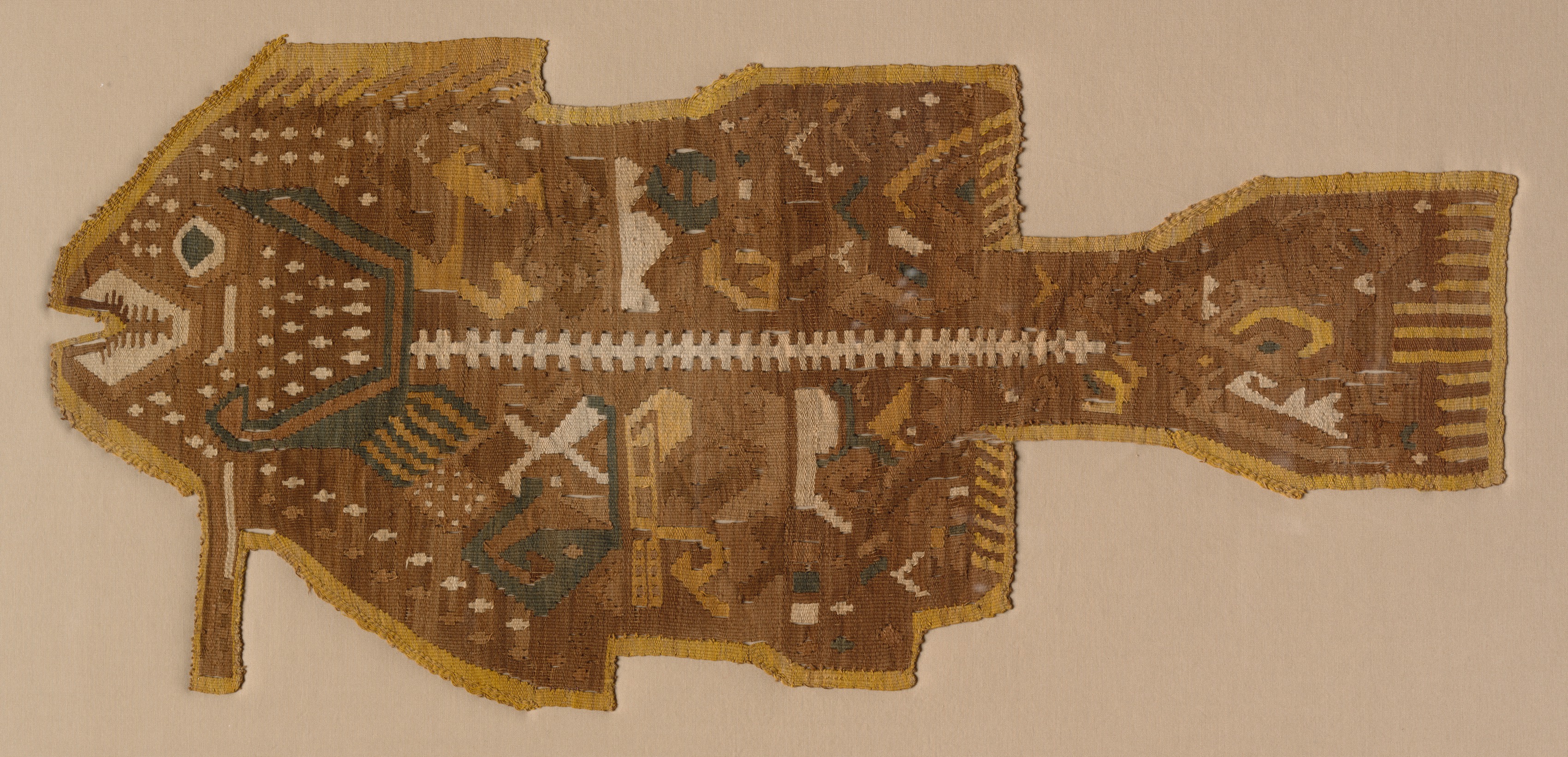
Deconstructing the Aquatic Icon: The Ychsma Fish-Shaped Applique as Avant-Garde Textile Catalyst
At Zoey Fashion Lab, our mandate is to dismantle the conventional and reconstruct it through a lens of radical materiality and cultural resonance. The subject of this analysis—a fish-shaped applique from the Central Andes, attributed to the Ychsma (Pachacamac) people of the Central Coast—is not merely an artifact. It is a tectonic plate of textile history, a compressed narrative of technique, cosmology, and ecological adaptation. Our role as Chief Fabric Deconstructionist is to strip this piece of its museological stillness and reanimate its core principles as a blueprint for avant-garde fashion. The Archive Resonance, which speaks to the silent witness of cultural collision between the 16th and 17th centuries, provides the crucial context: this object existed at the precipice of irreversible change, making its material choices and symbolic weight even more potent for our practice.
Technical Analysis: The Tapestry of Contradiction
The applique is constructed from cotton and camelid fiber, a pairing that immediately signals a dialogue between the coastal lowlands (cotton) and the highland sierras (camelid). This is not a neutral material choice; it is a geopolitical and ecological statement. The cotton provides a crisp, absorbent ground, while the camelid fiber—from alpaca or llama—introduces a halo of warmth, luster, and structural memory. The tapestry weave, executed with areas of eccentric weft floats, is where the avant-garde potential truly crystallizes.
Eccentric weft floats are a deliberate deviation from structural orthodoxy. In standard tapestry, wefts run perpendicular to warps in a disciplined, interlocking grid. Here, the Ychsma weaver allowed certain weft threads to float freely across the surface, creating areas of exaggerated texture, irregular tension, and visual rhythm. These floats are not mistakes; they are a form of controlled chaos. They mimic the shimmer of fish scales, the ripple of water, and the unpredictable movement of a living creature. For Zoey Fashion Lab, this technique is a direct precursor to our own experiments with deconstructed weaves and unstable surfaces. We can replicate this effect using modern yarns—perhaps a blend of recycled polyester and organic silk—to create garments that appear to be in a state of perpetual becoming, their surfaces shifting with the wearer’s motion.
Cultural and Symbolic Resonance: The Fish as Transgressive Form
The fish shape is not arbitrary. In Ychsma cosmology, the Pacific Ocean was a source of life, sustenance, and spiritual power. The fish, particularly species like the bonito or the sardine, were vital to the coastal economy and ritual life. But the applique form itself is transgressive. It is a two-dimensional representation of a three-dimensional creature, flattened onto a textile plane. This is a fundamental act of abstraction, of translating the fluid, aquatic world into the rigid geometry of warp and weft.
The Archive Resonance reminds us that this object was created during a period of intense cultural collision—the early colonial era. The Ychsma, centered at the sacred oracle of Pachacamac, were facing the imposition of Spanish aesthetics and religion. The fish motif, however, persisted. It became a silent code of resistance, a way to maintain a connection to pre-Columbian deities and ecological knowledge within the confines of a new material order. For our avant-garde practice, this is a profound lesson: the applique is not just decoration; it is a weaponized symbol. We can deploy the fish shape in our collections as a sign of resilience, of the survival of indigenous knowledge systems within globalized fashion. Imagine a deconstructed trench coat where the fish applique is rendered in laser-cut, heat-bonded synthetic leather, its scales formed from recycled microplastics—a commentary on both cultural endurance and ecological crisis.
Avant-Garde Application: From Artifact to Actionable Design
Our deconstruction process must move beyond mere inspiration. We need to extract actionable principles that can be translated into a cohesive, radical collection. Here are three core directives:
1. The Principle of Eccentric Tension: We will develop a new weaving technique we call "Controlled Instability." Using a digital jacquard loom, we will program patterns that deliberately introduce long, floating wefts at irregular intervals. These floats will be left unbound, creating a surface that is tactile, unpredictable, and almost organic. The fish shape will be rendered not as a solid block of color, but as a field of fluctuating tension, where the weft floats create a moiré effect reminiscent of water ripples. This will be applied to a capsule collection of asymmetrical dresses and oversized outerwear.
2. The Principle of Material Dissonance: The Ychsma pairing of cotton and camelid is a study in opposites. We will push this further by combining ultra-fine merino wool with industrial-grade nylon monofilament. The wool provides warmth and softness; the monofilament introduces rigidity, transparency, and a ghostly, fish-like shimmer. The applique will be constructed as a double-layered structure: the wool forms the body of the fish, while the monofilament creates a cage-like skeleton around it, referencing both the fish’s internal structure and the colonial grid imposed upon indigenous forms.
3. The Principle of Symbolic Recontextualization: The fish shape must be abstracted to the point of near-unrecognizability, then re-embedded in a contemporary context. We will create a series of modular appliques that can be attached, detached, and rearranged on a garment. These will be laser-cut from a bio-based, algae-derived polymer that changes color with temperature (thermochromic). The fish will appear and disappear, shift from blue to red, as the wearer moves through different environments. This is a direct homage to the Ychsma use of the fish as a living, responsive symbol, not a static icon. The garment becomes a dynamic canvas for ecological and cultural dialogue.
Conclusion: The Fabric as Living Archive
The Ychsma fish-shaped applique is not a relic to be preserved in a vitrine. It is a living archive of techniques, beliefs, and resistance. As Zoey Fashion Lab, our responsibility is to deconstruct this archive, not to destroy it, but to liberate its latent energy. By extracting the principles of eccentric weft floats, material dissonance, and symbolic recontextualization, we can create garments that are not merely fashionable but philosophically active. They will challenge the wearer to consider the silent witnesses of history, the ecological systems that sustain us, and the radical potential of a single, carefully crafted shape. This is the avant-garde mandate: to make the past speak in a language that the future can understand. The fish is no longer a creature of the Central Coast; it is a vector of transformation, swimming through the fabric of our time.