Deconstructing the Rowel Spur: A Proto-Cyborg Silhouette for SS26
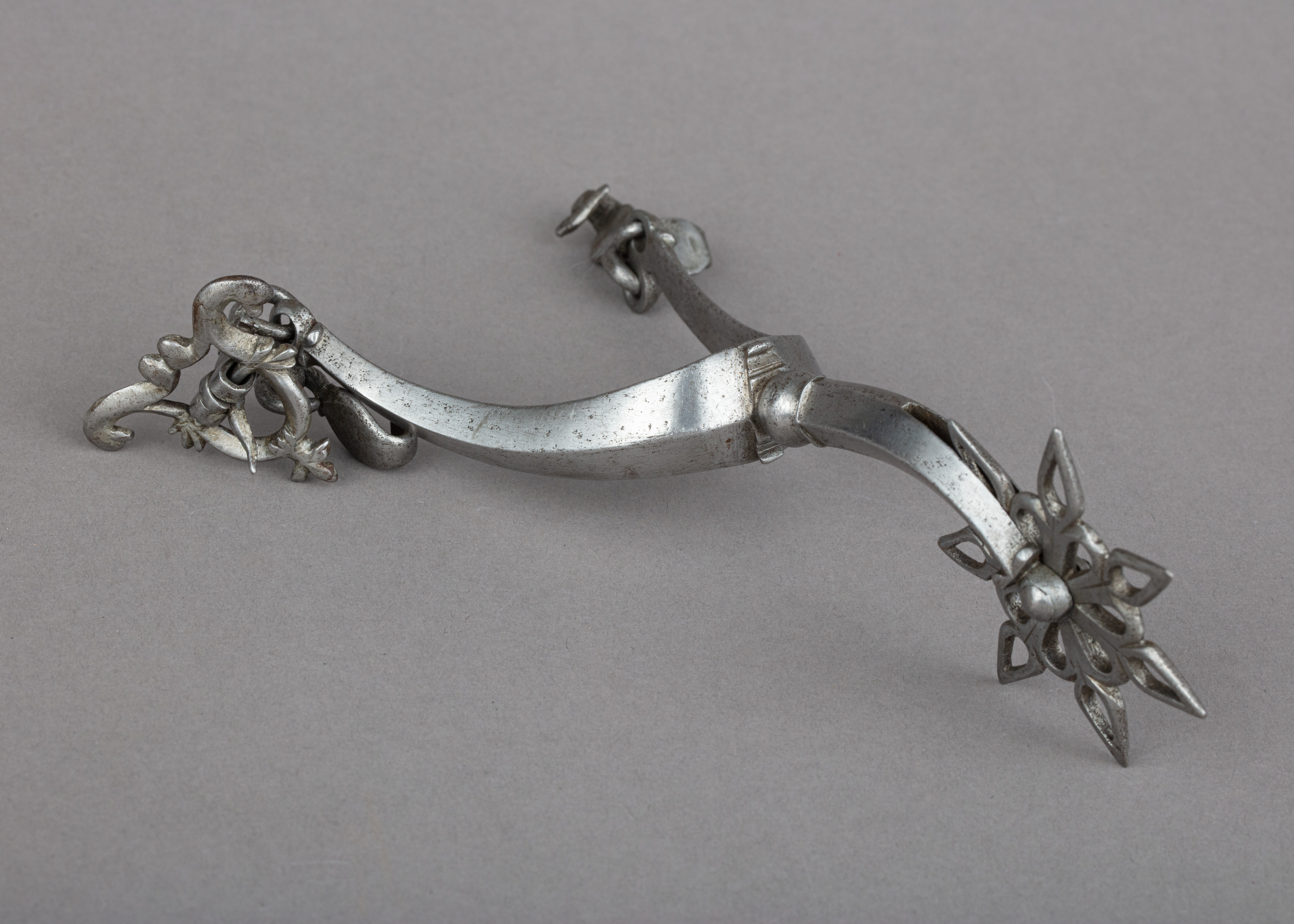
The archive node, “在人类文明的长河中,器物与绘画不仅是时代技艺的结晶,更是文化碰撞与美学交融的无声见证。十六至十七世纪…,” serves as a profound catalyst for Zoey Fashion Laboratory’s SS26 avant-garde analysis. We are drawn not to the historical narrative of the rowel spur as a tool of equestrian dominance or martial mobility, but to its latent, radical potential as a proto-cyborg appendage. This European iron alloy object, forged between the 16th and 17th centuries, is not a relic of a bygone era; it is a blueprint for a future where the human form is augmented by aggressive, functional, and architectonic metalwork. Our analysis decodes the spur’s morphology—its star-shaped rowel, its rigid shank, and its leather-clad fastening—to propose a SS26 collection that reimagines the body as a site of structural innovation and deconstructive aesthetics.
1. The Rowel as a Radial Propulsion System
The defining feature of the spur—the rowel, a rotating star of sharp points—is reinterpreted not as a tool of coercion, but as a radial propulsion system. In our SS26 vision, this element is abstracted into a series of concentric, kinetic panels that articulate around the ankle, the shoulder, and the hip. Imagine a garment where the rowel’s geometry is translated into laser-cut iron alloy scales, each point a micro-architectural fin that catches light and motion. These scales are not static; they are mounted on a flexible, carbon-fiber understructure, allowing them to rotate and lock into position as the wearer moves. The result is a silhouette that is simultaneously medieval and futuristic—a hybrid of knightly armor and biomechanical exoskeleton. The spur’s original function of delivering a sharp, precise stimulus is transformed into a visual and haptic language of propulsion, where the garment itself becomes an active agent in the wearer’s interaction with space.
2. Deconstructing the Shank: Structural Tension and Negative Space
The spur’s shank—the rigid, often curved arm that connects the rowel to the leather strap—is deconstructed to explore structural tension and negative space. In its original form, the shank is a bridge of force, transmitting the rider’s command to the horse. For SS26, we sever this bridge, isolating its components into fragmented, floating architectural elements. A jacket, for instance, might feature a shank-like spine that curves away from the body, supported by a single, slender iron alloy strut. The resulting void—a negative space between the garment and the torso—becomes a site of visual and conceptual tension. This is not merely a silhouette; it is a statement of disconnection and reconnection, where the wearer’s body is both the anchor and the void. The iron alloy is treated with a matte, gunmetal finish, its surface etched with micro-grooves that recall the spur’s original forging marks, grounding the futuristic form in a tactile, historical memory.
3. The Leather Strap: From Constraint to Kinetic Infrastructure
The leather strap of the spur, traditionally a symbol of restraint, is reimagined as a kinetic infrastructure. In our SS26 analysis, leather is not a passive material; it is a dynamic, responsive membrane. We propose laser-perforated leather panels that are interwoven with shape-memory alloy threads, allowing the garment to contract and expand with the wearer’s movements. The strap’s buckle is exaggerated into a central locking mechanism at the waist or the neck, functioning as a structural node that distributes tension across the entire ensemble. This transforms the spur’s original purpose from a tool of control into a system of adaptive support, where the garment learns and responds to the body’s biomechanics. The leather is dyed in deep, oxidized blacks and rust tones, echoing the iron alloy’s patina, while the shape-memory threads create a subtle, living texture that shifts under light.
4. Futuristic Silhouettes: The Augmented Human Form
The synthesis of these deconstructed elements yields a series of futuristic silhouettes that challenge conventional notions of the human form. We propose a “Centaur 2.0” silhouette, where the spur’s rowel and shank are integrated into a lower-body exoskeleton that extends the wearer’s stride. The garment is a hybrid of tailored trousers and iron alloy struts, creating a silhouette that is both powerful and alien. Alternatively, a “Radial Torso” silhouette features a corset-like structure where the rowel’s points radiate outward from the spine, forming a halo of sharp, metallic fins. This is not armor in the traditional sense; it is a statement of vulnerability and strength, where the points protect the wearer by defining a zone of personal space. The overall aesthetic is one of controlled chaos—asymmetrical, fragmented, yet rigorously engineered. The color palette is monochromatic, dominated by iron grey, oxidized bronze, and deep charcoal, with occasional flashes of electroluminescent thread that mimic the spur’s original, aggressive gleam.
5. Structural Innovation: Iron Alloy as a Living Material
Our structural innovation for SS26 hinges on treating iron alloy not as a static material, but as a living, adaptive component. We employ a technique of differential heat treatment to create zones of varying hardness and flexibility within a single piece of metal. The rowel’s points, for instance, are hardened to maintain their sharp, aggressive profile, while the shank is tempered to allow for controlled flexion. This enables the creation of garments that are both armor and fabric, where iron alloy panels can bend and move with the body without sacrificing structural integrity. The fastening mechanisms are equally innovative: we replace traditional zippers and buttons with magnetic clasp systems derived from the spur’s buckle, allowing for rapid, silent assembly and disassembly. The result is a collection that is as functional as it is avant-garde, where each garment is a piece of wearable architecture that celebrates the tension between rigidity and fluidity.
6. Aesthetic Correlation: The Archive Node as Conceptual Anchor
The archive node’s reference to the 16th-17th centuries as a period of “cultural collision and aesthetic fusion” is the conceptual anchor for our analysis. The rowel spur, born from European equestrian culture, is itself a product of such collisions—a synthesis of functional necessity and decorative excess. In SS26, we honor this legacy by colliding the spur’s historical form with cyberpunk and post-humanist aesthetics. The iron alloy is not polished to a mirror shine; it retains the rough, textured patina of age, suggesting a future that is built upon the ruins of the past. The leather straps are deliberately distressed, their edges raw and unhemmed, evoking a sense of impermanent, brutalist beauty. This is not a nostalgic revival; it is a radical recontextualization, where the spur becomes a symbol of transhumanist evolution. The wearer of our SS26 collection is not a rider; they are a cyborg pioneer, navigating a world where the boundaries between human and machine, history and future, are dissolved.
In conclusion, the rowel spur, as deconstructed through Zoey Fashion Laboratory’s avant-garde lens, offers a definitive blueprint for SS26. Its iron alloy body, its radial rowel, its rigid shank, and its leather strap are not merely aesthetic motifs; they are structural and conceptual building blocks for a new kind of garment. By treating the spur as a proto-cyborg appendage, we propose a collection that is both a tribute to historical craftsmanship and a leap into a future of kinetic, adaptive, and architectonic fashion. The result is a wearable manifesto that challenges the very definition of clothing, transforming it into a system of augmentation, protection, and expression. This is the definitive avant-garde couture analysis for SS26: a collision of iron and flesh, history and prophecy, form and function.