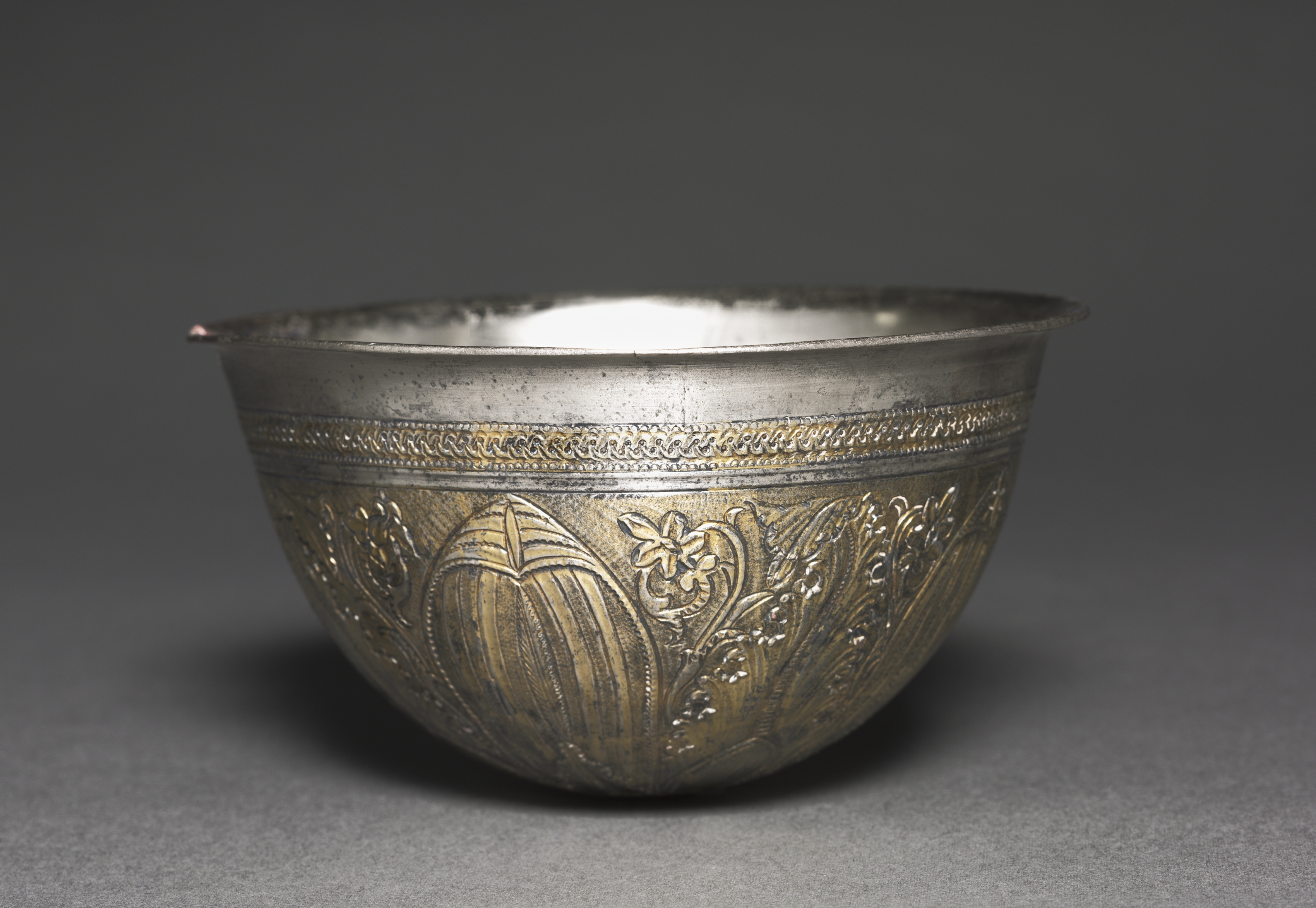
Deconstructing the Hellenistic Bowl: An Avant-Garde Analysis for Zoey Fashion Lab
At Zoey Fashion Lab, our mandate is to deconstruct historical artifacts not as static relics, but as dynamic blueprints for radical textile and form innovation. The subject of this analysis—a silver gilt bowl from the late Hellenistic period, originating in Greece—presents a paradox that is profoundly fertile for avant-garde fashion design. The artifact’s technical description, “silver gilt,” immediately signals a dualism: the cold, structural strength of silver and the warm, liquid opulence of gold. However, the true resonance lies in the tension between its two faces, as evoked by the Archive Resonance: “一面是光洁银镜上以黄金镶嵌的纷繁棕叶纹,另一面是冰冷石棺板上以浮雕诉说的生命叙事.” This translates to a clash between reflective, ornamental surface and a deep, narrative, almost funereal depth. For the avant-garde designer, this bowl is not a drinking vessel; it is a wearable manifesto on the collision of surface and substance, of light and memory.
I. The Mirror Face: Ornament as Optical Disruption
The first face of the bowl is described as a “光洁银镜” (smooth silver mirror) inlaid with “黄金镶嵌的纷繁棕叶纹” (complex palm leaf patterns in gold). In an avant-garde context, this is not mere decoration. The highly polished silver surface functions as a disruptive optical device. It rejects the passive role of a background; instead, it actively reflects the viewer, the environment, and the gaze of the observer. For Zoey Fashion Lab, this suggests a garment that is self-aware and environmentally interactive.
The “纷繁棕叶纹” (complex palm leaf patterns) are not organic growths but controlled, metallic interventions. The use of gold inlay against silver creates a high-contrast, almost electric visual rhythm. This is not the soft drape of natural foliage; it is a rigid, geometricized nature, a stylized architecture of the botanical. For fashion, this translates to a technique we call “metallic lattice plating.” Imagine a base garment of liquid silver lamé—highly reflective, almost liquid in its movement. Onto this surface, we apply laser-cut panels of gold-toned metalized leather or rigid resin, arranged in a fragmented, overlapping palm leaf motif. The pattern is not painted; it is embedded, creating actual topography. The garment becomes a mirror that is broken by its own ornamentation, forcing the light to scatter and the eye to constantly refocus. This is a direct translation of the bowl’s “光洁” (smooth) surface being punctured by the “镶嵌” (inlaid) gold. The design is a study in controlled chaos, where every leaf is a deliberate, sharp interruption of the reflective plane.
II. The Funereal Face: Narrative as Structural Weight
The second face of the bowl is the antithesis of the first: “冰冷石棺板上以浮雕诉说的生命叙事” (a life narrative told in relief on a cold stone sarcophagus). This is the underside of the object, the hidden truth. The “cold stone” suggests a materiality that is heavy, opaque, and final. The “浮雕” (relief sculpture) is not a surface pattern but a carved narrative, a story that is physically pressed into the material. This face is about depth, history, and the weight of memory. For Zoey Fashion Lab, this is the structural core of the garment—the unseen architecture that supports the glittering facade.
This translates into a design concept we call “narrative substructure.” The garment’s internal skeleton—its boning, its corsetry, its underlayer—is not hidden but exposed and ornamented with its own story. Imagine a sheer, dark, almost charcoal-grey silk organza that forms the “skin” of the garment. Beneath this transparent layer, a rigid, sculpted structure of blackened silver or carbon fiber is visible. This structure is not smooth; it is carved with a low-relief narrative—scenes of growth, decay, and resurrection, echoing the Hellenistic life narrative. The “cold stone” is translated into a high-tech, lightweight composite that mimics the weight and texture of stone but is wearable. The wearer becomes a living sarcophagus, carrying their own history on their frame. The outer, reflective layer (the silver mirror) floats above this narrative, creating a haunting visual dichotomy: the present, shiny self versus the deep, carved past. This is the avant-garde’s answer to the bowl’s dual nature: the garment is both a shield and a confession.
III. The Avant-Garde Synthesis: Wearable Contradiction
The true genius of this artifact for fashion is not in its individual faces but in their simultaneous existence. The bowl is a single object with two opposing realities. The avant-garde garment must embody this irreconcilable duality. The design, therefore, is not a compromise but a deliberate, violent juxtaposition.
We propose a garment that is asymmetric and transformative. One half of the silhouette—perhaps the left shoulder and sleeve—is constructed entirely from the “mirror face” principle: a smooth, silver lamé base with aggressive, gold-toned, laser-cut palm leaf appliqués. This side is sharp, reflective, and almost aggressive in its ornamentation. It is the public, performative self. The other half of the garment—the right side, flowing down into a long, weighted train—is the “funereal face.” It is constructed from a matte, almost black, textured fabric (like a heavy wool crepe or a crushed velvet) that is deeply pleated and carved with heavy, almost sculptural, relief panels that tell a fragmented story. This side is heavy, grounded, and introspective. It is the private, historical self.
The line of division between these two halves is not a soft blend but a jagged, metallic seam—a “scar” of silver gilt thread that binds the two worlds together. The garment is a walking contradiction: it is both a mirror and a tomb, both an ornament and a narrative. The wearer does not simply wear a dress; they inhabit a dialectical space between surface and depth. The “Archive Resonance” is thus fully realized: the garment is a living archive of its own making, a testament to the fact that the most profound beauty often lies in the tension between what is shown and what is hidden, between the glittering present and the cold, carved past. This is the ultimate expression of the Hellenistic bowl’s legacy in the avant-garde fashion lab.